Nine of Europe’s biggest banks—including ING, UniCredit, Danske Bank, SEB, KBC, DekaBank, Banca Sella, and Raiffeisen Bank International—have decided to collaborate on a euro-backed stablecoin. Under the European Union’s (EU) Markets in Crypto-Assets Regulation (MiCA) framework, the collaborating banks will roll out the stablecoin in the second half of 2026. Will this be a game-changer for European crypto payments?  Will the euro-backed stablecoin reduce Europe’s reliance on US dollar-denominated stablecoins?  On 25 September 2025, ING released the joint statement confirming that “the initiative will provide a real European alternative to the US-dominated stablecoin market, contributing to Europe’s strategic autonomy in payments.” According to the banking giants, the stablecoin will provide near-instant, low-cost payments and settlements. Furthermore, it will enable 24/7 access to efficient cross-border payments, programmable payments, and improvements in supply chain management and digital asset settlements, which can vary from securities to cryptocurrencies. BREAKING NINE EUROPEAN BANKS ARE TEAMING UP TO LAUNCH A MICA COMPLIANT EURO STABLECOIN, WITH A TARGET DEBUT IN 2026. TRADITIONAL FINANCE IS LOCKING IN ON DIGITAL MONEY FOR THE EUROZONE. pic.twitter.com/W967MJW3gR — DustyBC Crypto (@TheDustyBC) September 25, 2025 DISCOVER: 20+ Next Crypto to Explode in 2025 “Digital payments are key for new euro-denominated payments and financial market infrastructure” The member banks made it clear – they are open to new members. Hence, additional banks are expected to join the original nine.  “This digital payment instrument, leveraging blockchain technology, aims to become a trusted European payment standard in the digital ecosystem,” the joint statement said. The project is interestingly spearheaded by a newly formed company based in Netherlands. It will seek licensing and oversight from the Dutch Central bank, positioning itself as an “e-money institution.” Floris Lugt, Digital Assets lead at ING and joint public representative of the initiative said, “Digital payments are key for new euro-denominated payments and financial market infrastructure. They offer significant efficiency and transparency, thanks to blockchain technology’s programmability features and 24/7 instant cross-currency settlement.” “We believe this development requires an industry-wide approach, and it’s imperative that banks adopt the same standards,” he added. DISCOVER: Next 1000X Crypto: 10+ Crypto Tokens That Can Hit 1000x in 2025 New European Guidelines Boosted Demand For Euro-backed Stablecoins A  2024 analysis by Kaiko Research revealed that while Europe has traditionally lagged the US and APAC when it comes to crypto trading, Euro-backed stablecoin’s have consistently grown in volume since the beginning of the year. This concretely suggests that demand for stablecoin is finally picking up in European markets. Particularly, Circle’s USDC stablecoin is expected to gain substantial market share from its larger rival, Tether’s USDT, found Kaiko.  Anastasia Melachrinos, an analyst at Kaiko Research, highlighted that USDC could potentially benefit the most from the new European guidelines. EXPLORE: 9+ Best High-Risk, High-Reward Crypto to Buy in 2025 Key Takeaways The euro-backed stablecoin is expected to reduce Europe’s reliance on US dollar-denominated stablecoins – which currently dominate the global market.  The euro stablecoin aims to enable near-instant, low-fee payments and settlements across borders, available 24/7. The post Launch Of Euro-Backed Stablecoin In H2 2026? Nine European Banking Giants Join Forces appeared first on 99Bitcoins.Nine of Europe’s biggest banks—including ING, UniCredit, Danske Bank, SEB, KBC, DekaBank, Banca Sella, and Raiffeisen Bank International—have decided to collaborate on a euro-backed stablecoin. Under the European Union’s (EU) Markets in Crypto-Assets Regulation (MiCA) framework, the collaborating banks will roll out the stablecoin in the second half of 2026. Will this be a game-changer for European crypto payments?  Will the euro-backed stablecoin reduce Europe’s reliance on US dollar-denominated stablecoins?  On 25 September 2025, ING released the joint statement confirming that “the initiative will provide a real European alternative to the US-dominated stablecoin market, contributing to Europe’s strategic autonomy in payments.” According to the banking giants, the stablecoin will provide near-instant, low-cost payments and settlements. Furthermore, it will enable 24/7 access to efficient cross-border payments, programmable payments, and improvements in supply chain management and digital asset settlements, which can vary from securities to cryptocurrencies. BREAKING NINE EUROPEAN BANKS ARE TEAMING UP TO LAUNCH A MICA COMPLIANT EURO STABLECOIN, WITH A TARGET DEBUT IN 2026. TRADITIONAL FINANCE IS LOCKING IN ON DIGITAL MONEY FOR THE EUROZONE. pic.twitter.com/W967MJW3gR — DustyBC Crypto (@TheDustyBC) September 25, 2025 DISCOVER: 20+ Next Crypto to Explode in 2025 “Digital payments are key for new euro-denominated payments and financial market infrastructure” The member banks made it clear – they are open to new members. Hence, additional banks are expected to join the original nine.  “This digital payment instrument, leveraging blockchain technology, aims to become a trusted European payment standard in the digital ecosystem,” the joint statement said. The project is interestingly spearheaded by a newly formed company based in Netherlands. It will seek licensing and oversight from the Dutch Central bank, positioning itself as an “e-money institution.” Floris Lugt, Digital Assets lead at ING and joint public representative of the initiative said, “Digital payments are key for new euro-denominated payments and financial market infrastructure. They offer significant efficiency and transparency, thanks to blockchain technology’s programmability features and 24/7 instant cross-currency settlement.” “We believe this development requires an industry-wide approach, and it’s imperative that banks adopt the same standards,” he added. DISCOVER: Next 1000X Crypto: 10+ Crypto Tokens That Can Hit 1000x in 2025 New European Guidelines Boosted Demand For Euro-backed Stablecoins A  2024 analysis by Kaiko Research revealed that while Europe has traditionally lagged the US and APAC when it comes to crypto trading, Euro-backed stablecoin’s have consistently grown in volume since the beginning of the year. This concretely suggests that demand for stablecoin is finally picking up in European markets. Particularly, Circle’s USDC stablecoin is expected to gain substantial market share from its larger rival, Tether’s USDT, found Kaiko.  Anastasia Melachrinos, an analyst at Kaiko Research, highlighted that USDC could potentially benefit the most from the new European guidelines. EXPLORE: 9+ Best High-Risk, High-Reward Crypto to Buy in 2025 Key Takeaways The euro-backed stablecoin is expected to reduce Europe’s reliance on US dollar-denominated stablecoins – which currently dominate the global market.  The euro stablecoin aims to enable near-instant, low-fee payments and settlements across borders, available 24/7. The post Launch Of Euro-Backed Stablecoin In H2 2026? Nine European Banking Giants Join Forces appeared first on 99Bitcoins.

Launch Of Euro-Backed Stablecoin In H2 2026? Nine European Banking Giants Join Forces

Nine of Europe’s biggest banks—including ING, UniCredit, Danske Bank, SEB, KBC, DekaBank, Banca Sella, and Raiffeisen Bank International—have decided to collaborate on a euro-backed stablecoin. Under the European Union’s (EU) Markets in Crypto-Assets Regulation (MiCA) framework, the collaborating banks will roll out the stablecoin in the second half of 2026. Will this be a game-changer for European crypto payments?  Will the euro-backed stablecoin reduce Europe’s reliance on US dollar-denominated stablecoins? 

On 25 September 2025, ING released the joint statement confirming that “the initiative will provide a real European alternative to the US-dominated stablecoin market, contributing to Europe’s strategic autonomy in payments.”

According to the banking giants, the stablecoin will provide near-instant, low-cost payments and settlements. Furthermore, it will enable 24/7 access to efficient cross-border payments, programmable payments, and improvements in supply chain management and digital asset settlements, which can vary from securities to cryptocurrencies.

DISCOVER: 20+ Next Crypto to Explode in 2025

“Digital payments are key for new euro-denominated payments and financial market infrastructure”

The member banks made it clear – they are open to new members. Hence, additional banks are expected to join the original nine. 

“This digital payment instrument, leveraging blockchain technology, aims to become a trusted European payment standard in the digital ecosystem,” the joint statement said.

The project is interestingly spearheaded by a newly formed company based in Netherlands. It will seek licensing and oversight from the Dutch Central bank, positioning itself as an “e-money institution.”

Floris Lugt, Digital Assets lead at ING and joint public representative of the initiative said, “Digital payments are key for new euro-denominated payments and financial market infrastructure. They offer significant efficiency and transparency, thanks to blockchain technology’s programmability features and 24/7 instant cross-currency settlement.”

“We believe this development requires an industry-wide approach, and it’s imperative that banks adopt the same standards,” he added.
DISCOVER: Next 1000X Crypto: 10+ Crypto Tokens That Can Hit 1000x in 2025

New European Guidelines Boosted Demand For Euro-backed Stablecoins

A  2024 analysis by Kaiko Research revealed that while Europe has traditionally lagged the US and APAC when it comes to crypto trading, Euro-backed stablecoin’s have consistently grown in volume since the beginning of the year. This concretely suggests that demand for stablecoin is finally picking up in European markets.

Particularly, Circle’s USDC stablecoin is expected to gain substantial market share from its larger rival, Tether’s USDT, found Kaiko.  Anastasia Melachrinos, an analyst at Kaiko Research, highlighted that USDC could potentially benefit the most from the new European guidelines.

EXPLORE: 9+ Best High-Risk, High-Reward Crypto to Buy in 2025

Key Takeaways

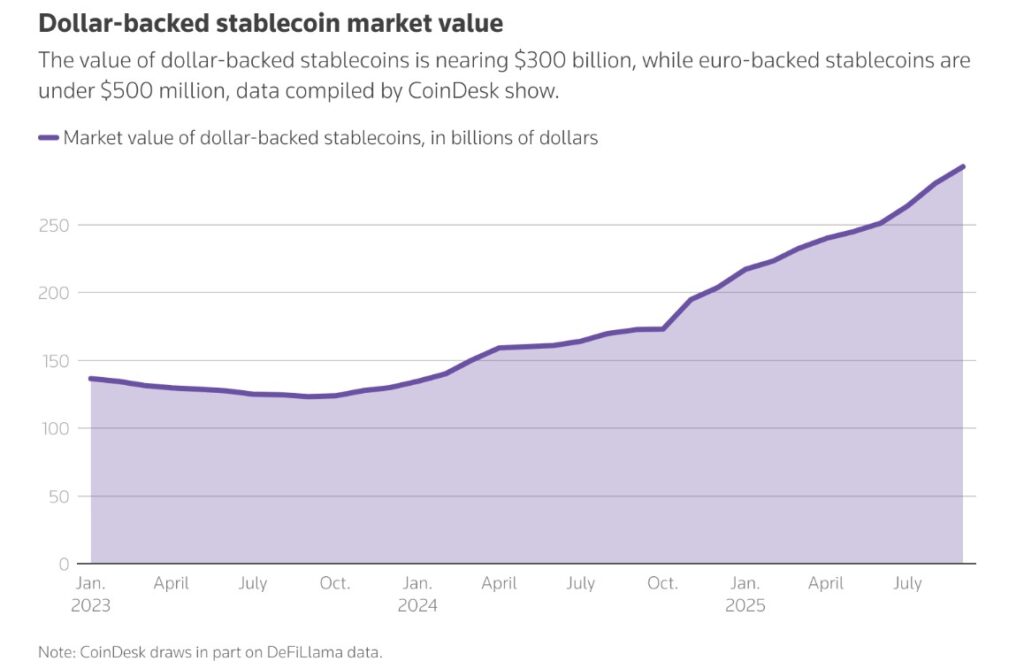
    • The euro-backed stablecoin is expected to reduce Europe’s reliance on US dollar-denominated stablecoins – which currently dominate the global market. 

    • The euro stablecoin aims to enable near-instant, low-fee payments and settlements across borders, available 24/7.

    The post Launch Of Euro-Backed Stablecoin In H2 2026? Nine European Banking Giants Join Forces appeared first on 99Bitcoins.

    Market Opportunity
    Lorenzo Protocol Logo
    Lorenzo Protocol Price(BANK)
    $0.05257
    $0.05257$0.05257
    -1.25%
    USD
    Lorenzo Protocol (BANK) Live Price Chart
    Disclaimer: The articles reposted on this site are sourced from public platforms and are provided for informational purposes only. They do not necessarily reflect the views of MEXC. All rights remain with the original authors. If you believe any content infringes on third-party rights, please contact [email protected] for removal. MEXC makes no guarantees regarding the accuracy, completeness, or timeliness of the content and is not responsible for any actions taken based on the information provided. The content does not constitute financial, legal, or other professional advice, nor should it be considered a recommendation or endorsement by MEXC.

    You May Also Like

    Franklin Templeton CEO Dismisses 50bps Rate Cut Ahead FOMC

    Franklin Templeton CEO Dismisses 50bps Rate Cut Ahead FOMC

    The post Franklin Templeton CEO Dismisses 50bps Rate Cut Ahead FOMC appeared on BitcoinEthereumNews.com. Franklin Templeton CEO Jenny Johnson has weighed in on whether the Federal Reserve should make a 25 basis points (bps) Fed rate cut or 50 bps cut. This comes ahead of the Fed decision today at today’s FOMC meeting, with the market pricing in a 25 bps cut. Bitcoin and the broader crypto market are currently trading flat ahead of the rate cut decision. Franklin Templeton CEO Weighs In On Potential FOMC Decision In a CNBC interview, Jenny Johnson said that she expects the Fed to make a 25 bps cut today instead of a 50 bps cut. She acknowledged the jobs data, which suggested that the labor market is weakening. However, she noted that this data is backward-looking, indicating that it doesn’t show the current state of the economy. She alluded to the wage growth, which she remarked is an indication of a robust labor market. She added that retail sales are up and that consumers are still spending, despite inflation being sticky at 3%, which makes a case for why the FOMC should opt against a 50-basis-point Fed rate cut. In line with this, the Franklin Templeton CEO said that she would go with a 25 bps rate cut if she were Jerome Powell. She remarked that the Fed still has the October and December FOMC meetings to make further cuts if the incoming data warrants it. Johnson also asserted that the data show a robust economy. However, she noted that there can’t be an argument for no Fed rate cut since Powell already signaled at Jackson Hole that they were likely to lower interest rates at this meeting due to concerns over a weakening labor market. Notably, her comment comes as experts argue for both sides on why the Fed should make a 25 bps cut or…
    Share
    BitcoinEthereumNews2025/09/18 00:36
    Tom Lee’s Bitmine Scoops Up 3.4% of Ethereum, Triggering a Supply Squeeze

    Tom Lee’s Bitmine Scoops Up 3.4% of Ethereum, Triggering a Supply Squeeze

    Bitmine Immersion now controls 3.4% of Ethereum amid shrinking exchange supply and rising institutional accumulation.
    Share
    Crypto Breaking News2026/01/20 16:27
    Pendle introduces the sPENDLE mechanism to replace vePENDLE and introduce liquidity staking.

    Pendle introduces the sPENDLE mechanism to replace vePENDLE and introduce liquidity staking.

    PANews reported on January 20th that, according to an official Pendle announcement, vePENDLE will be completely replaced by the sPENDLE mechanism. sPENDLE is a
    Share
    PANews2026/01/20 16:38