Top 10 Green Tech Companies in Singapore And Their Corporate Profiles
Is your firm prepared for a $2.3 trillion shift in global energy?
Clean energy investment hit that record high in 2025, led by electric transport and renewables. Now in 2026, Singapore’s carbon tax has climbed to $45 per tonne. This move forces businesses to treat carbon efficiency as a core financial metric. Standardized ESG reporting is now mandated by new global frameworks. As the nation accelerates its sustainability goals, green tech companies in Singapore are becoming essential partners for corporate survival.
Can you balance these costs while AI usage drives power needs higher? Sixteen Singapore-based firms are currently providing the tools to solve these 2026 decarbonization challenges.
Key Takeaways:
- Singapore’s carbon tax increased to $45 per tonne in 2026, driving corporate demand for greentech solutions to manage mandatory ESG reporting.
- The Australia-Asia PowerLink will provide 1.75 GW of power, meeting 15% of Singapore’s electricity demand and cutting 6 million tonnes of CO2e annually.
- SCB Group aims to mobilize $300 billion in sustainable finance by 2030, planning to facilitate 1 billion tonnes of global carbon emissions abatement in 2026.
- AI-driven efficiency, like bbp’s Energy-Savings-as-a-Service, reduces building energy costs by up to 50% while addressing the rising power needs from AI usage.
SCB Group
SCB Group manages the global trade of biofuels, battery materials, and carbon credits. This work creates the market price for green materials. The company reached net-zero for its own direct emissions in 2025. This year, every global office uses 100% renewable energy.
The firm uses technology to simplify carbon accounting. A partnership with Aviation Fuelling Services Norway tracks sustainable aviation fuel (SAF). The system turns physical fuel data into official carbon credits. Businesses use these credits to follow strict international reporting rules. This tech is vital as Singapore begins requiring a 1% SAF blend in 2026. Among the leading green tech companies in Singapore, SCB also moves large amounts of money into green projects. The group plans to direct $300 billion toward sustainable finance by 2030. These funds support green home loans and building upgrades. In 2026, the company aims to help cut 1 billion tonnes of carbon emissions worldwide.
SCB Group: Core Operations and 2026 Milestones
| Strategic Parameters | Details |
| Traded Commodities | Biodiesel, Ethanol, Methanol, Battery Materials, Carbon Credits |
| Sustainable Finance Goal | USD 300 billion mobilized globally by 2030 |
| Aviation Partnership | AFSN (Norway) for SAF Certified Emission Reductions (CERs) |
| 2026 Abatement Target | Facilitation of 1 billion tonnes of CO2e abatement |
Komunidad
Komunidad builds environmental software that combines weather data, climate risk tools, and compliance tracking. Organizations use the platform to prepare for severe weather instead of just reacting to damage. The software originated in the Philippines. Now, it operates in more than 100 cities and runs early warning systems covering 20 million people.
The company expanded its partnerships in late 2025 and early 2026 to manage new global reporting laws. A deal with Synerlinks Consulting distributes the SuRe platform for sustainability tracking across Asia. In Australia, Komunidad works with Climate & Decisions to process mandatory climate disclosures. The firm also partnered with Black Cat Building Consultancy in Europe. This system inserts location-specific hazard data, such as flood risks, straight into commercial real estate reports. A separate project with the Turkish bank TKYB targets climate resilience in the Middle East and Europe.
As one of the most innovative green tech companies in Singapore, Komunidad also uses spatial technology to verify environmental data. A recent project connects satellite images with ground sensors to track coastal ecosystems. Space agencies in the Philippines and the Maldives use this setup to monitor digital carbon records. Planners use these exact tracking methods to measure how new rules, like power limits for AI data centers, impact local environments.
Komunidad: Global Deployment & Architecture
| Operational Metrics | Details |
| Core Platforms | SuRe Platform (ESG), Climate Risk Intelligence Platform |
| Municipal Reach | Deployed across 100+ cities; 20M+ lives protected |
| Space Consortium | Blue carbon dMRV via satellite and terrestrial sensor fusion |
| International Partnerships | Black Cat (UK), Climate & Decisions (AUS), TKYB (Turkiye) |
Bankers Without Boundaries
Bankers Without Boundaries (BwB) is a non-profit group of former investment bankers. They create financial tools to move private money into green projects. The group operates in Singapore, the UK, and Ireland. They help cities bridge the gap between climate goals and the requirements of private investors. Many green tech companies in Singapore rely on such financial structures to scale their impact.
BwB uses a digital infrastructure called the Climate City Capital Hub to change how money moves into green city projects. The firm uses the “Renew” model to group small home or building upgrades into large packages. These large groups are easier for big banks to fund. This tech-driven approach uses public funds to lower the risk for private investors. This allows cities to move away from small grants toward large-scale green finance.
BwB also works on international projects to support green energy. In Serbia, they helped create a model that mixes grants with commercial loans. In 2025, the firm helped launch a plan to raise $1 billion for energy and agriculture in Africa by 2030. Their data shows European cities need EUR 307 billion by 2030 for climate goals. These investments will result in EUR 394 billion in total benefits.
Bankers Without Boundaries: Financial Architecture
| Structural Mechanism | Details |
| Core Innovation | The “Renew” Model: Bundling sub-scale projects into bankable portfolios |
| Capital Mechanism | Blended finance; using public guarantees to de-risk private capital |
| Major Initiative | Climate City Capital Hub (EU NetZeroCities consortium) |
| Estimated Capital Requirement | EUR 307 billion required for EU Mission Cities by 2030 |
Zuno Carbon
Zuno Carbon provides a digital system called a “Sustainability OS.” Many businesses currently use spreadsheets to track environmental data, which creates legal and financial risks as regulations change. This platform digitizes the entire process of carbon and ESG management. It replaces manual data entry with an automated workflow to ensure compliance.
The technology uses AI to read data from a company’s internal business software. It automatically maps this information to a database of emission factors. This process handles the accounting for all types of greenhouse gases, including Scope 1, 2, and 3. The software shows exactly where emissions are highest across different locations or assets in real time. Since the platform has ISO27001 certification, the data is ready for formal audits.
Zuno Carbon released several new features between 2025 and 2026 to handle changing laws. In March 2025, the company launched Zuno Sapient Reporting. This AI tool generates and checks sustainability reports in minutes. A new data module also lets users create multiple reports from a single dataset to satisfy different global frameworks like the GRI and CDP. Within the landscape of green tech companies in Singapore, Zuno Carbon is a leader in regulatory reporting. By early 2026, the software updated to support new climate disclosure rules in Australia and international IFRS standards.
Zuno Carbon: System Capabilities
| Technical Specifications | Details |
| Primary Platform | Sustainability OS / Carbon Intelligence Platform |
| Data Automation | AI-driven emission factor auto-matching across ERP systems |
| Framework Integration | Native support for GRI, CDP, IFRS S1/S2, and AASB S2 |
| Recent Launch (2025) | Zuno Sapient Reporting (AI report generation) |
Sun Cable
SunCable is building the Australia-Asia PowerLink (AAPowerLink). This project places a 12,000-hectare solar farm in Australia’s Northern Territory. The site generates between 17 and 20 gigawatts (GW) of power and connects to a battery storage system holding 36 to 42 gigawatt-hours (GWh). An 800-kilometer overhead High Voltage Direct Current (HVDC) line moves this power to Darwin. From there, a 4,300-kilometer subsea HVDC cable carries the electricity to Singapore.
Singapore currently relies on imported natural gas for over 94% of its electricity. The AAPowerLink will supply 1.75 GW of continuous power to the country. This output covers 15% of Singapore’s total electricity requirements. The system cuts carbon dioxide emissions by up to 6 million tonnes every year. As projects like this demonstrate, green tech companies in Singapore are thinking beyond borders to secure a clean energy future.
Grok Ventures acquired and restructured SunCable after financial disputes in 2023. In late 2024, the Australian and Northern Territory governments approved the project. Singapore’s Energy Market Authority (EMA) also granted conditional approval to import the power. SunCable signed a 70-year land agreement with the Traditional Owners of Powell Creek to secure the solar farm site. The company plans to deliver power to industrial customers in Australia by the late 2020s. Darwin will receive power in the early 2030s, and the subsea cable will reach Singapore by the mid-2030s.
Sun Cable: AAPowerLink Infrastructure
| Project Specifications | Details |
| Generation Capacity | 17-20 GW Solar Array (12,000 hectares) |
| Storage Capacity | 36-42 GWh Battery Complex |
| Transmission Network | 800km overhead HVDC; 4,300km subsea HVDC |
| Singapore Impact | 1.75 GW import capacity; 15% of national demand |
Arkadiah
Arkadiah uses AI to track and verify carbon projects in nature. Many groups currently use manual estimates for forest measurements, but these methods are often inaccurate. Poor data makes it hard to value carbon credits and creates risks of greenwashing. This technology creates a digital way to monitor forests and restore ecosystems accurately.
The company runs two platforms called NatureOS and ArkVantage. These systems combine satellite images with laser-based mapping data known as LiDAR. The software builds 3D digital models of forest ecosystems. These “digital twins” show exactly how much carbon a forest holds and track how well restoration projects work. This high-quality data helps companies issue carbon credits much faster than traditional methods. For businesses looking for transparency, green tech companies in Singapore like Arkadiah provide essential data verification.
Arkadiah started a five-year partnership with Golden Agri-Resources in February 2026. This project focuses on measuring forests in West Kalimantan, Indonesia. The Singapore Economic Development Board and the Office for Space Technology and Industry support this work. In January 2026, the government also launched the Blue Carbon Support Programme. This initiative funds new technology to map and measure greenhouse gases across Southeast Asia.
Arkadiah: Technological Integration
| Functional Application | Details |
| Data Acquisition | Space-borne LiDAR, Satellite Imagery, Ground Sensors |
| Analytical Engine | AI geospatial modeling; 3D Digital Twins |
| Flagship Product | NatureOS and ArkVantage |
| 2026 Key Partnership | Golden Agri-Resources (West Kalimantan deployment) |
Meranti Green Steel
Meranti Green Steel (MGS) focuses on reducing carbon emissions in the steel industry. Standard steel production uses coal, which produces high levels of pollution. MGS manages a supply chain that spans multiple countries to use the most effective renewable energy. This model allows the company to operate in both Oman and Thailand to take advantage of local resources. This cross-border strategy is common among ambitious green tech companies in Singapore.
The organization is building a facility in Oman to create Hot Briquetted Iron (HBI). This plant uses green hydrogen made from renewable energy to process iron ore without using coal. MGS ships this material to a new flat steel plant in Thailand. The Thai facility uses Electric Arc Furnaces to melt the iron into finished steel. MGS aims to run these furnaces on 100% renewable energy within five years of opening. The company has secured agreements for 1.7 GW of solar, wind, and hydro power to support this goal.
This $3 billion project is moving toward a final investment decision in mid-2026. MGS plans for the entire supply chain to be fully active by 2029. The project targets a carbon reduction of at least 1,650 kg per tonne of steel by 2045. In late 2025, the firm Kingspan agreed to purchase this green steel to help lower its own environmental impact.
Meranti Green Steel: Bifurcated Supply Chain
| Feature | Oman (Duqm Hub) | Thailand (Rayong Hub) |
| Operational Phase | Primary iron reduction | Final steel manufacturing |
| Product Output | Hot Briquetted Iron (HBI) | Flat Green Steel |
| Target Capacity | 2.5 Mtpa | 2.5 Mtpa |
| Core Technology | Green Hydrogen / Natural Gas Reduction | Electric Arc Furnace (EAF) |
| Energy Procurement | Omani renewables | 1.7 GW Solar/Wind/Hydro PPAs |
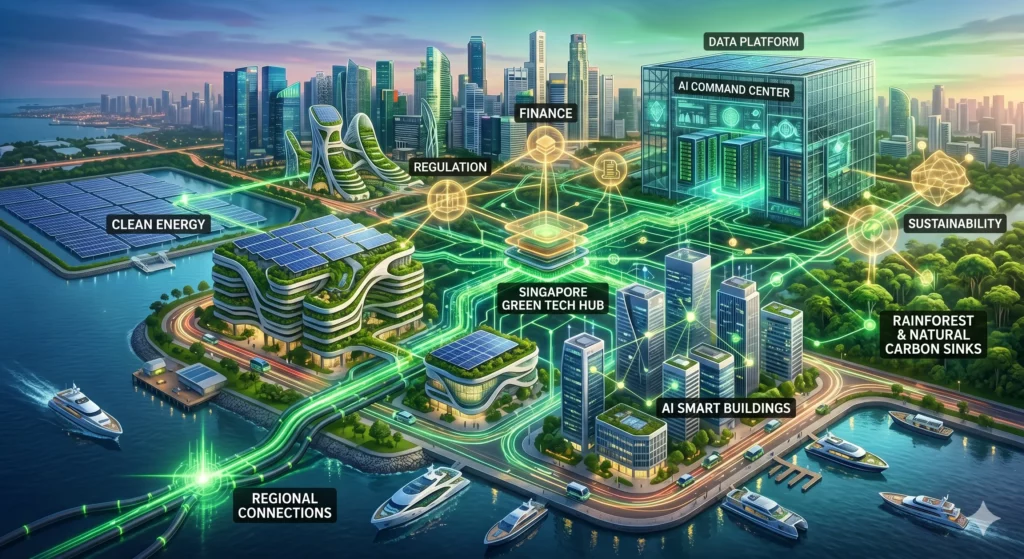 Green tech companies in Singapore
Maxeon Solar Technologies
Maxeon Solar Technologies is a Singapore-based manufacturer that makes high-efficiency solar panels. The company holds more than 2,000 patents for its specific solar cell technology. In February 2026, the manufacturer AIKO Solar licensed this technology to use in products sold outside the United States. Even with this large portfolio of inventions, the firm faced significant financial challenges due to international trade rules.
The U.S. government blocked Maxeon’s solar panels from entering the country for two years. This action prevented the company from selling to its primary group of customers. This loss of income forced the company to try to sell its assets to stay in business. Maxeon also dealt with a lawsuit claiming the firm owed more than $70 million for a contract disagreement.
On April 6, 2026, Maxeon asked the Singapore High Court to step in and manage the business. The court appointed interim managers on April 9. Following this event, the Nasdaq stock market issued a notice on April 24, 2026, to remove the company’s shares from the exchange. These events show that even for established green tech companies in Singapore, technical expertise is not always enough to protect a business from international trade disputes.
bbp (Barghest Building Performance)
Barghest Building Performance (bbp) uses artificial intelligence to lower energy use in large buildings. Heating and cooling systems are the biggest users of power in offices and factories. Many building managers avoid upgrades because new equipment is expensive. bbp solves this by using sensors and software to make existing systems run more efficiently. These tools automatically adjust equipment settings in real time to reduce waste.
The company uses a business model called “Energy-Savings-as-a-Service.” bbp pays the full cost for all sensors, software, and controls. Building owners do not have to pay any upfront money for the technology. bbp earns its money by taking a share of the actual energy savings it creates. This system has reduced energy costs by up to 50% for large companies like Hewlett Packard and Resorts World Sentosa.
To date, bbp technology has saved more than 3.8 million kWh of electricity. This has prevented 1.8 million kilograms of carbon emissions. In July 2025, the investment firm Actis purchased the entire company. As of 2026, the business is expanding across China, India, and Southeast Asia. High temperatures and rising power prices in 2026 have increased the demand for these tools. Building owners use this technology to lower their monthly bills without spending their own capital, highlighting why green tech companies in Singapore are so vital to regional efficiency.
bbp: Optimization & Impact Metrics
| Performance Data | Details |
| Commercial Model | Energy-Savings-as-a-Service (ESaaS); Zero-CAPEX |
| Core Technology | AI adaptive machine learning; patented HVAC algorithms |
| Energy Reduction | Up to 50% savings on chiller/facilities consumption |
| Cumulative Impact | >3.84 million kWh saved; >1.81 million kg CO2e avoided |
BillionBricks
BillionBricks combines housing construction with renewable energy production. This approach addresses the global need for affordable homes and the high carbon footprint of the building industry. The company operates from Singapore and builds communities that generate electricity. This energy production helps lower the total cost of owning a home.
The standard home is a 45-square-meter, two-story building designed to resist earthquakes and typhoons. Each house features a “PowerShade” solar roof. This system replaces traditional roofing materials with a 10 kWp solar array and battery storage. A community of 1,000 homes creates a 10 MW solar farm. The company sells this power through long-term contracts to help homeowners pay for their properties. Among the many green tech companies in Singapore, BillionBricks uniquely addresses both housing and energy.
The income from energy sales reduces homeownership costs by 20%. This makes mortgages more affordable for more people. Currently, BillionBricks is completing the Sienna Community II in the Philippines. This 130-home project is scheduled for completion in March 2026. The development uses solar microgrids to provide steady power over a 60-year lifespan.
Nature’s Vault
Nature’s Vault uses blockchain technology and accounting tools to protect natural resources. Gold mining often damages forests and water systems. The company created the Legacy Token to address this issue. Each token represents 0.01 grams of gold that stays in the ground. The company sells these tokens for up to 80% of a gold deposit. This allows the gold to have value without being mined. This process keeps land healthy and prevents carbon emissions.
The firm also works on removing carbon dioxide from the air through biochar. Farmers in parts of Asia often burn leftover crops, which releases pollution. Nature’s Vault uses a process called pyrolysis to heat this waste and turn it into a solid material. This material traps carbon for hundreds of years. Farmers can also add biochar to their soil to help plants grow. As green tech companies in Singapore innovate, they find new ways to combine ancient farming with modern tech.
Several new projects will begin in 2026. A facility in Gujarat, India, plans to produce 300,000 tons of carbon credits over the next ten years. The company is also working with partners to start projects in Côte d’Ivoire. These actions help Singapore become a central location for carbon trading.
Chemsearch
Chemsearch, a division of NCH Corporation, manages water and chemical systems for industrial buildings. While large energy projects get more attention, the way a facility handles its cooling fluids and wastewater is a major part of sustainability. The company provides these maintenance solutions to commercial networks across Singapore and the Asia-Pacific region.
The organization helps businesses reduce their use of city water through its Sustainability Partnership Program. Chemsearch installs systems that collect rainwater and condensation from air conditioners. This water is reused for cooling towers, flushing toilets, and watering plants. These systems save an average of 285,000 gallons of water per day across the buildings where they are installed.
The firm also produces biodegradable cleaners for heating and cooling systems. These non-toxic chemicals help facilities follow strict safety codes and wastewater rules. In 2026, these methods are being featured at major sustainability events in Singapore. Using digital platforms to track these chemical systems allows buildings to lower their environmental impact. This focus on utility-level sustainability is what sets these green tech companies in Singapore apart.
Bluenergy Solutions
Bluenergy Solutions captures energy from ocean tides to create electricity. Unlike solar or wind power, tidal energy is predictable because it follows the movement of the moon and gravity. This allows for a steady supply of power throughout the year without relying on large batteries. The company uses a “Plug and Play” system of modular turbines to generate power directly in the water.
In a project near Raffles Lighthouse in Singapore, the firm installed an array of four turbines. These units were developed with the Maritime and Port Authority of Singapore and the NYK Group. Over a six-month period, the system produced 2,700 kWh of electricity. This power replaced the need to transport diesel fuel to the lighthouse, which lowered the site’s carbon footprint.
The turbines are designed to protect marine life. They spin at a low speed and use sensors to monitor the surrounding water. If the sensors detect a marine mammal nearby, the system automatically stops the blades. By 2026, the company is working on plans to add these turbines to sea walls and breakwaters. These installations could provide clean power for ships to charge while they are at port, cementing the firm’s place among the top green tech companies in Singapore.
Nūl Global Technologies
Nūl Global Technologies (referred to in some reports as focusing on industry-specific AI) uses agentic AI to address waste. The company worked with the Maritime and Port Authority of Singapore and the NYK Group on specific integration projects. By 2026, the firm is exploring how to build advanced AI systems into various infrastructure projects.
Nūl Global Technologies: Platform Architecture
| Strategic Utility | Details |
| System Integration | Agnostic integration with existing ERPs; Unstructured data parsing |
| Core AI Interface | “Zoey” – Agentic AI for proactive workflow automation |
| Primary Value Vector | Elimination of the 30% unsold apparel overproduction baseline |
| 2026 Recognition | Global Fashion Agenda Trailblazer Programme 2026 |
EDP Renewables
EDP Renewables runs its Asia-Pacific operations from Singapore. Companies in the region need renewable power to follow international trade rules, but local grids often lack the capacity. To meet this need, the firm builds large solar farms on land and water. These projects provide a steady source of clean energy for the regional supply chain.
The organization more than doubled its power capacity from 2022 to 2024. It now manages 1 gigawatt (GWp) of power across nine markets. This includes 510 megawatts (MWp) in Vietnam and 335 MWp in Singapore. Rooftop solar is a major part of this strategy. These systems provide electricity directly to buildings, which avoids long wait times for grid connections. This approach is helpful in busy cities where open land is scarce.
The group expects its rooftop solar capacity to triple by 2026. Its global business plan involves a €20 billion investment to add 17 GW of power by the end of 2026. Seven percent of that total investment is dedicated to the Asia-Pacific region. The goal is to reach 2.4 GW of installed capacity in this area within that timeframe. As one of the largest green tech companies in Singapore, EDP Renewables uses the Corporate Sustainability Reporting Directive and other European standards to share its environmental data with investors.
Vinova
Vinova applies green software engineering to address the high energy demands of artificial intelligence. Training and running large AI models creates a carbon debt for the technology industry. The company has a team of more than 400 professionals based in Singapore. They design digital tools that require less power to operate. This approach helps reduce the environmental impact of the tech sector as it expands.
In 2026, the firm highlighted a trend called the Jevons Paradox in the AI industry. Improvements in hardware have made it cheaper to generate AI data. Because it is more affordable, businesses are adding AI to a wider variety of software applications. This causes the total energy use of the industry to increase even though individual tasks are more efficient. Vinova counters this by making energy efficiency a core part of its software development process.
The company uses Small Language Models and specialized hardware to minimize energy consumption. Developers write clean code architectures to reduce the amount of processing power needed for each task. These methods allow businesses to build and launch new products without causing a negative impact on the environment. This helps organizations modernize their systems while remaining sustainable.
This focus on efficient technology has supported the firm’s business success. In 2026, Vinova earned a spot on the list of Singapore’s Fastest-Growing Companies for the third year in a row. This ranking is compiled by The Straits Times and Statista. The firm’s performance shows that energy efficiency is a key requirement for success in the 2026 IT market. As an expert in green software, Vinova stands out among green tech companies in Singapore.
Schedule a consultation with Vinova today.
Frequently Asked Questions (FAQ)
1. Question: What major regulatory changes are driving demand for green tech companies in Singapore in 2026?
Answer: Singapore’s carbon tax has increased to $45 per tonne, and standardized ESG reporting is now mandated, forcing businesses to prioritize carbon efficiency as a core financial metric.
2. Question: How are green tech companies in Singapore addressing Singapore’s electricity needs?
Answer: Projects like the Australia-Asia PowerLink (Sun Cable) will supply 1.75 GW of power, meeting 15% of Singapore’s electricity demand and cutting 6 million tonnes of CO2e annually. Other firms like EDP Renewables are expanding local rooftop solar capacity.
3. Question: What are some innovative financial models used by green tech companies in Singapore to fund sustainability?
Answer: SCB Group plans to mobilize $300 billion in sustainable finance by 2030, while Bankers Without Boundaries (BwB) uses the “Renew” model to bundle small building upgrade projects into bankable portfolios for large-scale funding.
4. Question: How do green tech companies in Singapore use AI to achieve efficiency and compliance?
Answer: Firms like Zuno Carbon provide a “Sustainability OS” using AI to automate carbon and ESG reporting. bbp uses AI to manage HVAC systems, offering Energy-Savings-as-a-Service that reduces building energy costs by up to 50%.
5. Question: Beyond energy, how are green tech companies in Singapore innovating in material tracking and nature protection?
Answer: Arkadiah uses AI and satellite LiDAR to create 3D digital twins for accurate carbon project verification in nature. Nature’s Vault uses blockchain to create Legacy Tokens, giving value to unmined gold deposits to prevent deforestation and emissions.


You May Also Like

Offchain Labs, Circle, 21Shares, And S&P Global Lead Hack Seasons Cannes 2026 In Charting The Future Of Institutional Digital Finance

AI Helps Recover 5 BTC After 11 Years, CoinDCX CEO Issues Warning