Not quite a wrap for this designer
Ditta Sandico never gives up
WHEN we say “it’s a wrap,” it usually means we’re ending something. When Ditta Sandico says that, she’s talking about her continuing work.
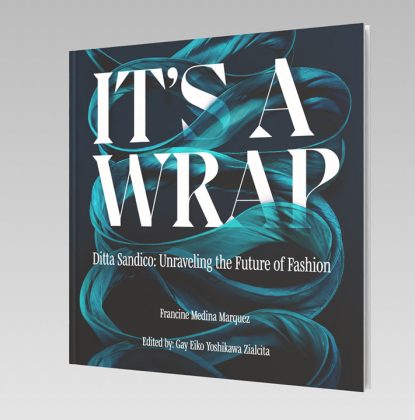
It’s A Wrap: Unraveling the Future of Fashion — published by Far Eastern University, written by Francine Medina Marquez, and edited by Gayle Zialcita — summarizes the designer’s 40-year journey, beginning in her observation of Mangyan textiles in her girlhood and ending with her 40th anniversary fashion show last year.
While it is about her life, there’s a wider discussion in the book about Philippine textiles and materials, and the people who made them. Photographs of the designer’s work and as they were shown in magazines and runways give the book color and heft. The book launch was held on May 13 at the Yuchengco Museum, with a fashion show showing off the designer’s work.
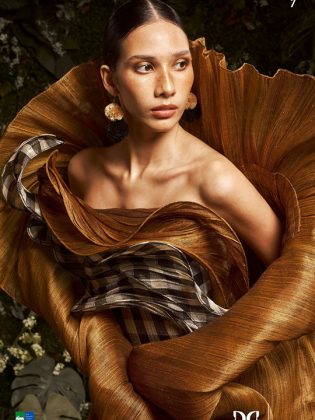
Ms. Sandico, born the daughter of the family behind the COD Department Store, studied at the University of the Philippines and at Tobe-Coburn in New York. She began designing in the mid-1980s. In the late ’90s and early 2000s, she found her signature: abaca (which she branded as “banaca”). Working against the material’s stiffness, she manipulated the fibers into wraps used to jazz up outfit bases. One such wrap appeared on the runway during the launch: in a rich bronze color, it appeared first like a cocoon around the model, covering her upper body and face. Unfolding the wrap, she turned it into something shaped like a flower. Wearing a Ditta, every ordinary woman could be someone flamboyant, someone the opposite of invisible.
In an interview while she signed the books, she told us about the sort of person who wears her pieces. “The first few years were difficult for me. We had to initiate; we had to teach people how to wear the clothes themselves, the wraps. Even the colors. It took time, and it took a lot of courage from the women to be able to get themselves out there.”
We told her a story about a friend of ours who was graduating magna cum laude, and insisted on wearing a white Ditta wrap over her white graduation dress — this woman wore Ditta in her early 20s. Pointing first to her own wrap, Ms. Sandico then pointed to a loyal customer who is 90 years old. “She’s wearing the same wrap,” she explained. “But it’s worn differently. I guess it’s really the manipulation. The way things are reimagined and reinvented.”
The wraps seem almost amorphous, taking shape as a partnership between herself and a customer. Asked what other shapes she can still do, she said, “It’s always a work in progress. Every time I wake up in the morning, I look forward to a new day. All these inspirations just come, through dreams.” She corrected herself, saying, “I do a little research here and there to find out what’s going on in the malls and in the retail market. It just grows from that.”
“It’s going to be cliché to say everything is divine inspiration. But it does come from there.”
While today we take for granted the mainstreaming of Filipino textiles, she was one of the first to use them in her collections, opting to work directly with indigenous weaving communities. “There seems to be such a redeeming factor,” she told BusinessWorld. “I feel so validated, every time I think that I was one of the first, and I didn’t give up,” she said.
“I’ve always kept that in my vocabulary — in the things that I do and the things that I come up with. There’s got to be a progression in things and it just doesn’t come easy.”
Her clothes have been shown around the world — in Helsinki, Paris, Rome, Dubai, Los Angeles, New York, Moscow, Amsterdam, Tokyo, and Kuala Lumpur, among others.
She talked about her 40 years in fashion, and how she measures her own success. “I think the 40 years speak for itself. I don’t really have to shout it out. I was always: what’s going to happen to me next? I was always kind of insecure about things. ‘Is this enough?’
“But now, I can’t look back. I just have to keep moving forward. There’s nothing to stop me now.”
The book is partly titled “The Future of Fashion,” and on her own future, she says, “I still have to think about that. I’m learning to really appreciate my individuality. I’m learning to appreciate being myself, and being out there in the world seems a bit daunting.
“Many things can come.”
It’s a Wrap is available for purchase through TAMS Bookstore at [email protected]. — Joseph L. Garcia


You May Also Like

CLARITY Act Passes Senate Banking Committee: What Does This Mean for Crypto?

The Amount of Bitcoin Held by Long-Term Investors Has Reached Its Highest Level in the Past Year