

S&P 500 Could Hit 9,000 by End of 2026: Evercore ISI’s Bull Case Scenario
Key Takeaways
- Evercore ISI projects an S&P 500 base target of 7,750 by the conclusion of 2026, while assigning a 30% probability to a bullish scenario of 9,000.
- Technology, communication services, and consumer discretionary sectors are expected to benefit most from AI advancements in the bull scenario.
- RBC Capital has established a 7,900 target over the next 12 months, suggesting approximately 7.7% appreciation from early May price levels.
- RBC anticipates market corrections to remain moderate at 5–10%, with more severe downturns only emerging if recession concerns resurface.
- Artificial intelligence creates a dramatic earnings divide: RBC forecasts 28% growth for AI-linked companies compared to just 6% for traditional index components.
Two prominent Wall Street research houses have published their S&P 500 projections through 2026. While both maintain optimistic outlooks, each acknowledges potential volatility ahead.
Evercore ISI: Multiple Scenarios Point Higher
Julian Emanuel, analyst at Evercore ISI, has established a year-end 2026 base case projection of 7,750 for the S&P 500. However, he assigns a significant 30% likelihood to a bull scenario that could propel the benchmark index to 9,000.
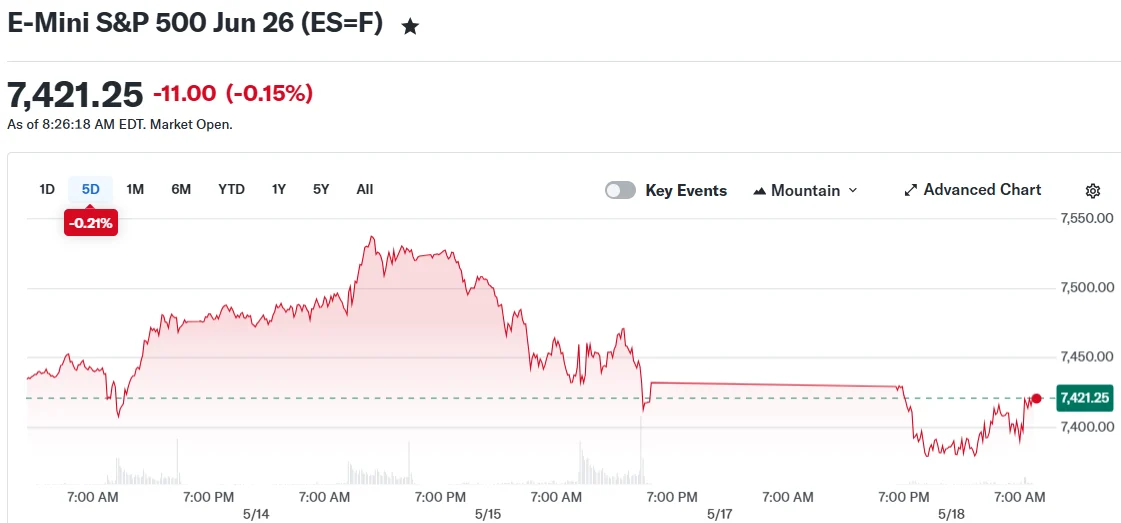 E-Mini S&P 500 Jun 26 (ES=F)
According to Emanuel, the market faces an intersection of two powerful dynamics: a technology boom powered by artificial intelligence innovations and fundamental shifts in international geopolitical structures. This convergence, he argues, expands the spectrum of potential market outcomes beyond historical norms.
Emanuel drew parallels to the 1920s and 1990s eras, highlighting what he described as “wartime-scale economic stimulus, accelerating M2 money supply, and a transformative productivity surge” coinciding with the AI transformation. His analysis suggests productivity expansion could reach 3% annually before the decade closes.
The firm advises clients to purchase long-dated call options targeting the “AI Class of 2026” portfolio companies and the QQQ exchange-traded fund to maximize exposure to potential gains. Simultaneously, Evercore recommends implementing collar strategies on S&P 500 index funds to protect against short-term volatility stemming from crude oil fluctuations and interest rate movements.
Emanuel also noted an inherent constraint within AI technology itself. He observed that large language models frequently gravitate toward consensus predictions and fail to account for tail-risk events. Consequently, sustainable competitive advantages will emerge from specialized industry knowledge and comprehensive workflow ownership rather than simple AI tool adoption.
RBC Capital: Gradual Ascent With Intermittent Volatility
Lori Calvasina, who leads U.S. equity strategy at RBC Capital, has positioned her 12-month S&P 500 price objective at 7,900. This target represents roughly 7.7% potential upside from valuation levels observed in early May.
Calvasina emphasized that the anticipated advance will include periodic setbacks. She projects corrections in the 5–10% range as likely, though she doesn’t foresee more substantial declines of 14–20% unless recessionary concerns reemerge.
RBC’s analytical framework centers on what the firm characterizes as an “AI acceleration, Middle East deceleration” environment. Their calculations assume 28% earnings expansion for AI-centered enterprises in 2027, contrasted with merely 6% growth across remaining index constituents.
The model incorporates a 5% reduction to consensus earnings expectations and projects inflation stabilizing near 3.3%, with the Federal Reserve maintaining current policy and 10-year Treasury yields hovering around 4.5%. Should inflation climb to 3.8% and prompt Fed rate increases, RBC estimates fair value would decline to the 7,400–7,500 territory.
Immediate headwinds identified by the firm include potential earnings revisions linked to geopolitical conflict effects, profit-taking activity in semiconductor equities, midterm election-related uncertainty, and elevated borrowing costs.
RBC continues to favor growth-oriented equities over value stocks, and maintains its overweight stance on U.S. markets relative to international alternatives.
The post S&P 500 Could Hit 9,000 by End of 2026: Evercore ISI’s Bull Case Scenario appeared first on Blockonomi.


You May Also Like

Analyst Says XRP Looks Ready for a Massive Breakout. Here’s the Signal

Alphabet (GOOGL) Stock Nears $5 Trillion Market Cap Ahead of Google I/O Tuesday




