

Kaspa Price Prediction: Low-Volume KAS Dip and Historic Volatility Compression Hint at…
Kaspa is walking into one of the biggest moments in its history. Developers are running the final Testnet-10 dry run for the Toccata hard fork. The real launch is expected between June 5 and June 20, 2026.
This upgrade brings native KRC-20 tokens, SilverScript covenant programming, and zero-knowledge proof tools. Those features could turn Kaspa into a full programmable Layer 1 network, not just a chain for sending payments.
The network has already handled over 2.1 billion transactions. Also, 95.55% of all KAS that will ever exist is already mined. That tightens the pressure from new supply coming into the market. Price action has cooled after the May rally. The Kaspa price trades near $0.03387, with daily volume down close to 20%.
Kaspa Volatility Compression and Low-Volume Pullback Keep Traders Watching
The latest market commentary from the Kaspa trading community points to a very controlled correction instead of aggressive selling. Kaspa Daily pointed out that KAS fell from its May 11 high around $0.040 to about $0.0343. That put it a little under the 30-day average near $0.0345. The 90-day average around $0.0335 is still holding for now. That gives buyers a key area to protect.
What stands out is the volume structure during the move lower. Trading activity expanded heavily during the rally between May 10 and May 14, but the retracement happened on noticeably weaker volume.
Traders usually associate stronger sell-side volume with distribution. That pattern has not appeared here yet, which keeps the broader recovery structure alive despite the rejection near $0.040.
Another major point is volatility compression. Kaspa’s 30-day realized volatility dropped to 54.8%, far below its historical average of 106.3% and nowhere near the previous 191.9% peak. Markets rarely stay compressed for long periods, especially after strong directional moves.
Traders now expect a larger breakout attempt once volume returns, although the direction still depends on whether buyers can reclaim the short-term moving averages.
Factors Supporting the KAS Price
The Toccata hardfork remains the biggest near-term catalyst for Kaspa. If the launch goes smoothly next month, the network will gain native token creation, programmable covenants through SilverScript, and zero-knowledge verification support directly on-chain. That opens the door for decentralized finance applications, token ecosystems, and more advanced smart contract activity on Kaspa’s Proof-of-Work network.
The timing also matters because Kaspa’s circulating supply is already close to full distribution. More than 95% of the planned supply has been mined, and the Chromatic Phase emission model continues reducing miner rewards every month.
New issuance is expected to drop near-zero levels by the end of 2026. Lower token emissions can increase price sensitivity when demand improves since fewer newly mined coins enter the market.
Institutional infrastructure around Kaspa (KAS) is also expanding. Zodia Custody, backed by Standard Chartered, already supports KAS custody services, and regulated exchange-traded products have appeared in Sweden. Traders are also watching the next technical milestone after Toccata.
The team plans a DAGKnight consensus upgrade sometime in Q3 2026. It is supposed to make confirmations faster and the network safer. Further out, Kaspa developers keep talking about the 100 BPS roadmap and vProgs smart contract design planned for 2027. If they stay on schedule, those changes could make the network much faster than most other Proof-of-Work chains.
What the Kaspa Chart Is Saying Now
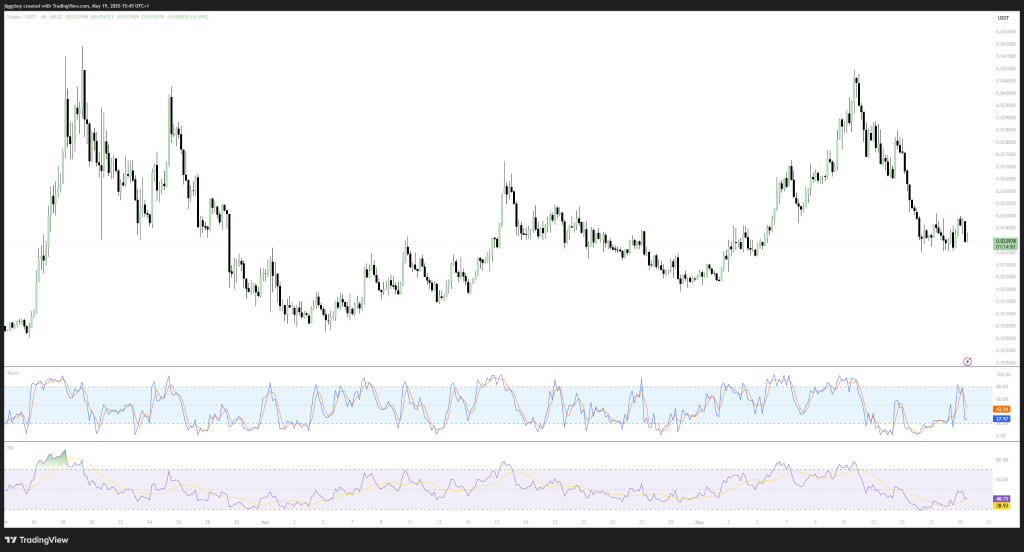
We had a look at the chart, and the structure still leans neutral-to-bullish despite the cooldown from the May peak. Price ran aggressively from the April lows near $0.030 before peaking around $0.0405 earlier this month. Since then, the KAS price has entered a slower consolidation phase with lower highs and reduced volatility.
The first zone traders are watching is the support between $0.0330 and $0.0335. That area lines up with the 90-day average traders keep talking about online. Buyers have held that line several times over the last few sessions. If that level breaks cleanly, KAS could revisit the broader accumulation zone near $0.0310.
Related Kaspa News: Kaspa (KAS) Price Drops Despite Explosive Network Growth – Here’s Why
 Source: Tradingview.com
Momentum indicators still show a mixed setup. The stochastic oscillator on the chart is recovering from oversold territory after dipping below the 20 level. RSI also cooled sharply after spending time above 70 earlier in May. It now trades around the low-40 range, which shows momentum reset without entering deeply bearish territory. That usually gives the market room for another directional attempt.
The biggest level overhead remains $0.0365 to $0.0400. A confirmed breakout above that area would likely reopen the path toward the April highs and potentially trigger another expansion phase if volume returns. Price swings have been very small lately. So traders think a bigger move will happen once this calm stretch ends. Until then, the market looks stuck between strong support near $0.033 and a ceiling near $0.040.
But Kaspa enters the second half of May in one of the strongest positions it has seen in years. The Toccata hardfork, falling token emissions, and rising network usage continue supporting the broader KAS narrative. Price action has cooled, but the low-volume nature of the pullback keeps bullish traders engaged.
The chart also shows a market compressing after a fast rally. Volatility has dropped sharply, momentum indicators have reset, and key support levels still hold. If buyers reclaim the short-term resistance zones ahead of the hardfork launch window, the Kaspa price could attempt another move toward the May highs.
Frequently Asked Questions

Yes, Kaspa is available on Bybit through KASUSDT perpetual futures trading. Traders can monitor live KAS prices, funding rates, market activity, and use leverage on the platform. Bybit also offers charting tools and risk management features for futures traders interested in Kaspa.
A $10 Kaspa price would require massive growth from current levels and likely several strong crypto market cycles. Most long-range forecasts do not expect KAS to reach that level before 2040 or even 2050. Still, many investors believe Kaspa has strong upside potential if network adoption and ecosystem growth continue improving.
Subscribe to our YouTube channel for daily crypto updates, market insights, and expert analysis.
The post Kaspa Price Prediction: Low-Volume KAS Dip and Historic Volatility Compression Hint at… appeared first on CaptainAltcoin.


You May Also Like
TabTrade and BestPropFirms Launch Joint Demo Trading Contest

Google unveils AI-powered audio glasses with Warby Parker and Samsung at I/O 2026




