Crude Oil Dips 2% Amid Iran Talks, But Analysts Forecast Brent at $120 — Here’s What’s Next
TLDR
- Crude markets declined approximately 1–2.5% Wednesday following Trump’s comments that the Iran conflict could conclude “very quickly”
- Brent crude slipped to roughly $109 while WTI declined near $102 per barrel
- A pair of Chinese supertankers departed the Strait of Hormuz, signaling potential supply route improvements
- American crude stockpiles declined for the fifth consecutive week, showing an unexpected 9.1 million barrel withdrawal
- Citi analysts project Brent will climb to $120 per barrel soon, cautioning that markets are underestimating supply disruption risks
Crude oil markets experienced declines of approximately 1–2.5% Wednesday as investors digested encouraging signals from U.S.-Iran diplomatic discussions. Market participants remain vigilant, though energy experts emphasize that supply vulnerabilities persist despite growing diplomatic optimism.
Brent crude futures retreated to approximately $109 per barrel while U.S. West Texas Intermediate declined toward $102. Both benchmarks had already shed roughly 1% during the previous session following Vice President JD Vance’s statements about negotiation progress.
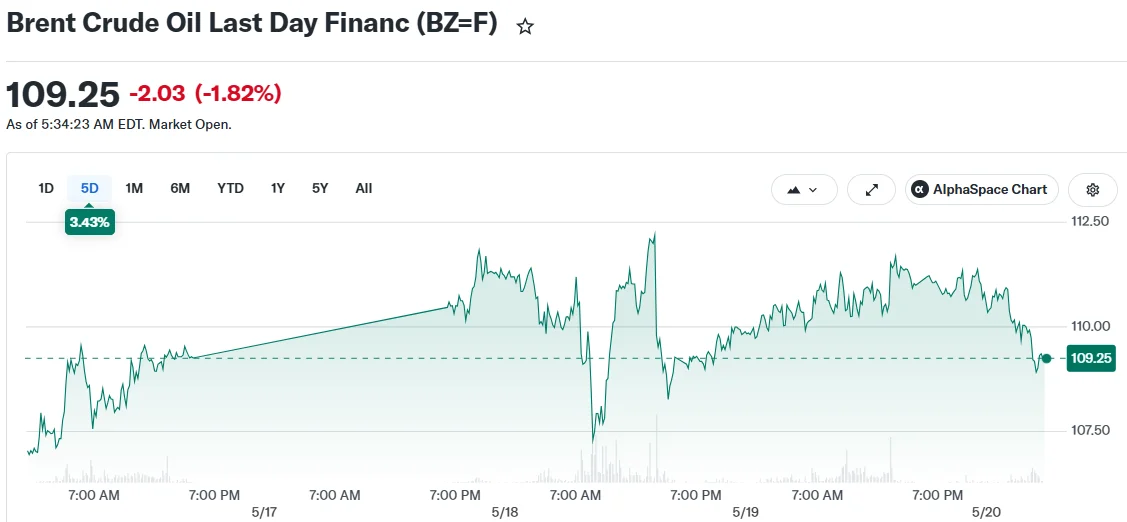 Brent Crude Oil Last Day Financ (BZ=F)
President Donald Trump informed congressional members Tuesday evening that the Iranian conflict might conclude “very quickly.” He had previously announced the postponement of a scheduled American military strike against Iran while characterizing discussions with Tehran as productive.
Tehran’s most recent peace framework proposed cessation of military operations across all theaters, removal of American military presence from the broader region, and compensation for war damages. Washington has largely dismissed previous Iranian proposals, insisting that dismantling Iran’s nuclear capabilities remains essential for any comprehensive agreement.
Tankers Moving Again Through the Strait of Hormuz
Two supertankers flying Chinese flags successfully navigated out of the Strait of Hormuz Wednesday. Additionally, a South Korean-flagged vessel was proceeding outbound after remaining stationary for over two months while carrying 6 million barrels of Middle Eastern crude.
The critical waterway has been essentially shut to tanker operations since the U.S.-Israeli military campaign against Iran commenced in late February. The volume of vessels transiting the strait continues far below the approximately 130 that passed through daily prior to hostilities.
Despite this vessel movement, LSEG analysts warned that supply flows will probably not recover to pre-conflict volumes rapidly, even following a potential peace agreement.
Citi stated Tuesday it anticipates Brent crude advancing to $120 per barrel in coming weeks. The financial institution indicated oil markets are inadequately pricing the probability of extended supply interruptions.
U.S. Inventories Drop Sharply
American crude reserves have contracted for five consecutive weeks. Information from the American Petroleum Institute revealed a 9.1 million barrel reduction last week, substantially exceeding the 3.4 million barrel drawdown analysts had anticipated.
Official American inventory figures from the Energy Information Administration were scheduled for release later Wednesday and were projected to demonstrate comparable patterns.
Trump has authorized the deployment of 172 million barrels from the Strategic Petroleum Reserve to mitigate supply disruptions stemming from the military engagement.
PVM analysts cautioned that worldwide petroleum inventories might approach dangerously depleted thresholds. They observed that market participants have demonstrated surprising composure considering the magnitude of supply constraints.
The price differential on Brent contracts for immediate delivery versus six-month forward contracts remains around $21 per barrel — significantly beneath last month’s peak exceeding $35.
Highlighting additional supply pressures, Britain relaxed sanctions to permit imports of diesel and aviation fuel processed from Russian crude.
Markets are incorporating expectations of diplomatic advancement, yet analysts persistently caution that supply disruptions could intensify before any agreement materializes.
The post Crude Oil Dips 2% Amid Iran Talks, But Analysts Forecast Brent at $120 — Here’s What’s Next appeared first on Blockonomi.


You May Also Like

What Are Instagram Engagement Pools and How Do They Really Work?

Ripple CEO Tells Bloomberg: What Are Working Daily to Take Over SWIFT