World Liberty Financial (WLFI), the Trump-linked DeFi project, is scrambling to stop a market collapse after its token lost over 50% of its value in September. On Friday, the project unveiled a full buyback-and-burn program, directing all treasury liquidity fees to absorb selling pressure. According to a governance post on X, the community approved the plan overwhelmingly, with WLFI pledging full transparency for every burn. The urgency of the move reflects WLFI’s steep losses in recent weeks. WLFI is trading Friday at $0.19, down from its September 1 peak of $0.46, according to CoinMarketCap, a 58% drop in less than a month. Weekly losses stand at 12.85%, with a 15.45% decline for the month. This isn’t the project’s first attempt at intervention. Just days after launch, WLFI burned 47 million tokens on September 3 to counter a 31% sell-off, sending the supply to a verified burn address. For World Liberty Financial, the buyback-and-burn program represents both a damage-control measure and a test of community faith. While tokenomics adjustments can provide short-term relief, the project will need to convince investors that WLFI has staying power beyond interventions. WLFI Launches Buyback-and-Burn Plan, Linking Token Scarcity to Platform Growth According to the governance proposal, WLFI will use fees generated from its protocol-owned liquidity (POL) pools on Ethereum, BNB Chain, and Solana to repurchase tokens from the open market. Once bought back, the tokens will be sent to a burn address, permanently removing them from circulation.WLFI Proposal Source: WLFI The project stressed that this system ties supply reduction directly to platform growth. As trading activity rises, more liquidity fees are generated, fueling larger buybacks and burns. This seeks to create a feedback loop where adoption drives scarcity, and scarcity strengthens token value. Importantly, the plan applies only to WLFI’s protocol-controlled liquidity pools. Community and third-party liquidity pools remain unaffected, ensuring the mechanism doesn’t interfere with external ecosystem contributions. In its proposal, the WLFI team argued that the strategy aligns long-term holders with the project’s future by systematically reducing supply and discouraging short-term speculation. Each burn increases the relative stake of committed investors, reinforcing confidence in WLFI’s tokenomics. To bolster credibility, WLFI has pledged full transparency: every buyback and burn will be verifiable on-chain and reported to the community in real time. WLFI Joins Hyperliquid, Jupiter, and Sky as Buyback Craze Spills Into Wall Street WLFI’s decision to adopt a full buyback-and-burn strategy places it among the most ambitious tokenomic models in crypto. While partly a response to its sharp September price decline, the move also reflects a trend of DeFi protocols leveraging revenue streams to cut supply, align incentives, and strengthen token value. Hyperliquid illustrates the model at scale. Nearly all of its platform fees are funneled into automated $HYPE buybacks via its Assistance Fund, creating sustained demand. By mid-2025, more than 20 million tokens had been repurchased, with nearly 30 million held by Q3, worth over $1.5 billion. This consistency both increased scarcity and cemented Hyperliquid’s dominance in decentralized derivatives. Other protocols have adopted variations. Jupiter directs half its fees into $JUP repurchases, locking tokens for three years. Raydium earmarks 12% of fees for $RAY buybacks, already removing 71 million tokens, roughly a quarter of the circulating supply. Burn-based models push further, as seen with Sky, which has spent $75 million since February 2025 to permanently erase $SKY tokens, boosting scarcity and governance influence. But the buyback phenomenon isn’t limited to DeFi. Increasingly, listed companies with crypto treasuries are adopting aggressive repurchase programs, sometimes to offset losses as their digital assets decline. According to a report, at least seven firms, ranging from gaming to biotech, have turned to buybacks, often funded by debt, to prop up falling stock prices. One of the latest is Thumzup Media, a digital advertising company with a growing Web3 footprint. On Thursday, it launched a $10 million share repurchase plan, extending its capital return strategy through 2026, after completing a $1 million program that saw 212,432 shares bought at an average of $4.71. DeFi Development Corp, the first public company built around a Solana-based treasury strategy, also recently expanded its buyback program to $100 million, up from $1 million, making it one of the largest stock repurchase initiatives in the digital asset sector. Together, these cases show how buybacks, whether in tokenomics or equities, are emerging as a key mechanism for stabilizing value and signaling confidence, even as motivations and execution vary widelyWorld Liberty Financial (WLFI), the Trump-linked DeFi project, is scrambling to stop a market collapse after its token lost over 50% of its value in September. On Friday, the project unveiled a full buyback-and-burn program, directing all treasury liquidity fees to absorb selling pressure. According to a governance post on X, the community approved the plan overwhelmingly, with WLFI pledging full transparency for every burn. The urgency of the move reflects WLFI’s steep losses in recent weeks. WLFI is trading Friday at $0.19, down from its September 1 peak of $0.46, according to CoinMarketCap, a 58% drop in less than a month. Weekly losses stand at 12.85%, with a 15.45% decline for the month. This isn’t the project’s first attempt at intervention. Just days after launch, WLFI burned 47 million tokens on September 3 to counter a 31% sell-off, sending the supply to a verified burn address. For World Liberty Financial, the buyback-and-burn program represents both a damage-control measure and a test of community faith. While tokenomics adjustments can provide short-term relief, the project will need to convince investors that WLFI has staying power beyond interventions. WLFI Launches Buyback-and-Burn Plan, Linking Token Scarcity to Platform Growth According to the governance proposal, WLFI will use fees generated from its protocol-owned liquidity (POL) pools on Ethereum, BNB Chain, and Solana to repurchase tokens from the open market. Once bought back, the tokens will be sent to a burn address, permanently removing them from circulation.WLFI Proposal Source: WLFI The project stressed that this system ties supply reduction directly to platform growth. As trading activity rises, more liquidity fees are generated, fueling larger buybacks and burns. This seeks to create a feedback loop where adoption drives scarcity, and scarcity strengthens token value. Importantly, the plan applies only to WLFI’s protocol-controlled liquidity pools. Community and third-party liquidity pools remain unaffected, ensuring the mechanism doesn’t interfere with external ecosystem contributions. In its proposal, the WLFI team argued that the strategy aligns long-term holders with the project’s future by systematically reducing supply and discouraging short-term speculation. Each burn increases the relative stake of committed investors, reinforcing confidence in WLFI’s tokenomics. To bolster credibility, WLFI has pledged full transparency: every buyback and burn will be verifiable on-chain and reported to the community in real time. WLFI Joins Hyperliquid, Jupiter, and Sky as Buyback Craze Spills Into Wall Street WLFI’s decision to adopt a full buyback-and-burn strategy places it among the most ambitious tokenomic models in crypto. While partly a response to its sharp September price decline, the move also reflects a trend of DeFi protocols leveraging revenue streams to cut supply, align incentives, and strengthen token value. Hyperliquid illustrates the model at scale. Nearly all of its platform fees are funneled into automated $HYPE buybacks via its Assistance Fund, creating sustained demand. By mid-2025, more than 20 million tokens had been repurchased, with nearly 30 million held by Q3, worth over $1.5 billion. This consistency both increased scarcity and cemented Hyperliquid’s dominance in decentralized derivatives. Other protocols have adopted variations. Jupiter directs half its fees into $JUP repurchases, locking tokens for three years. Raydium earmarks 12% of fees for $RAY buybacks, already removing 71 million tokens, roughly a quarter of the circulating supply. Burn-based models push further, as seen with Sky, which has spent $75 million since February 2025 to permanently erase $SKY tokens, boosting scarcity and governance influence. But the buyback phenomenon isn’t limited to DeFi. Increasingly, listed companies with crypto treasuries are adopting aggressive repurchase programs, sometimes to offset losses as their digital assets decline. According to a report, at least seven firms, ranging from gaming to biotech, have turned to buybacks, often funded by debt, to prop up falling stock prices. One of the latest is Thumzup Media, a digital advertising company with a growing Web3 footprint. On Thursday, it launched a $10 million share repurchase plan, extending its capital return strategy through 2026, after completing a $1 million program that saw 212,432 shares bought at an average of $4.71. DeFi Development Corp, the first public company built around a Solana-based treasury strategy, also recently expanded its buyback program to $100 million, up from $1 million, making it one of the largest stock repurchase initiatives in the digital asset sector. Together, these cases show how buybacks, whether in tokenomics or equities, are emerging as a key mechanism for stabilizing value and signaling confidence, even as motivations and execution vary widely

Trump-Backed WLFI Plunges 58% – Buyback Plan Announced to Halt Freefall

World Liberty Financial (WLFI), the Trump-linked DeFi project, is scrambling to stop a market collapse after its token lost over 50% of its value in September.

On Friday, the project unveiled a full buyback-and-burn program, directing all treasury liquidity fees to absorb selling pressure. According to a governance post on X, the community approved the plan overwhelmingly, with WLFI pledging full transparency for every burn.

The urgency of the move reflects WLFI’s steep losses in recent weeks. WLFI is trading Friday at $0.19, down from its September 1 peak of $0.46, according to CoinMarketCap, a 58% drop in less than a month. Weekly losses stand at 12.85%, with a 15.45% decline for the month.

This isn’t the project’s first attempt at intervention. Just days after launch, WLFI burned 47 million tokens on September 3 to counter a 31% sell-off, sending the supply to a verified burn address.

For World Liberty Financial, the buyback-and-burn program represents both a damage-control measure and a test of community faith. While tokenomics adjustments can provide short-term relief, the project will need to convince investors that WLFI has staying power beyond interventions.

WLFI Launches Buyback-and-Burn Plan, Linking Token Scarcity to Platform Growth

According to the governance proposal, WLFI will use fees generated from its protocol-owned liquidity (POL) pools on Ethereum, BNB Chain, and Solana to repurchase tokens from the open market. Once bought back, the tokens will be sent to a burn address, permanently removing them from circulation.
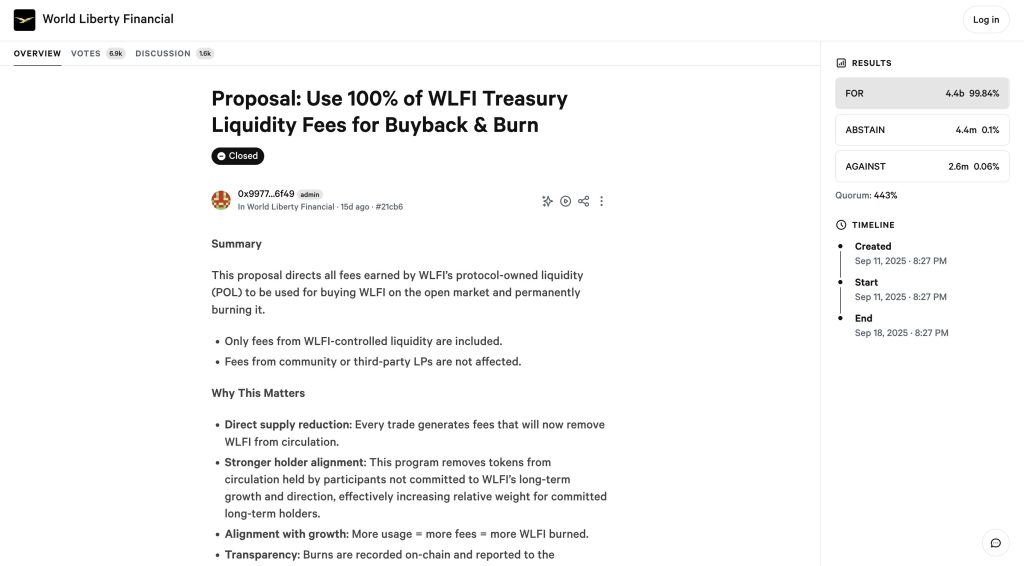
WLFI Proposal Source: WLFI

The project stressed that this system ties supply reduction directly to platform growth. As trading activity rises, more liquidity fees are generated, fueling larger buybacks and burns. This seeks to create a feedback loop where adoption drives scarcity, and scarcity strengthens token value.

Importantly, the plan applies only to WLFI’s protocol-controlled liquidity pools. Community and third-party liquidity pools remain unaffected, ensuring the mechanism doesn’t interfere with external ecosystem contributions.

In its proposal, the WLFI team argued that the strategy aligns long-term holders with the project’s future by systematically reducing supply and discouraging short-term speculation. Each burn increases the relative stake of committed investors, reinforcing confidence in WLFI’s tokenomics.

To bolster credibility, WLFI has pledged full transparency: every buyback and burn will be verifiable on-chain and reported to the community in real time.

WLFI Joins Hyperliquid, Jupiter, and Sky as Buyback Craze Spills Into Wall Street

WLFI’s decision to adopt a full buyback-and-burn strategy places it among the most ambitious tokenomic models in crypto. While partly a response to its sharp September price decline, the move also reflects a trend of DeFi protocols leveraging revenue streams to cut supply, align incentives, and strengthen token value.

Hyperliquid illustrates the model at scale. Nearly all of its platform fees are funneled into automated $HYPE buybacks via its Assistance Fund, creating sustained demand.

By mid-2025, more than 20 million tokens had been repurchased, with nearly 30 million held by Q3, worth over $1.5 billion. This consistency both increased scarcity and cemented Hyperliquid’s dominance in decentralized derivatives.

Other protocols have adopted variations. Jupiter directs half its fees into $JUP repurchases, locking tokens for three years.

Raydium earmarks 12% of fees for $RAY buybacks, already removing 71 million tokens, roughly a quarter of the circulating supply.

Burn-based models push further, as seen with Sky, which has spent $75 million since February 2025 to permanently erase $SKY tokens, boosting scarcity and governance influence.

But the buyback phenomenon isn’t limited to DeFi. Increasingly, listed companies with crypto treasuries are adopting aggressive repurchase programs, sometimes to offset losses as their digital assets decline.

According to a report, at least seven firms, ranging from gaming to biotech, have turned to buybacks, often funded by debt, to prop up falling stock prices.

One of the latest is Thumzup Media, a digital advertising company with a growing Web3 footprint. On Thursday, it launched a $10 million share repurchase plan, extending its capital return strategy through 2026, after completing a $1 million program that saw 212,432 shares bought at an average of $4.71.

DeFi Development Corp, the first public company built around a Solana-based treasury strategy, also recently expanded its buyback program to $100 million, up from $1 million, making it one of the largest stock repurchase initiatives in the digital asset sector.

Together, these cases show how buybacks, whether in tokenomics or equities, are emerging as a key mechanism for stabilizing value and signaling confidence, even as motivations and execution vary widely.


Market Opportunity
OFFICIAL TRUMP Logo
OFFICIAL TRUMP Price(TRUMP)
$5.212
$5.212$5.212
-1.00%
USD
OFFICIAL TRUMP (TRUMP) Live Price Chart
Disclaimer: The articles reposted on this site are sourced from public platforms and are provided for informational purposes only. They do not necessarily reflect the views of MEXC. All rights remain with the original authors. If you believe any content infringes on third-party rights, please contact [email protected] for removal. MEXC makes no guarantees regarding the accuracy, completeness, or timeliness of the content and is not responsible for any actions taken based on the information provided. The content does not constitute financial, legal, or other professional advice, nor should it be considered a recommendation or endorsement by MEXC.

You May Also Like

China Blocks Nvidia’s RTX Pro 6000D as Local Chips Rise

China Blocks Nvidia’s RTX Pro 6000D as Local Chips Rise

The post China Blocks Nvidia’s RTX Pro 6000D as Local Chips Rise appeared on BitcoinEthereumNews.com. China Blocks Nvidia’s RTX Pro 6000D as Local Chips Rise China’s internet regulator has ordered the country’s biggest technology firms, including Alibaba and ByteDance, to stop purchasing Nvidia’s RTX Pro 6000D GPUs. According to the Financial Times, the move shuts down the last major channel for mass supplies of American chips to the Chinese market. Why Beijing Halted Nvidia Purchases Chinese companies had planned to buy tens of thousands of RTX Pro 6000D accelerators and had already begun testing them in servers. But regulators intervened, halting the purchases and signaling stricter controls than earlier measures placed on Nvidia’s H20 chip. Image: Nvidia An audit compared Huawei and Cambricon processors, along with chips developed by Alibaba and Baidu, against Nvidia’s export-approved products. Regulators concluded that Chinese chips had reached performance levels comparable to the restricted U.S. models. This assessment pushed authorities to advise firms to rely more heavily on domestic processors, further tightening Nvidia’s already limited position in China. China’s Drive Toward Tech Independence The decision highlights Beijing’s focus on import substitution — developing self-sufficient chip production to reduce reliance on U.S. supplies. “The signal is now clear: all attention is focused on building a domestic ecosystem,” said a representative of a leading Chinese tech company. Nvidia had unveiled the RTX Pro 6000D in July 2025 during CEO Jensen Huang’s visit to Beijing, in an attempt to keep a foothold in China after Washington restricted exports of its most advanced chips. But momentum is shifting. Industry sources told the Financial Times that Chinese manufacturers plan to triple AI chip production next year to meet growing demand. They believe “domestic supply will now be sufficient without Nvidia.” What It Means for the Future With Huawei, Cambricon, Alibaba, and Baidu stepping up, China is positioning itself for long-term technological independence. Nvidia, meanwhile, faces…
Share
BitcoinEthereumNews2025/09/18 01:37
The aftermath of the energy war: As Microsoft, BlackRock monopolize infrastructure, Eden Miner becomes retail’s last backdoor to the “hashrate yield network”

The aftermath of the energy war: As Microsoft, BlackRock monopolize infrastructure, Eden Miner becomes retail’s last backdoor to the “hashrate yield network”

As mining goes institutional in 2025, Eden Miner opens retail access to hashrate investing through a new model. The year 2025 marks a watershed moment for global
Share
Crypto.news2025/12/17 00:08
Gold continues to hit new highs. How to invest in gold in the crypto market?

Gold continues to hit new highs. How to invest in gold in the crypto market?

As Bitcoin encounters a "value winter", real-world gold is recasting the iron curtain of value on the blockchain.
Share
PANews2025/04/14 17:12