Google Invests in Bitcoin Miner Cipher: Is PEPENODE the Next Big AI-Crypto Play?
The $3 billion deal, structured through a Fluidstack lease agreement, includes Google’s guarantee of $1.4 billion in obligations. This highlights Big Tech’s recent focus: integrating AI with crypto infrastructure.
This partnership marks a turning point for both the AI and crypto mining industries, with Bitcoin miners increasingly powering high-performance AI workloads instead of relying solely on $BTC block rewards.
The move also brings emerging decentralized projects like $PEPENODE into focus, which aim to merge AI compute with crypto mining at a fundamental level.
Cipher Mining: The AI-Ready Bitcoin Miner
Cipher Mining has established itself as an early pioneer in the Bitcoin-meets-AI revolution, partnering with Fluidstack to support high-performance computing (HPC) workloads alongside traditional Bitcoin mining.

This partnership establishes Cipher as a major data infrastructure provider, hosting AI computing clusters instead of solely relying on mining rewards like other crypto mining companies.
Cipher’s Barber Lake facility in Texas currently operates at 168 MW but can scale up to 500 MW across 587 acres – a substantial compute capacity that can support major AI training workloads.
Cipher Mining is following a similar model to TeraWulf: another crypto miner that Google backed earlier this year with $1.8 billion in guarantees. Analysts say this “AI pivot” trend could reshape mining economics, transforming operators into decentralized computing providers.
The AI-Mining Boom: New Trend in Crypto Infrastructure
Bitcoin miners are quickly transforming into AI infrastructure providers, utilizing their energy capacity and GPU clusters to support compute-intensive workloads.

Cipher’s $7 billion revenue potential from its Fluidstack deal underscores how profoundly this shift is transforming the mining economy.
Early movers like TeraWulf and Core Scientific have already rebranded part of their operations to serve AI and high-performance computing (HPC) clients, securing stable income streams that don’t depend on Bitcoin’s price cycles.
Texas has rapidly become the center of this hybrid infrastructure surge, partly due to its deregulated grid, renewable energy blend, and tech-friendly atmosphere.
This increasing overlap between crypto mining and AI computing paves the way for next-generation decentralized networks like $PEPENODE, built for distributed computing sharing.
PEPENODE: The Next Generation of Crypto Mining
$PEPENODE reimagines crypto mining as an engaging, gamified experience: a virtual mining simulator that allows users to create customizable “server rooms” and earn rewards without any hardware or energy costs.
Unlike corporate miners like Cipher or TeraWulf, $PEPENODE makes mining accessible to everyone. It lets anyone buy and stake digital Miner Nodes directly through its Ethereum-based platform.
This model combines the excitement of meme culture with actual token utility, developing a new type of “play-to-mine” community involvement.
As Google and leading miners move toward AI-powered data centers, $PEPENODE provides a grassroots alternative: decentralized, accessible, and driven by its community.
Early interest in $PEPENODE is already gaining momentum, with the project raising over $1.4M in its ongoing presale. Tokens are currently priced at just $0.0010745 each, offering an affordable entry point for early investors ahead of the TGE virtual mining launch.

Early buyers can also stake their tokens immediately for up to 913% APY, making it one of the most lucrative passive income options among presales in the crypto space.
Combined with its gamified mining concept and memecoin bonuses, $PEPENODE stands out as a high-engagement, high-reward alternative to traditional crypto mining and staking platforms. And at its current valuation of $1.4M, it’s a smart choice.
Check out the $PEPENODE presale before the crowd catches on!
This publication is sponsored. Coindoo does not endorse or assume responsibility for the content, accuracy, quality, advertising, products, or any other materials on this page. Readers are encouraged to conduct their own research before engaging in any cryptocurrency-related actions. Coindoo will not be liable, directly or indirectly, for any damages or losses resulting from the use of or reliance on any content, goods, or services mentioned. Always do your own research.
The post Google Invests in Bitcoin Miner Cipher: Is PEPENODE the Next Big AI-Crypto Play? appeared first on Coindoo.
You May Also Like

UK crypto holders brace for FCA’s expanded regulatory reach
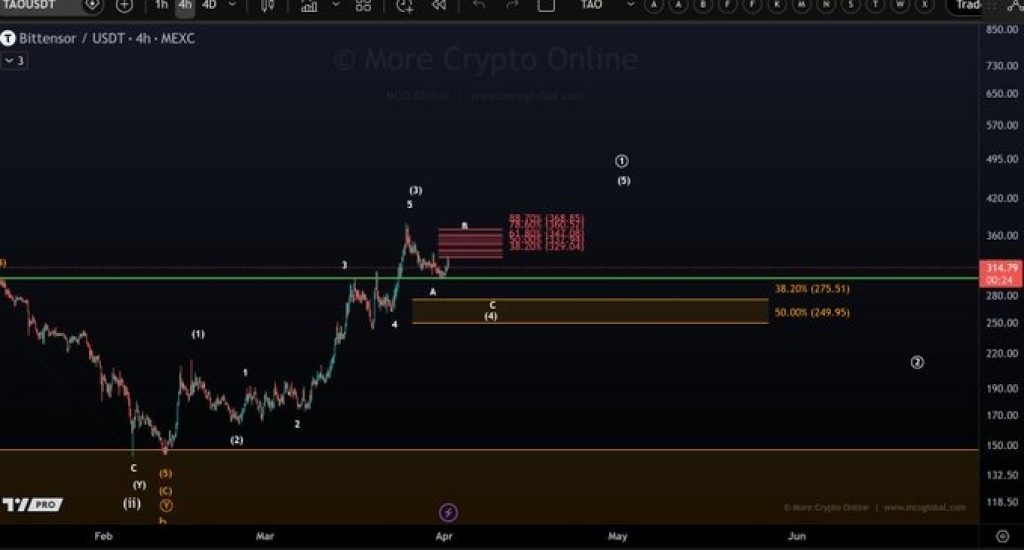
Thinking of Buying Bittensor? Watch These TAO Price Correction Levels First

China Nabs Another Huione Group Core Member in Cambodia Extradition