

Sivers Semiconductors (SIVO) Stock Rockets 50% on Defense Contract Amid Insider Trading Scandal
TLDR
- Sivers Semiconductors jumped approximately 50% in a two-day period after landing a $6.6M Department of Defense contract for year two of the EW STAR initiative under CHIPS Act funding.
- Shares reached 87.70 Swedish kronor during Monday trading, marking a 20.30% daily increase after climbing 23.45% the previous session.
- The firm revised its financial statements for both 2024 and 2025, showing an expanded 2025 net deficit of 222.6 million kronor versus the initially disclosed 186.5 million.
- Swedish authorities are probing potential insider trading related to premature disclosure of the company’s planned Nasdaq dual-listing.
- Current valuation reflects a price-to-sales ratio of 59.69, significantly exceeding the consensus analyst target of 6.55 Swedish kronor per share.
Sivers Semiconductors has delivered one of the most dramatic stock performances in European markets this year. The Swedish manufacturer of photonics and RF semiconductor components rallied approximately 50% over just two trading days — powered by a $6.6 million U.S. military contract and growing investor enthusiasm for AI infrastructure opportunities.
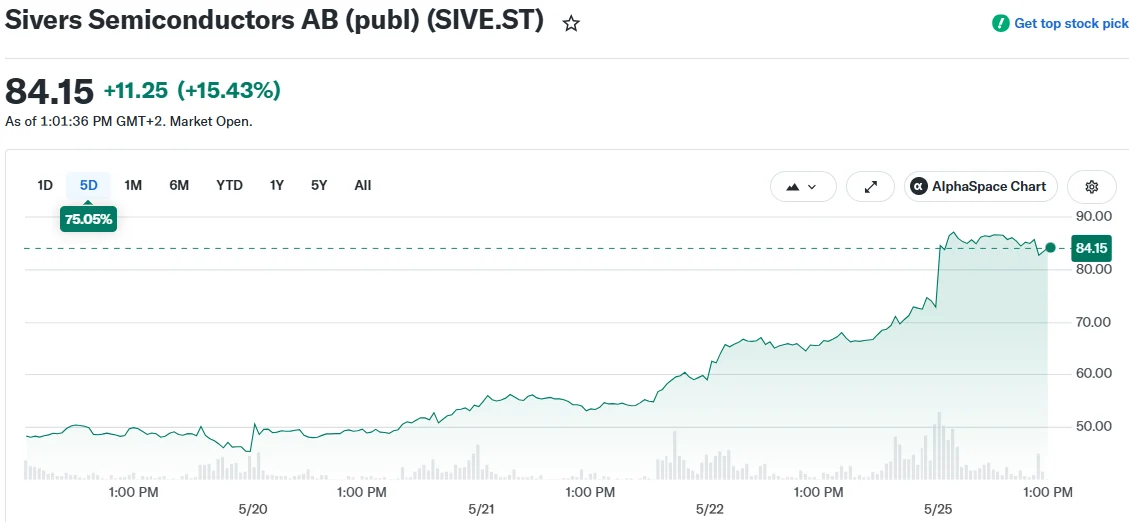 Sivers Semiconductors AB (publ) (SIVE.ST)
When markets closed on Monday, shares stood at 87.70 Swedish kronor, representing a 20.30% single-day advance. This came immediately after a 23.45% surge from 72.90 kronor in the preceding session. The consecutive gains elevated the company’s market capitalization to approximately 21.54 billion Swedish kronor.
The driving force behind this momentum was the second-year funding approval under the EW STAR initiative, administered through the U.S. Microelectronics Commons program with backing from the CHIPS and Science Act. The Pentagon-supported financing comes via the Northeast Microelectronics Coalition Hub, which encompasses eight states across the northeastern United States. Significantly, these funds are milestone-dependent — Sivers secured payment only after successfully completing year-one technical objectives, lending some legitimacy to the achievement.
EW STAR concentrates on developing broadband antenna array systems designed for simultaneous transmission and reception capabilities in electronic warfare, radar detection, and secure communications. Sivers is simultaneously marketing its beamforming and photonic innovations for satellite connectivity and AI-powered data center infrastructure — two segments where investor demand has been particularly intense recently.
Momentum Accelerates Without Fresh Catalysts
Monday’s 20% spike occurred without any new company disclosures. The preceding days had featured governance announcements — a recommended board restructuring that would introduce two new directors with expertise in capital markets and technology expansion, while removing several founding members and early investors. The incoming nominees, Joakim Nideborn and Helena Svancar, align with the company’s strategic pivot toward American markets and AI-related infrastructure.
The board overhaul also signals mounting pressure from various stakeholders. Achilles Capital, Sivers’ top individual shareholder, maintains connections to DDM Finance, currently undergoing debt restructuring with plans to liquidate €30–50 million in holdings. Whether Sivers shares factor into that disposal remains uncertain. Meanwhile, short positions include Voleon Capital at 1.86% and Two Sigma at 1.78%.
Financial Revisions and Criminal Scrutiny
The company’s financial standing presents challenges. Sivers reissued its accounts for 2024 and 2025 to align with U.S. PCAOB compliance requirements in preparation for a prospective Nasdaq dual-listing. The 2025 revision showed revenue of 306.6 million kronor, while the operating deficit expanded to 177.8 million kronor and the net loss reached 222.6 million kronor — substantially higher than the previously disclosed 186.5 million. The 2024 adjustments proved even more significant, reducing revenue from 243.7 million to 219.2 million kronor and enlarging the net loss from 116.3 million to 183.9 million kronor.
Compounding these concerns, Sweden’s Economic Crime Authority has launched an investigation into suspected insider trading. An unidentified social media profile with substantial reach published specifics about the Nasdaq listing strategy approximately 48 hours ahead of the official statement, triggering abnormal trading activity. Prosecutor Jonas Myrdal is evaluating whether violations of EU Market Abuse Regulation occurred.
Despite these headwinds, the stock commands a price-to-sales multiple of 59.69 and a price-to-book ratio of 20.00. The mean analyst price target remains at only 6.55 Swedish kronor — substantially below current trading levels.
Sivers has postponed its Q1 earnings release until May 29 and scheduled its annual general meeting for June 15, where investors will decide on a management incentive structure covering up to 7 million stock options, equating to roughly 2% equity dilution.
The post Sivers Semiconductors (SIVO) Stock Rockets 50% on Defense Contract Amid Insider Trading Scandal appeared first on Blockonomi.


You May Also Like

Not a loophole: Singapore AI export controls let China tap US AI legally

Ondo Finance Launches USDY Yieldcoin on Stellar, Bringing Tokenized U.S. Treasuries to Users

Q2 Market Insights: Bitcoin regains dominance in risk-averse environment, ETFs remain critical to market structure



