Raoul Pal believes the crypto cycle is not nearing a peak but entering a longer, more powerful expansion that can run well into 2026, driven by a global liquidity uptrend tied to government debt dynamics. In a special Sept. 25 “Everything Code” masterclass with Global Macro Investor (GMI) head of macro research Julien Bittel, the Real Vision co-founder laid out a tightly interlocked framework connecting demographics, debt, liquidity and the business cycle to asset returns—arguing that crypto and tech remain the only asset classes structurally capable of outpacing what he calls the hidden debasement of fiat. Everything Code: Liquidity Is Crypto’s Master Switch “The biggest macro variable of all time,” Pal said, “is that global governments and central banks are increasing liquidity to manage debt at 8% a year.” He separated that ongoing debasement from measured inflation, warning investors to think in hurdle rates, not headlines: “You’ve got an 11% hurdle rate on any investment that you have. If your investments are not hitting 11% you are getting poorer.” Pal and Bittel’s “Everything Code” starts with trend GDP as the sum of population growth, productivity and debt growth. With working-age populations declining and productivity subdued, public debt has filled the gap—structurally lifting debt-to-GDP and hard-wiring the need for liquidity. “Demographics are destiny,” Pal said, pointing to a falling labor-force participation rate that, in GMI’s work, mirrors the inexorable rise in government debt as a share of GDP. The bridge between the two, they argue, is the liquidity toolkit—balance sheets, the Treasury General Account (TGA), reverse repos and banking-system channels—deployed in cycles to finance interest costs that the economy cannot organically bear. “If trend growth is ~2% and rates are 4%, that gap has to be monetized,” Pal said. “It’s a story as old as the hills.” Related Reading: All-Time Highs For Gold, S&P500; Crypto Stands Alone In The Red – What’s The Root Cause? Bittel then mapped what he called the “dominoes.” GMI’s Financial Conditions Index—an econometric blend of commodities, the dollar and rates—leads total liquidity by roughly three months; total liquidity leads the ISM manufacturing index by about six months; and the ISM, in turn, sets the tone for earnings, cyclicals and crypto beta. “Our job is to live in the future,” Bittel said. “Financial conditions lead the ISM by nine months. Liquidity leads by six. That sequence is what risk markets actually trade.” In that sequence, crypto is not an outlier but a high-beta macro asset. “Bitcoin is the ISM,” Bittel said, noting that the same diffusion-index dynamics that govern small-cap equities, cyclicals, crude and emerging markets also map onto BTC and ETH. As the cycle accelerates from sub-50 ISM toward the high-50s, risk appetite migrates down the curve: first from BTC into ETH, then into large alternative L1s and, only later, into smaller caps—coinciding with falling BTC dominance. Pal cautioned investors who expect “instant altseason” that they are fighting the phasing of the real economy: “It always goes into the next safest asset first… only when the ISM is really pushing higher and dominance is falling hard do you get the rest.” Part of the recent “sideways chop,” they argued, reflected a sharp TGA rebuild—an exogenous liquidity drain that disproportionately impacts the far end of the risk curve. Bittel highlighted that the $500 billion rate of change since mid-July effectively removed fuel that otherwise would have buoyed crypto prices, while stressing that the drain is nearing an inflection. He also flagged DeMark timing signals pointing to a reversal in the TGA’s contribution to net liquidity. “That should now reverse and work lower into year-end, which then will drive our liquidity composites higher,” he said, adding that the People’s Bank of China’s balance sheet at all-time highs has partially offset US drags. Against that backdrop, the pair contend that the forthcoming 12 months are critical. “We’ve got $9 trillion of debt to roll over the next 12 months,” Pal said. “This is the 12 months where maximum money printing comes.” Their base case has policy rates moving lower into a still-subdued but improving cycle, with central banks focused on lagging mandates—unemployment and core services inflation—while early-cycle inflation breadth remains contained. Bittel underscored the sequencing inside inflation itself: commodities first, then goods, with shelter disinflation mechanically lagging, giving central banks cover to cut even as growth accelerates. The implication for portfolio construction, Pal argued, is radical. “Diversification is dead. The best thing is hyper-concentration,” he said, framing the choice not as a taste for volatility but as arithmetic survival against debasement. In GMI’s long-horizon tables, most traditional assets underperform the combined debasement-plus-inflation hurdle, while the Nasdaq earns excess returns over liquidity and Bitcoin dwarfs both. “What is the point of owning any other asset?” Pal asked rhetorically. “This is the super-massive black hole of assets, which is why we personally are all-in on crypto… It’s the greatest macro trade of all time.” Related Reading: Crypto Bloodbath Shakes Market—But Is The Real Storm Still To Come? Bittel overlaid Bitcoin’s log-regression channel—what Pal called the “network adoption rails”—on the ISM to illustrate how time and cycle amplitude interact. Because adoption drifts price targets higher through time, longer cycles mechanically point to higher potential outcomes. He showed illustrative channel levels tied to hypothetical ISM prints to explain the mechanism, from mid-$200Ks if the ISM rises into the low-50s to materially higher if the cycle extends toward the low-60s. The numbers were not presented as forecasts but as a map for how cycle strength translates into range-bound fair value bands. Macro Liquidity Extends The Crypto Bull Run Critically, Pal and Bittel argued the current cycle differs from 2020–2021, when both liquidity and the ISM peaked in March 2021, truncating the run. Today, they say, liquidity is re-accelerating into the debt-refinancing window and the ISM is still below 50 with forward indicators pointing up, setting up a 2017-style Q4 impulse with seasonal tailwinds—and, unlike 2017, a higher probability that strength spills into 2026 because the refinancing cycle itself has lengthened. “It is extremely unlikely that it tops this year,” Pal said. “The ISM just isn’t there, and global liquidity isn’t either.” The framework also locates crypto within a broader secular S-curve. Pal contrasted fiat debasement, which lifts asset prices, with GDP-anchored earnings and wages, which lag—explaining why traditional valuation optics look stretched and why owning long-duration, network-effect assets becomes existential. He placed crypto’s user growth at roughly double the internet’s at a comparable stage and argued that tokens uniquely allow investors to own the infrastructure layer of the next web. On total addressable value, he applied the same log-trend framing to the entire digital asset market, sketching a path from roughly $4 trillion today toward a potential $100 trillion by the early 2030s if the space tracks its “fair value” adoption channel, with Bitcoin ultimately occupying a role analogous to gold inside a much larger digital asset stack. Pal closed with operational advice consistent with a longer, liquidity-driven expansion: maintain exposure to proven, large-cap crypto networks, avoid leverage that forces capitulation during routine 20–30% drawdowns, and match time horizon to the macro clock rather than headlines. “We’re four percent of the way there,” he said. “Your job is to not mess this up.” At press time, the total crypto market cap stood at $3.67 trillion. Featured image created with DALL.E, chart from TradingView.comRaoul Pal believes the crypto cycle is not nearing a peak but entering a longer, more powerful expansion that can run well into 2026, driven by a global liquidity uptrend tied to government debt dynamics. In a special Sept. 25 “Everything Code” masterclass with Global Macro Investor (GMI) head of macro research Julien Bittel, the Real Vision co-founder laid out a tightly interlocked framework connecting demographics, debt, liquidity and the business cycle to asset returns—arguing that crypto and tech remain the only asset classes structurally capable of outpacing what he calls the hidden debasement of fiat. Everything Code: Liquidity Is Crypto’s Master Switch “The biggest macro variable of all time,” Pal said, “is that global governments and central banks are increasing liquidity to manage debt at 8% a year.” He separated that ongoing debasement from measured inflation, warning investors to think in hurdle rates, not headlines: “You’ve got an 11% hurdle rate on any investment that you have. If your investments are not hitting 11% you are getting poorer.” Pal and Bittel’s “Everything Code” starts with trend GDP as the sum of population growth, productivity and debt growth. With working-age populations declining and productivity subdued, public debt has filled the gap—structurally lifting debt-to-GDP and hard-wiring the need for liquidity. “Demographics are destiny,” Pal said, pointing to a falling labor-force participation rate that, in GMI’s work, mirrors the inexorable rise in government debt as a share of GDP. The bridge between the two, they argue, is the liquidity toolkit—balance sheets, the Treasury General Account (TGA), reverse repos and banking-system channels—deployed in cycles to finance interest costs that the economy cannot organically bear. “If trend growth is ~2% and rates are 4%, that gap has to be monetized,” Pal said. “It’s a story as old as the hills.” Related Reading: All-Time Highs For Gold, S&P500; Crypto Stands Alone In The Red – What’s The Root Cause? Bittel then mapped what he called the “dominoes.” GMI’s Financial Conditions Index—an econometric blend of commodities, the dollar and rates—leads total liquidity by roughly three months; total liquidity leads the ISM manufacturing index by about six months; and the ISM, in turn, sets the tone for earnings, cyclicals and crypto beta. “Our job is to live in the future,” Bittel said. “Financial conditions lead the ISM by nine months. Liquidity leads by six. That sequence is what risk markets actually trade.” In that sequence, crypto is not an outlier but a high-beta macro asset. “Bitcoin is the ISM,” Bittel said, noting that the same diffusion-index dynamics that govern small-cap equities, cyclicals, crude and emerging markets also map onto BTC and ETH. As the cycle accelerates from sub-50 ISM toward the high-50s, risk appetite migrates down the curve: first from BTC into ETH, then into large alternative L1s and, only later, into smaller caps—coinciding with falling BTC dominance. Pal cautioned investors who expect “instant altseason” that they are fighting the phasing of the real economy: “It always goes into the next safest asset first… only when the ISM is really pushing higher and dominance is falling hard do you get the rest.” Part of the recent “sideways chop,” they argued, reflected a sharp TGA rebuild—an exogenous liquidity drain that disproportionately impacts the far end of the risk curve. Bittel highlighted that the $500 billion rate of change since mid-July effectively removed fuel that otherwise would have buoyed crypto prices, while stressing that the drain is nearing an inflection. He also flagged DeMark timing signals pointing to a reversal in the TGA’s contribution to net liquidity. “That should now reverse and work lower into year-end, which then will drive our liquidity composites higher,” he said, adding that the People’s Bank of China’s balance sheet at all-time highs has partially offset US drags. Against that backdrop, the pair contend that the forthcoming 12 months are critical. “We’ve got $9 trillion of debt to roll over the next 12 months,” Pal said. “This is the 12 months where maximum money printing comes.” Their base case has policy rates moving lower into a still-subdued but improving cycle, with central banks focused on lagging mandates—unemployment and core services inflation—while early-cycle inflation breadth remains contained. Bittel underscored the sequencing inside inflation itself: commodities first, then goods, with shelter disinflation mechanically lagging, giving central banks cover to cut even as growth accelerates. The implication for portfolio construction, Pal argued, is radical. “Diversification is dead. The best thing is hyper-concentration,” he said, framing the choice not as a taste for volatility but as arithmetic survival against debasement. In GMI’s long-horizon tables, most traditional assets underperform the combined debasement-plus-inflation hurdle, while the Nasdaq earns excess returns over liquidity and Bitcoin dwarfs both. “What is the point of owning any other asset?” Pal asked rhetorically. “This is the super-massive black hole of assets, which is why we personally are all-in on crypto… It’s the greatest macro trade of all time.” Related Reading: Crypto Bloodbath Shakes Market—But Is The Real Storm Still To Come? Bittel overlaid Bitcoin’s log-regression channel—what Pal called the “network adoption rails”—on the ISM to illustrate how time and cycle amplitude interact. Because adoption drifts price targets higher through time, longer cycles mechanically point to higher potential outcomes. He showed illustrative channel levels tied to hypothetical ISM prints to explain the mechanism, from mid-$200Ks if the ISM rises into the low-50s to materially higher if the cycle extends toward the low-60s. The numbers were not presented as forecasts but as a map for how cycle strength translates into range-bound fair value bands. Macro Liquidity Extends The Crypto Bull Run Critically, Pal and Bittel argued the current cycle differs from 2020–2021, when both liquidity and the ISM peaked in March 2021, truncating the run. Today, they say, liquidity is re-accelerating into the debt-refinancing window and the ISM is still below 50 with forward indicators pointing up, setting up a 2017-style Q4 impulse with seasonal tailwinds—and, unlike 2017, a higher probability that strength spills into 2026 because the refinancing cycle itself has lengthened. “It is extremely unlikely that it tops this year,” Pal said. “The ISM just isn’t there, and global liquidity isn’t either.” The framework also locates crypto within a broader secular S-curve. Pal contrasted fiat debasement, which lifts asset prices, with GDP-anchored earnings and wages, which lag—explaining why traditional valuation optics look stretched and why owning long-duration, network-effect assets becomes existential. He placed crypto’s user growth at roughly double the internet’s at a comparable stage and argued that tokens uniquely allow investors to own the infrastructure layer of the next web. On total addressable value, he applied the same log-trend framing to the entire digital asset market, sketching a path from roughly $4 trillion today toward a potential $100 trillion by the early 2030s if the space tracks its “fair value” adoption channel, with Bitcoin ultimately occupying a role analogous to gold inside a much larger digital asset stack. Pal closed with operational advice consistent with a longer, liquidity-driven expansion: maintain exposure to proven, large-cap crypto networks, avoid leverage that forces capitulation during routine 20–30% drawdowns, and match time horizon to the macro clock rather than headlines. “We’re four percent of the way there,” he said. “Your job is to not mess this up.” At press time, the total crypto market cap stood at $3.67 trillion. Featured image created with DALL.E, chart from TradingView.com
Liquidity Wave Extends The Crypto Bull Run Into 2026, Predicts Raoul Pal

2025/09/27 09:00
6 min read
For feedback or concerns regarding this content, please contact us at [email protected]

Raoul Pal believes the crypto cycle is not nearing a peak but entering a longer, more powerful expansion that can run well into 2026, driven by a global liquidity uptrend tied to government debt dynamics. In a special Sept. 25 “Everything Code” masterclass with Global Macro Investor (GMI) head of macro research Julien Bittel, the Real Vision co-founder laid out a tightly interlocked framework connecting demographics, debt, liquidity and the business cycle to asset returns—arguing that crypto and tech remain the only asset classes structurally capable of outpacing what he calls the hidden debasement of fiat.

Everything Code: Liquidity Is Crypto’s Master Switch

“The biggest macro variable of all time,” Pal said, “is that global governments and central banks are increasing liquidity to manage debt at 8% a year.” He separated that ongoing debasement from measured inflation, warning investors to think in hurdle rates, not headlines: “You’ve got an 11% hurdle rate on any investment that you have. If your investments are not hitting 11% you are getting poorer.”

Pal and Bittel’s “Everything Code” starts with trend GDP as the sum of population growth, productivity and debt growth. With working-age populations declining and productivity subdued, public debt has filled the gap—structurally lifting debt-to-GDP and hard-wiring the need for liquidity.

“Demographics are destiny,” Pal said, pointing to a falling labor-force participation rate that, in GMI’s work, mirrors the inexorable rise in government debt as a share of GDP. The bridge between the two, they argue, is the liquidity toolkit—balance sheets, the Treasury General Account (TGA), reverse repos and banking-system channels—deployed in cycles to finance interest costs that the economy cannot organically bear. “If trend growth is ~2% and rates are 4%, that gap has to be monetized,” Pal said. “It’s a story as old as the hills.”

Bittel then mapped what he called the “dominoes.” GMI’s Financial Conditions Index—an econometric blend of commodities, the dollar and rates—leads total liquidity by roughly three months; total liquidity leads the ISM manufacturing index by about six months; and the ISM, in turn, sets the tone for earnings, cyclicals and crypto beta. “Our job is to live in the future,” Bittel said. “Financial conditions lead the ISM by nine months. Liquidity leads by six. That sequence is what risk markets actually trade.”

In that sequence, crypto is not an outlier but a high-beta macro asset. “Bitcoin is the ISM,” Bittel said, noting that the same diffusion-index dynamics that govern small-cap equities, cyclicals, crude and emerging markets also map onto BTC and ETH.

As the cycle accelerates from sub-50 ISM toward the high-50s, risk appetite migrates down the curve: first from BTC into ETH, then into large alternative L1s and, only later, into smaller caps—coinciding with falling BTC dominance. Pal cautioned investors who expect “instant altseason” that they are fighting the phasing of the real economy: “It always goes into the next safest asset first… only when the ISM is really pushing higher and dominance is falling hard do you get the rest.”

Part of the recent “sideways chop,” they argued, reflected a sharp TGA rebuild—an exogenous liquidity drain that disproportionately impacts the far end of the risk curve. Bittel highlighted that the $500 billion rate of change since mid-July effectively removed fuel that otherwise would have buoyed crypto prices, while stressing that the drain is nearing an inflection.

He also flagged DeMark timing signals pointing to a reversal in the TGA’s contribution to net liquidity. “That should now reverse and work lower into year-end, which then will drive our liquidity composites higher,” he said, adding that the People’s Bank of China’s balance sheet at all-time highs has partially offset US drags.

Against that backdrop, the pair contend that the forthcoming 12 months are critical. “We’ve got $9 trillion of debt to roll over the next 12 months,” Pal said. “This is the 12 months where maximum money printing comes.” Their base case has policy rates moving lower into a still-subdued but improving cycle, with central banks focused on lagging mandates—unemployment and core services inflation—while early-cycle inflation breadth remains contained. Bittel underscored the sequencing inside inflation itself: commodities first, then goods, with shelter disinflation mechanically lagging, giving central banks cover to cut even as growth accelerates.

The implication for portfolio construction, Pal argued, is radical. “Diversification is dead. The best thing is hyper-concentration,” he said, framing the choice not as a taste for volatility but as arithmetic survival against debasement. In GMI’s long-horizon tables, most traditional assets underperform the combined debasement-plus-inflation hurdle, while the Nasdaq earns excess returns over liquidity and Bitcoin dwarfs both. “What is the point of owning any other asset?” Pal asked rhetorically. “This is the super-massive black hole of assets, which is why we personally are all-in on crypto… It’s the greatest macro trade of all time.”

Bittel overlaid Bitcoin’s log-regression channel—what Pal called the “network adoption rails”—on the ISM to illustrate how time and cycle amplitude interact. Because adoption drifts price targets higher through time, longer cycles mechanically point to higher potential outcomes. He showed illustrative channel levels tied to hypothetical ISM prints to explain the mechanism, from mid-$200Ks if the ISM rises into the low-50s to materially higher if the cycle extends toward the low-60s. The numbers were not presented as forecasts but as a map for how cycle strength translates into range-bound fair value bands.

Macro Liquidity Extends The Crypto Bull Run

Critically, Pal and Bittel argued the current cycle differs from 2020–2021, when both liquidity and the ISM peaked in March 2021, truncating the run. Today, they say, liquidity is re-accelerating into the debt-refinancing window and the ISM is still below 50 with forward indicators pointing up, setting up a 2017-style Q4 impulse with seasonal tailwinds—and, unlike 2017, a higher probability that strength spills into 2026 because the refinancing cycle itself has lengthened. “It is extremely unlikely that it tops this year,” Pal said. “The ISM just isn’t there, and global liquidity isn’t either.”

The framework also locates crypto within a broader secular S-curve. Pal contrasted fiat debasement, which lifts asset prices, with GDP-anchored earnings and wages, which lag—explaining why traditional valuation optics look stretched and why owning long-duration, network-effect assets becomes existential.

He placed crypto’s user growth at roughly double the internet’s at a comparable stage and argued that tokens uniquely allow investors to own the infrastructure layer of the next web. On total addressable value, he applied the same log-trend framing to the entire digital asset market, sketching a path from roughly $4 trillion today toward a potential $100 trillion by the early 2030s if the space tracks its “fair value” adoption channel, with Bitcoin ultimately occupying a role analogous to gold inside a much larger digital asset stack.

Pal closed with operational advice consistent with a longer, liquidity-driven expansion: maintain exposure to proven, large-cap crypto networks, avoid leverage that forces capitulation during routine 20–30% drawdowns, and match time horizon to the macro clock rather than headlines. “We’re four percent of the way there,” he said. “Your job is to not mess this up.”

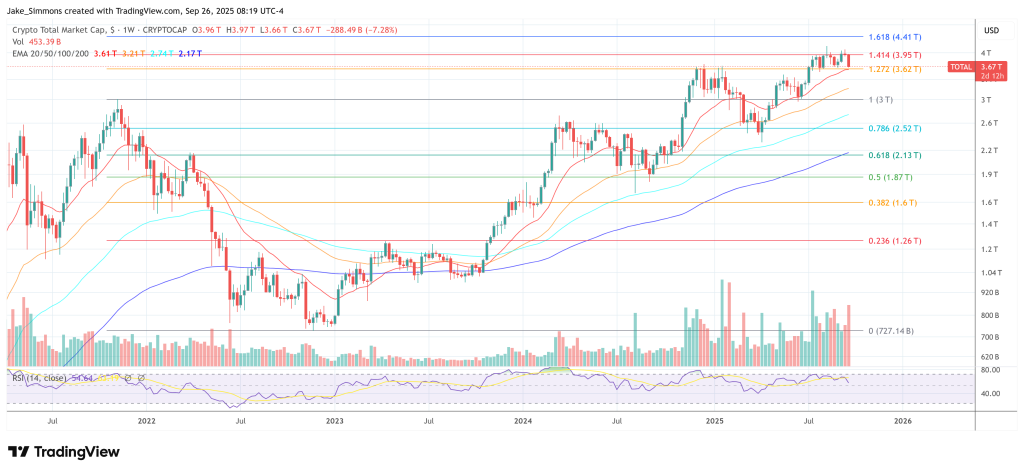
At press time, the total crypto market cap stood at $3.67 trillion.

Total crypto market cap
Market Opportunity
Palio Logo
Palio Price(PAL)
$0,002289
$0,002289$0,002289
-1,67%
USD
Palio (PAL) Live Price Chart
Disclaimer: The articles reposted on this site are sourced from public platforms and are provided for informational purposes only. They do not necessarily reflect the views of MEXC. All rights remain with the original authors. If you believe any content infringes on third-party rights, please contact [email protected] for removal. MEXC makes no guarantees regarding the accuracy, completeness, or timeliness of the content and is not responsible for any actions taken based on the information provided. The content does not constitute financial, legal, or other professional advice, nor should it be considered a recommendation or endorsement by MEXC.

You May Also Like

X money beta expands with 6% yield and cashback in beta

X money beta expands with 6% yield and cashback in beta

The post X money beta expands with 6% yield and cashback in beta appeared on BitcoinEthereumNews.com. This week, Elon Musk moved another step toward his vision
Share
BitcoinEthereumNews2026/03/05 20:55
Crucial US Stock Market Update: What Wednesday’s Mixed Close Reveals

Crucial US Stock Market Update: What Wednesday’s Mixed Close Reveals

BitcoinWorld Crucial US Stock Market Update: What Wednesday’s Mixed Close Reveals The financial world often keeps us on our toes, and Wednesday was no exception. Investors watched closely as the US stock market concluded the day with a mixed performance across its major indexes. This snapshot offers a crucial glimpse into current investor sentiment and economic undercurrents, prompting many to ask: what exactly happened? Understanding the Latest US Stock Market Movements On Wednesday, the closing bell brought a varied picture for the US stock market. While some indexes celebrated gains, others registered slight declines, creating a truly mixed bag for investors. The Dow Jones Industrial Average showed resilience, climbing by a notable 0.57%. This positive movement suggests strength in some of the larger, more established companies. Conversely, the S&P 500, a broader benchmark often seen as a barometer for the overall market, experienced a modest dip of 0.1%. The technology-heavy Nasdaq Composite also saw a slight retreat, sliding by 0.33%. This particular index often reflects investor sentiment towards growth stocks and the tech sector. These divergent outcomes highlight the complex dynamics currently at play within the American economy. It’s not simply a matter of “up” or “down” for the entire US stock market; rather, it’s a nuanced landscape where different sectors and company types are responding to unique pressures and opportunities. Why Did the US Stock Market See Mixed Results? When the US stock market delivers a mixed performance, it often points to a tug-of-war between various economic factors. Several elements could have contributed to Wednesday’s varied closings. For instance, positive corporate earnings reports from certain industries might have bolstered the Dow. At the same time, concerns over inflation, interest rate policies by the Federal Reserve, or even global economic uncertainties could have pressured growth stocks, affecting the S&P 500 and Nasdaq. Key considerations often include: Economic Data: Recent reports on employment, manufacturing, or consumer spending can sway market sentiment. Corporate Announcements: Strong or weak earnings forecasts from influential companies can significantly impact their respective sectors. Interest Rate Expectations: The prospect of higher or lower interest rates directly influences borrowing costs for businesses and consumer spending, affecting future profitability. Geopolitical Events: Global tensions or trade policies can introduce uncertainty, causing investors to become more cautious. Understanding these underlying drivers is crucial for anyone trying to make sense of daily market fluctuations in the US stock market. Navigating Volatility in the US Stock Market A mixed close, while not a dramatic downturn, serves as a reminder that market volatility is a constant companion for investors. For those involved in the US stock market, particularly individuals managing their portfolios, these days underscore the importance of a well-thought-out strategy. It’s important not to react impulsively to daily movements. Instead, consider these actionable insights: Diversification: Spreading investments across different sectors and asset classes can help mitigate risk when one area underperforms. Long-Term Perspective: Focusing on long-term financial goals rather than short-term gains can help weather daily market swings. Stay Informed: Keeping abreast of economic news and company fundamentals provides context for market behavior. Consult Experts: Financial advisors can offer personalized guidance based on individual risk tolerance and objectives. Even small movements in major indexes can signal shifts that require attention, guiding future investment decisions within the dynamic US stock market. What’s Next for the US Stock Market? Looking ahead, investors will be keenly watching for further economic indicators and corporate announcements to gauge the direction of the US stock market. Upcoming inflation data, statements from the Federal Reserve, and quarterly earnings reports will likely provide more clarity. The interplay of these factors will continue to shape investor confidence and, consequently, the performance of the Dow, S&P 500, and Nasdaq. Remaining informed and adaptive will be key to understanding the market’s trajectory. Conclusion: Wednesday’s mixed close in the US stock market highlights the intricate balance of forces influencing financial markets. While the Dow showed strength, the S&P 500 and Nasdaq experienced slight declines, reflecting a nuanced economic landscape. This reminds us that understanding the ‘why’ behind these movements is as important as the movements themselves. As always, a thoughtful, informed approach remains the best strategy for navigating the complexities of the market. Frequently Asked Questions (FAQs) Q1: What does a “mixed close” mean for the US stock market? A1: A mixed close indicates that while some major stock indexes advanced, others declined. It suggests that different sectors or types of companies within the US stock market are experiencing varying influences, rather than a uniform market movement. Q2: Which major indexes were affected on Wednesday? A2: On Wednesday, the Dow Jones Industrial Average gained 0.57%, while the S&P 500 edged down 0.1%, and the Nasdaq Composite slid 0.33%, illustrating the mixed performance across the US stock market. Q3: What factors contribute to a mixed stock market performance? A3: Mixed performances in the US stock market can be influenced by various factors, including specific corporate earnings, economic data releases, shifts in interest rate expectations, and broader geopolitical events that affect different market segments uniquely. Q4: How should investors react to mixed market signals? A4: Investors are generally advised to maintain a long-term perspective, diversify their portfolios, stay informed about economic news, and avoid impulsive decisions. Consulting a financial advisor can also provide personalized guidance for navigating the US stock market. Q5: What indicators should investors watch for future US stock market trends? A5: Key indicators to watch include upcoming inflation reports, statements from the Federal Reserve regarding monetary policy, and quarterly corporate earnings reports. These will offer insights into the future direction of the US stock market. Did you find this analysis of the US stock market helpful? Share this article with your network on social media to help others understand the nuances of current financial trends! To learn more about the latest stock market trends, explore our article on key developments shaping the US stock market‘s future performance. This post Crucial US Stock Market Update: What Wednesday’s Mixed Close Reveals first appeared on BitcoinWorld.
Share
Coinstats2025/09/18 05:30
Surge Reload or Downside Drift Ahead?

Surge Reload or Downside Drift Ahead?

The post Surge Reload or Downside Drift Ahead? appeared on BitcoinEthereumNews.com. Pump.fun is hovering at the $0.0020 mark. PUMP’s trading volume has soared by
Share
BitcoinEthereumNews2026/03/05 21:25