

CLARITY Act Faces Senate Test as Lummis Warns of Long Delay
Key Insights
- Senator Cynthia Lummis said failure to pass the CLARITY Act could delay market-structure legislation until 2030.
- Polymarket data assigned a 58.5% probability that the CLARITY Act becomes law in 2026.
- JPMorgan CEO Jamie Dimon criticized stablecoin provisions and called for bank-equivalent regulation.
The CLARITY Act moved closer to a Senate floor debate after the Senate Banking Committee approved the legislation in a 15-9 vote on May 14.
The development came as Senator Cynthia Lummis warned that Congress may not have another realistic opportunity to pass broad digital-asset market structure legislation before the end of the decade. At the same time, major banking institutions continue challenging parts of the proposal, particularly its treatment of stablecoins.
Crypto News Focuses on CLARITY Act Timeline
Lummis has positioned the current congressional session as a key opportunity for digital-asset legislation.
In a post on X, she argued that failure to pass the CLARITY Act could leave developers operating without clearer legal protections while regulators and law enforcement continue relying on older frameworks for digital-asset oversight.
The statement followed the Senate Banking Committee’s approval of the legislation and its advancement toward the Senate floor.
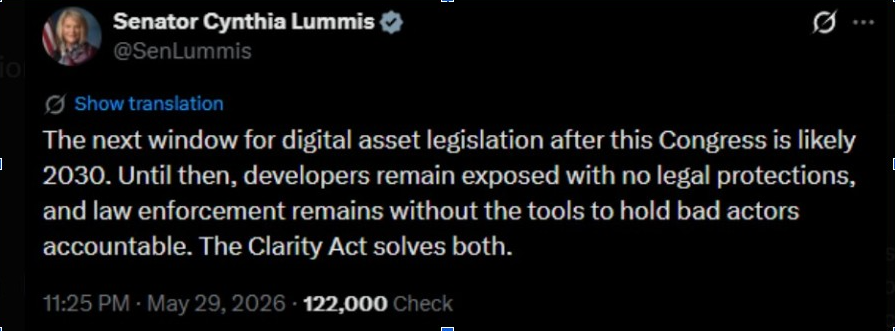 Clarity Act News | Source: X
The timing has drawn attention because the debate now overlaps with preparations for the 2026 midterm elections. Supporters of the bill argue that a change in congressional priorities could delay progress and require lawmakers to restart the legislative process.
Prediction market platform Polymarket currently assigns a 58.5% probability that the CLARITY Act becomes law during 2026, reflecting uncertainty over the remaining legislative process.
What the Bill is Trying to Do Now
The CLARITY Act is designed to create a federal framework for digital assets by setting definitions, dividing oversight responsibilities, and adding compliance rules for platforms and products that operate inside the U.S. market. The Senate version addresses stablecoin rewards, anti-money-laundering controls, token fundraising, DeFi, and tokenized securities, while also trying to draw clearer lines between the SEC and the CFTC.
That is why the bill has drawn so much attention from both the crypto industry and traditional finance. Crypto firms want a durable structure that reduces enforcement-by-ambiguity. However, banks have focused on the stablecoin section, especially where the bill would allow transaction-linked rewards while still imposing compliance rules through the Bank Secrecy Act and related standards.
Earlier reports said disagreements over stablecoin rewards and the risk of deposits moving out of banks had already slowed the bill once before, adding fresh uncertainty around whether lawmakers can hold a final compromise together.
JPMorgan CEO Attacks the Stablecoin Section
Jamie Dimon has now made that banking opposition more public. In an interview, he said banks would oppose the bill in its current form and argued that if crypto platforms take deposits or offer products that resemble bank accounts, they should face bank-style rules on liquidity, capital, anti-money-laundering, customer verification, and consumer protection.
Dimon’s warning is part of a wider argument that stablecoins could become a “huge problem” if the rules are not aligned with existing banking standards.
Other crypto news said Dimon also challenged Coinbase chief Brian Armstrong over support for the bill and argued that the current version gives crypto companies advantages that banks do not have. Meanwhile, banking groups, including small banks and trade associations, are preparing to fight the legislation if the stablecoin framework remains unchanged. That keeps the Senate phase highly contested even after the committee vote.
Despite that pushback, Paul Atkins has continued to project confidence. Reports from Fox Business and follow-on summaries said the SEC chair believes Congress will adopt the CLARITY Act and that President Trump will sign it into law. That view reflects the White House’s broader support for a national crypto framework.
The post CLARITY Act Faces Senate Test as Lummis Warns of Long Delay appeared first on The Market Periodical.


You May Also Like

The changing face of elder care in Malaysia — Sayed Mohammad Reza Yamani Sayed Umar

Not a loophole: Singapore AI export controls let China tap US AI legally

Crypto Market Drops as Fear Grows and Major Assets Decline



