Dogecoin faced heavy selling in the past 24 hours after market analyst Ali reported that large investors unloaded about 40 million DOGE. This wave of distribution created fresh pressure on the price, which has already been showing signs of weakness on shorter timeframes. DOGE is currently trading around $0.230, positioned below its 20-day simple moving […]Dogecoin faced heavy selling in the past 24 hours after market analyst Ali reported that large investors unloaded about 40 million DOGE. This wave of distribution created fresh pressure on the price, which has already been showing signs of weakness on shorter timeframes. DOGE is currently trading around $0.230, positioned below its 20-day simple moving […]

Dogecoin Whales Dump 40 Million DOGE As Price Faces Key $0.216 Support Test

2025/09/28 10:00
3 min read
For feedback or concerns regarding this content, please contact us at [email protected]
Dogecoin
  • Whales sold around 40 million DOGE in just 24 hours, adding pressure on the market.
  • Short-term charts suggest a pullback toward $0.225–$0.216 before any recovery attempt.
  • Weekly structure remains strong if support near $0.216–$0.209 holds, keeping $0.30 in play.

Dogecoin faced heavy selling in the past 24 hours after market analyst Ali reported that large investors unloaded about 40 million DOGE. This wave of distribution created fresh pressure on the price, which has already been showing signs of weakness on shorter timeframes.
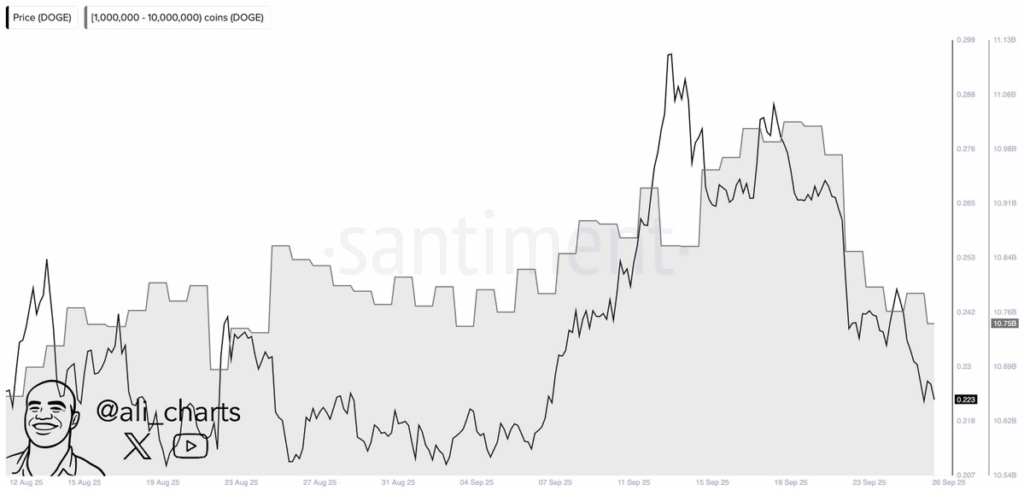
Source: X

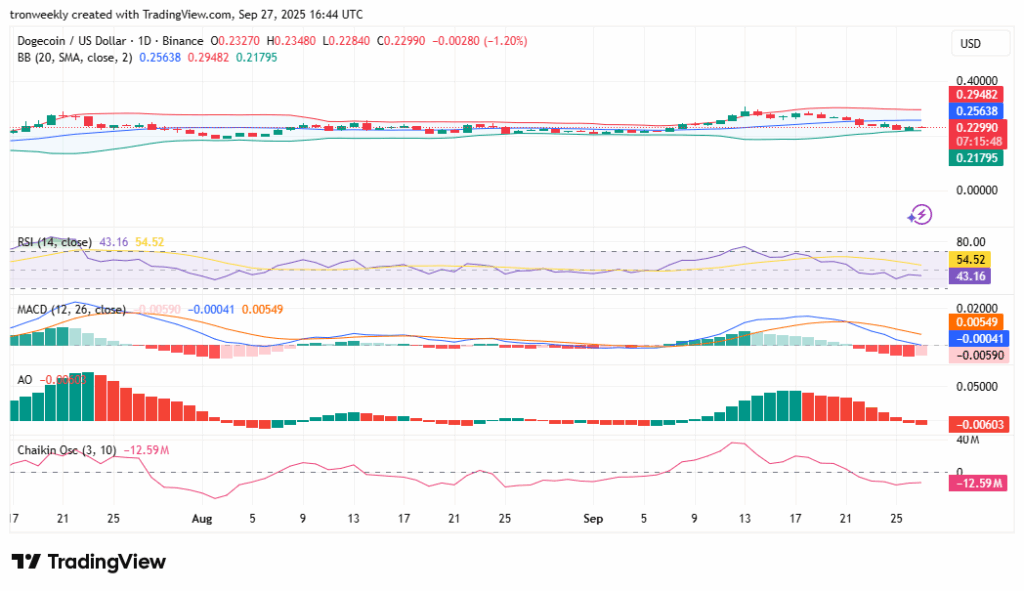
DOGE is currently trading around $0.230, positioned below its 20-day simple moving average of $0.256 but holding above its lower daily band at $0.218.

Indicators point to sellers being in control in the near term. The relative strength index (RSI) has slipped to 43 after dropping from the mid-50s, reflecting weakening momentum without reaching oversold conditions.

Meanwhile, the MACD has crossed into bearish territory, and the Awesome Oscillator has moved below zero, signaling increasing downside momentum. The Chaikin Oscillator also shows strong negative flows at -12.6 million, highlighting ongoing money outflows.
Source: Tradingview

Also Read: Dogecoin Breaks Key Level, Could Bounce Back From $0.20 Support

Dogecoin Short-Term Outlook Points to Pullback

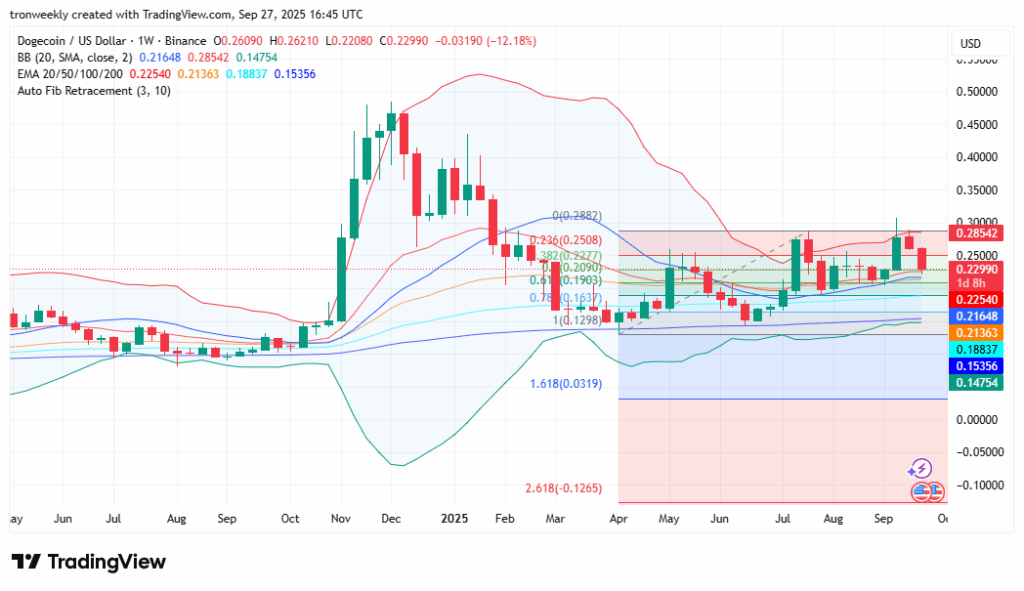
Within the next one to two weeks, probabilities are in favor of a retreat back to the $0.225–$0.218 area. This area lies right on the daily lower band and also lies on the weekly 20-EMA, hence it’s a level that needs to be defended by bulls.

If this shelf holds good, DOGE should rebound back to the $0.245–$0.256 area of resistance, which is the mid-Bollinger band and also the 20-day SMA.

But if price movement further weakens and DOGE falls through $0.218 on the daily chart or drops through $0.209 on the weekly chart, steeper corrections are likely.

If that becomes the situation, then the Fibonacci level of $0.196 and even $0.188 could come into play, which also happen to correspond to longer-term moving averages.
Source: Tradingview

Long-Term Structure Remains Positive

Despite the short-term pressure, Dogecoin’s weekly chart remains in a positive structure. Prices are all above the 20, 50, 100, and 200-week EMAs, which lie at $0.225, $0.214, $0.188, and $0.154, respectively.

This maintains the long-term bull trend as long as the weekly support in the vicinity of $0.216 to $0.209 holds good.

If buyers can maintain control above that level, the path back to health becomes viable again, with $0.27, $0.285, and eventually the psychological $0.30 level as potential targets within the next four to six weeks.

Or, a breach of the $0.209 level on a weekly close should shift focus back to the $0.196–$0.188 range, which would suggest a much larger correction.

Also Read: Dogecoin Faces $0.22 Support Test After Sharp Pullback From Recent Highs

Market Opportunity
DOGE Logo
DOGE Price(DOGE)
$0.09455
$0.09455$0.09455
-4.59%
USD
DOGE (DOGE) Live Price Chart
Disclaimer: The articles reposted on this site are sourced from public platforms and are provided for informational purposes only. They do not necessarily reflect the views of MEXC. All rights remain with the original authors. If you believe any content infringes on third-party rights, please contact [email protected] for removal. MEXC makes no guarantees regarding the accuracy, completeness, or timeliness of the content and is not responsible for any actions taken based on the information provided. The content does not constitute financial, legal, or other professional advice, nor should it be considered a recommendation or endorsement by MEXC.

You May Also Like

Cashing In On University Patents Means Giving Up On Our Innovation Future
Cashing In On University Patents Means Giving Up On Our Innovation Future

The post Cashing In On University Patents Means Giving Up On Our Innovation Future appeared on BitcoinEthereumNews.com. “It’s a raid on American innovation that would deliver pennies to the Treasury while kneecapping the very engine of our economic and medical progress,” writes Pipes. Getty Images Washington is addicted to taxing success. Now, Commerce Secretary Howard Lutnick is floating a plan to skim half the patent earnings from inventions developed at universities with federal funding. It’s being sold as a way to shore up programs like Social Security. In reality, it’s a raid on American innovation that would deliver pennies to the Treasury while kneecapping the very engine of our economic and medical progress. Yes, taxpayer dollars support early-stage research. But the real payoff comes later—in the jobs created, cures discovered, and industries launched when universities and private industry turn those discoveries into real products. By comparison, the sums at stake in patent licensing are trivial. Universities collectively earn only about $3.6 billion annually in patent income—less than the federal government spends on Social Security in a single day. Even confiscating half would barely register against a $6 trillion federal budget. And yet the damage from such a policy would be anything but trivial. The true return on taxpayer investment isn’t in licensing checks sent to Washington, but in the downstream economic activity that federally supported research unleashes. Thanks to the bipartisan Bayh-Dole Act of 1980, universities and private industry have powerful incentives to translate early-stage discoveries into real-world products. Before Bayh-Dole, the government hoarded patents from federally funded research, and fewer than 5% were ever licensed. Once universities could own and license their own inventions, innovation exploded. The result has been one of the best returns on investment in government history. Since 1996, university research has added nearly $2 trillion to U.S. industrial output, supported 6.5 million jobs, and launched more than 19,000 startups. Those companies pay…
Share
BitcoinEthereumNews2025/09/18 03:26
Trump admin may be forced to reveal military-election plot with new lawsuit

Trump admin may be forced to reveal military-election plot with new lawsuit

The Democratic National Committee on Tuesday sued the Trump administration to force it to give up its election plans, according to The New York Times. The Trump
Share
Rawstory2026/03/11 06:21
XRP ‘super fans’ keep ETFs alive despite nearly 50% price dump

XRP ‘super fans’ keep ETFs alive despite nearly 50% price dump

Ripple-linked XRP enjoys one of crypto’s most devoted followings. Illustration: Hilary B; Source: Shutterstock
Share
DL News2026/03/11 05:34