

The true narrative behind the property firm is not just about longevityThe true narrative behind the property firm is not just about longevity
[Vantage Point] Ayala Land: The urban machine
For feedback or concerns regarding this content, please contact us at [email protected]
Through almost two centuries, the Ayala name has survived revolutions, colonial transitions, financial crises, property crashes, pandemics, political upheaval, and a dictatorship.
That resilience already sets it apart from most Philippine corporate dynasties. But the true narrative behind its property firm Ayala Land Inc. is not just about longevity. It is the disciplined capacity to transform land into persistent economic power.
Ayala Land today is not just a developer that sells condominiums. It is perhaps the closest the Philippines has to a privately architected urban operating system. Its most recent financials show the size of that machine. Ayala Land recorded P190.2 billion in consolidated revenues, P39.1 billion in reported net income, and P30.6 billion in core net income in 2025.
Property development revenues amounted to P113.9 billion, with P48.7 billion in leasing and hospitality operations. Those numbers matter because they reveal the true advantage of the company: Ayala Land isn’t built purely on speculative property sales. Unlike more fragile developers who depend on the pre-selling cycles of condominiums, Ayala Land has a well-diversified annuity engine which includes malls, office towers, hotels, logistics assets, industrial estates, and recurring lease income.
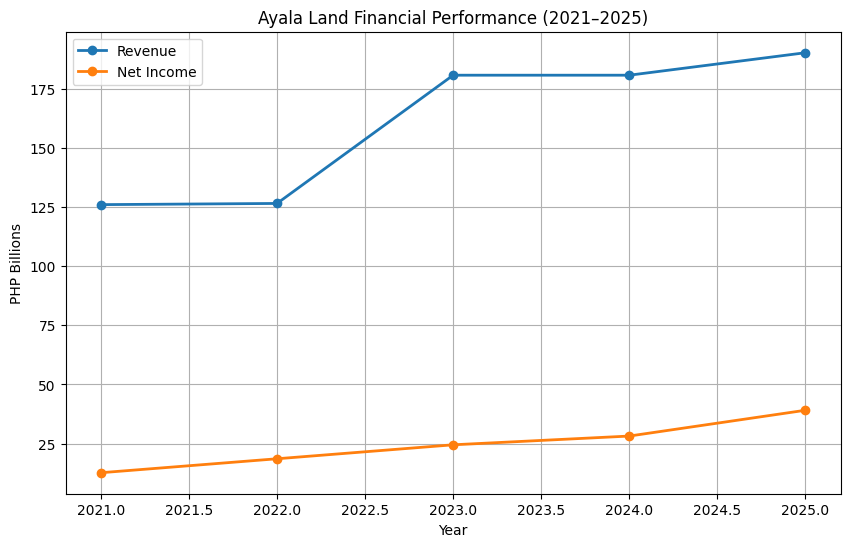
Ayala Land’s financial trajectory from 2021 to 2025 tells about more than a post-pandemic upturn. It captures the power of a recurring income, integrated urban estates, and disciplined capital allocation model. While revenues ramped up, net profits accelerated even faster, highlighting the company’s ability to monetize not just land sales, but the long-term economic ecosystems surrounding its malls, offices, hotels, and master-planned districts.
Controlling the ecosystem
That distinction is enormous. Property sales are cyclical. Recurring leasing income is defensive. Leasing stabilizes the balance sheet when interest rates rise and consumers slow down.
That is why Ayala Land has historically demonstrated resilience during the Asian Financial Crisis, the Global Financial Crisis, and the pandemic-era property collapse that crippled many developers globally. Its strategy was never simply “build and sell.” It was “control the ecosystem.” The philosophy traces directly to the stewardship of the Zóbel de Ayala family, whose corporate lineage dates back to 1834, making Ayala Corporation one of the oldest conglomerates in Asia.
The decisive transformation came under family patriarch Jaime Zobel de Ayala, who institutionalized the company during periods of political instability and guided its evolution into a modern publicly listed conglomerate. Under his sons Jaime Augusto Zobel de Ayala and Fernando Zobel de Ayala, Ayala Land expanded aggressively into master-planned urban estates that reshaped how large portions of the Filipino middle and upper-middle class would live and work.
Based on data submitted to the Securities and Exchange Commission (SEC), Ayala Land stands as the country’s highest-ranked pure integrated estate developer in the Top 1000 Corporations list, placing No. 35 overall. But the ranking only partially captures Ayala Land’s true influence. Unlike traditional property developers which merely erect structures, Ayala Land master-planned mixed-use environments that are fully integrated and self-sustaining.
Many real-estate firms build projects. Ayala Land builds districts that are not isolated developments: Makati Central Business District, Bonifacio Global City, Nuvali, Vertis North, Arca South, and Cebu Park District. These and other Ayala integrated estates and other integrated estates are interlocking economic ecosystems where land is monetized repeatedly through residential towers, office spaces, shopping centers, hotels, parking systems, transport access, and rising surrounding land values.
Navigating urban behavior
Ayala Land understood earlier than most Philippine developers that the highest returns in property do not come from one-time construction profits, but from controlling long-term urban behavior. That model produced enormous positive consequences for the Philippine economy.
Ayala Land’s estates have attracted multinationals, BPO (Business Process Outsourcing) agencies, retailers, tourism operators, banks, restaurants, and service providers. Its office towers institutionalized the country’s outsourcing boom. Its mixed-use districts spurred urban migration flows. Whole local government tax bases are now reliant on Ayala-created commercial ecosystems. Ayala Land has in many ways become a parallel infrastructure developer functioning alongside the state.
The financial infrastructure supporting that growth is equally important. Ayala Land’s leverage has traditionally maintained a more disciplined approach than that of many speculative property players. Its net gearing ratio remained below 1x, which is conservative by regional property standards. That balance-sheet discipline is important because real estate is among the most capital-intensive businesses in the economy. The huge capital commitments required for land acquisition, infrastructure buildout, utilities integration, and long project gestation periods take years before profits can be earned.
Ayala Land is in a unique balanced position against the competition. SM Prime arguably has the country’s strongest mall economics and retail cash-flow machine. Megaworld dominates the bulk of township office leasing shares connected to the BPO space. But Ayala Land is successful on the strength of its institutional credibility, premium urban planning, and diversified recurring income, and by packaging residential, leasing, hospitality, and estate development within one long-cycle strategy. In and of itself, that credibility is of economic currency.
Red flag
At its core, real estate is a confidence business. Homebuyers are investing in mortgages that extend for decades. Office tenants pledge long-term leases. Overseas investors demand predictable governance. The Ayala Land brand lowers the perceived risk premium on those transactions. In a sense, the company’s reputation became one of its most valuable invisible assets.
The company’s success also mirrors something that is getting rarer and rarer in Philippine capitalism: succession discipline. The Zóbel de Ayala family slowly institutionalized governance systems, professional management, and long-term planning, rather than building empires driven solely by personality. That continuity enabled Ayala Land to think in decades, not just in quarterly cycles.
And yet, even a good institution has structural risks. A red flag worth noting is the company’s reliance on property development revenues despite the strength of its leasing portfolio. Residential development remains the most important revenue stream, giving Ayala Land a lot of exposure to interest rate shocks, the affordability of mortgages, OFW (Overseas Filipino Workers) remittance trends, and purchasing power of the middle class.
Another risk is demand for office space. Ayala Land was among the biggest beneficiaries of the outsourcing boom, but hybrid work arrangements and workplace inefficiencies driven by artificial intelligence (AI) may eventually alter long-term office demand globally.
Still, our conclusion remains remarkably clear. Ayala Land wasn’t successful just for owning prime land. Many companies own real estate, but Ayala Land became successful because it understood earlier than most that the real business was never the land itself.
The real business was controlling how Filipinos would eventually live, work, shop, move, and consume within that land. That is a far more powerful — and far more enduring — economic moat.
I welcome your views on these and other issues where decisions made in power shape the country’s economic future. – Rappler.com
Click here for more Vantage Point articles.
Market Opportunity
Notcoin Price(NOT)
$0.0004621
$0.0004621$0.0004621
USD
Notcoin (NOT) Live Price Chart


Disclaimer: The articles reposted on this site are sourced from public platforms and are provided for informational purposes only. They do not necessarily reflect the views of MEXC. All rights remain with the original authors. If you believe any content infringes on third-party rights, please contact [email protected] for removal. MEXC makes no guarantees regarding the accuracy, completeness, or timeliness of the content and is not responsible for any actions taken based on the information provided. The content does not constitute financial, legal, or other professional advice, nor should it be considered a recommendation or endorsement by MEXC.
You May Also Like

'I beg your pardon!' Onlookers horrified as GOP congressman shuts down Epstein questions
Political analysts and observers were horrified on Tuesday after a Republican congressman shut down questions from a Democratic colleague about Acting Attorney
Share
Rawstory2026/06/03 07:53

LIQUIFY DAO Joins Forces With Orix To Scale Customer Engagement, DeFi Cross-Chain With AI Agents
The collaboration highlights the power of AI agents, with Orix's intelligence providing LIQUIFY DAO with opportunities in automation and user experience.
Share
Blockchainreporter2026/06/03 07:00
Crypto Market Shaken: $115 Million in Futures Liquidated in One Hour
BitcoinWorld Crypto Market Shaken: $115 Million in Futures Liquidated in One Hour The cryptocurrency market experienced a sudden and violent shakeout over the
Share
bitcoinworld2026/06/03 06:35


Trending News
More24/7 Live News
MoreQuick Reads
More
