Oil Prices Drop as Trump Says US-Iran Nuclear Talks Are Continuing
TLDR
- Oil prices fell Tuesday after Trump said US-Iran peace talks were still on track.
- Brent crude dropped about 2% to $93.06; West Texas Intermediate fell to around $90.32.
- Prices had surged Monday after Iranian reports said talks were suspended over Israel’s actions in Lebanon.
- The Strait of Hormuz remains largely closed, keeping oil prices elevated — it normally carries 20% of global daily oil traffic.
- Analysts warn prices won’t fall back to pre-conflict levels quickly even after a deal is reached.
Oil markets remained on edge Tuesday as conflicting signals from Washington and Tehran kept traders guessing about the future of a US-Iran peace deal.
Brent crude, the international oil benchmark, dropped around 2% to $93.06 a barrel on Tuesday morning. West Texas Intermediate fell roughly 1.9% to $90.32 a barrel.
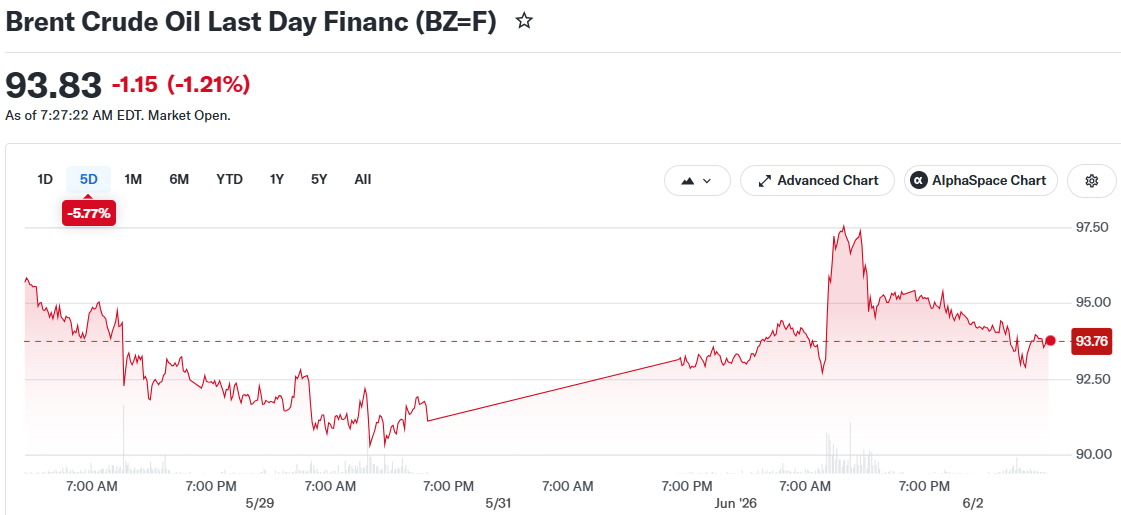 Brent Crude Oil Last Day Financ (BZ=F)
The moves came after a sharp rally on Monday. Prices climbed 4.2% after Iran’s semi-official Tasnim news agency reported that Tehran had suspended peace talks with the United States over Israel’s military actions in Lebanon.
Trump later pushed back on that account. He posted on Truth Social that Hezbollah had agreed to stop firing on Israel, and Israel had agreed to do the same. He said negotiations with Iran were still moving forward.
In a call with ABC News, Trump said a memorandum of understanding with Iran to reopen the Strait of Hormuz could come within a week. He added that Washington still had “a few more points” to settle before a deal could be signed.
Why the Strait of Hormuz Matters
The Strait of Hormuz is the narrow waterway between Iran and Oman at the entrance to the Persian Gulf. In normal times, it carries about one-fifth of the world’s daily oil and liquefied natural gas flows.
Since tensions escalated, commercial shipping through the strait has been heavily restricted. That constraint has kept global oil prices well above where they traded before the conflict.
Iran’s Tasnim agency also reported that Tehran and its regional partners had discussed the possibility of closing both the Strait of Hormuz and the Bab el-Mandeb Strait, a key chokepoint at the southern end of the Red Sea. That would affect another major route for oil exports.
HSBC analysts described the current commodity situation as a “super-squeeze,” warning it could worsen if Hormuz stays effectively shut.
UBS commodity analyst Giovanni Staunovo said Tuesday that Trump’s social media posts signaling de-escalation were weighing on crude prices. He added, however, that oil flows through Hormuz “remain restricted.”
What Happens When a Deal Is Reached?
Analysts expect prices to fall if a deal is finalized, but not all the way back to where they were before the conflict began.
Dave Sekera, chief US market strategist at Morningstar, said prices would drop “pretty substantially” after a resolution. However, he cautioned that the inflationary effects of sustained high oil prices could linger “for at least months if not several quarters.”
The ceasefire situation involving Israel and Hezbollah added another layer of uncertainty. Trump and Israeli Prime Minister Benjamin Netanyahu gave differing accounts of a call about Lebanon. Lebanon’s presidency said more negotiations were scheduled for Tuesday and Wednesday, with a goal of extending any ceasefire across all Lebanese territory.
As of Tuesday morning, oil prices remained well above pre-conflict levels, with the Strait of Hormuz still largely closed to normal commercial traffic.
The post Oil Prices Drop as Trump Says US-Iran Nuclear Talks Are Continuing appeared first on CoinCentral.


You May Also Like

Cathie Wood’s ARK Invest Buys $13.7M in Circle Shares While Selling Robinhood Stock

Metaplanet buys 5,075 Bitcoin in Q1 to become 3rd-largest treasury

The changing face of elder care in Malaysia — Sayed Mohammad Reza Yamani Sayed Umar