

Why Are Bitcoin Miners Setting Up Next to Nuclear and Hydro Plants?
BitcoinWorld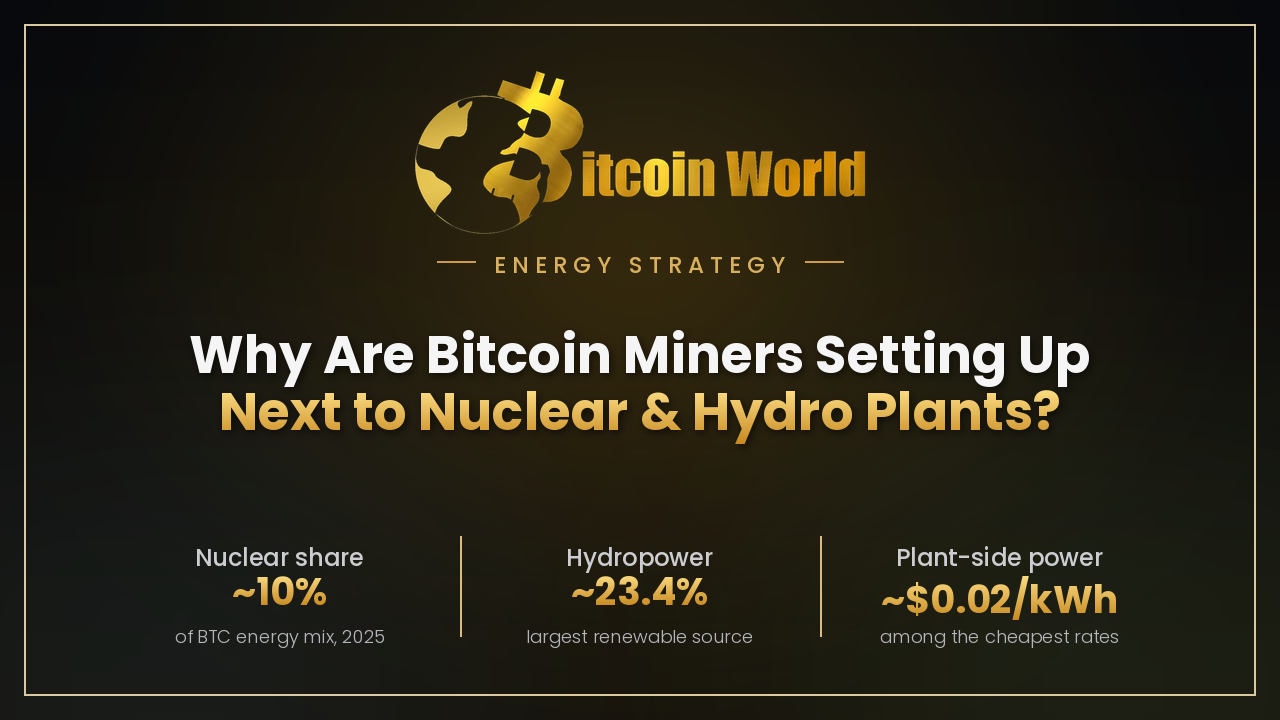
Why Are Bitcoin Miners Setting Up Next to Nuclear and Hydro Plants?
Bitcoin miners setting up next to nuclear and hydro plants is one of the clearest signals of how the mining industry has matured from a chaotic, fossil-heavy business into an energy-strategy game. The logic is simple: these plants offer cheap, reliable, low-carbon power that turns electricity, a miner’s single largest cost, into a durable competitive advantage. This article breaks down the economics behind these co-location deals, why nuclear and hydro specifically attract miners, the real-world partnerships already operating, and how miners double as flexible grid partners.
Why Do Bitcoin Miners Want to Be Located Next to Nuclear and Hydro Power Plants?
The core reason Bitcoin miners set up next to nuclear and hydro plants is cost. Electricity typically represents 60–80% of a mining operation’s operating expenses, so even a fraction of a cent per kilowatt-hour decides whether a miner is profitable or bleeding cash. Locating directly beside a power source eliminates transmission fees and grid markups, unlocking some of the lowest electricity rates in the industry.
Key drivers behind the co-location trend:
- Rock-bottom power costs: At Pennsylvania’s Nautilus Cryptomine, miners reportedly drew nuclear electricity at around $0.02 per kWh, one of the cheapest rates in the public mining sector.
- Baseload reliability: Nuclear and hydro deliver stable, 24/7 power, which suits mining hardware that earns most when it runs continuously.
- Low-carbon profile: Both sources are carbon-free or low-carbon, helping miners answer the ESG criticism that has dogged the industry.
- Squeezed margins: With network hashrate surging (exceeding 831 EH/s in May 2025) and rewards thinning after the halving, only the cheapest-power operators survive.
Why Are Nuclear Plants Specifically Attractive to Bitcoin Miners?
Nuclear plants face a structural problem that Bitcoin mining happens to solve: they run at full output around the clock but cannot always sell all that electricity, especially overnight when demand drops. A miner sitting next door becomes a guaranteed “buyer of last resort” for power that would otherwise be sold cheaply or wasted.
- Surplus monetization: Plants that can’t sell 100% of their output can route the excess to mining, improving plant economics.
- A clean-energy use case: Analysts at ScottMadden have framed nuclear-plus-mining as a partnership that diversifies utility income while putting carbon-free power to productive use.
- Rising nuclear share: Nuclear’s slice of Bitcoin’s energy mix climbed from about 4% in 2021 to roughly 10% in 2025, according to Cambridge Centre for Alternative Finance data.
- Real partnerships: TeraWulf formed a 2021 joint venture with Talen Energy beside the 2.5 GW Susquehanna plant; Standard Power partnered with Energy Harbor in Ohio; and Oklo has explored small modular reactor (SMR) deals with mining firms.
Why Do Bitcoin Miners Cluster Around Hydroelectric Dams?
Hydropower is the single largest renewable source in Bitcoin mining, accounting for around 23.4% of the surveyed energy mix in the Cambridge data. Its appeal is seasonal abundance: dams frequently generate more electricity than the local grid can absorb, particularly during high-flow rainy seasons, and miners convert that surplus into revenue instead of letting water spill past idle turbines.
- Soaking up surplus: In Paraguay, miners have worked with the national power authority to absorb excess hydropower from the massive Itaipu Dam.
- Cheap, cool, and renewable: Iceland, Norway, and Quebec pair abundant hydro (and geothermal) with cold climates that cut cooling costs, making them long-standing mining hubs.
- Curtailment avoidance: Around New York’s Niagara River, miners ramp up during high-flow seasons and scale back when household demand rises, helping balance the system.
How Does Locating Near Power Plants Help the Grid, Not Just the Miners?
A frequently overlooked point in the Bitcoin miners and nuclear/hydro plants story is that mining is an interruptible, location-flexible load unlike almost any other heavy industry. Miners can power down within seconds to minutes, which makes them useful partners for grid operators managing volatile supply from renewables.
- Rapid curtailment: During Winter Storm Elliott in December 2022, Texas miners curtailed over 1.5 GW within minutes, freeing enough power for roughly 300,000 homes.
- Paid to pause: In some ERCOT grid events, miners earned more by curtailing and selling power back than by continuing to hash.
- Renewable smoothing: Miners can soak up midday solar or overnight wind surpluses and step aside at peak demand, reducing curtailment without costly new storage.
- Plant viability: By providing steady baseline revenue, mining can improve the financial case for keeping struggling nuclear plants and renewable projects running.
Frequently Asked Questions
Why are Bitcoin miners setting up next to nuclear power plants in 2025 and 2026?
Bitcoin miners set up next to nuclear plants mainly to secure cheap, reliable, low-carbon baseload power, often at rates near $0.02 per kWh that are hard to beat anywhere else. Nuclear’s share of Bitcoin’s energy mix rose from about 4% in 2021 to roughly 10% in 2025, driven by deals like TeraWulf’s venture beside the Susquehanna plant. With mining margins squeezed by rising hashrate and post-halving rewards, locking in the lowest possible power cost is now a survival strategy.
Is Bitcoin mining with hydropower actually good for the grid?
In many cases, yes. Bitcoin miners act as flexible, interruptible buyers that absorb surplus hydropower during high-flow seasons and power down quickly when households need electricity, as seen in Paraguay’s Itaipu Dam partnership and Quebec’s hydro surpluses. This load flexibility helps avoid curtailment and improves the economics of hydroelectric plants, though it doesn’t make mining universally “green.”
Are AI data centers competing with Bitcoin miners for nuclear and hydro power?
Yes, and increasingly so. The same baseload nuclear and hydro power that drew Bitcoin miners is now in high demand from AI hyperscalers, who often generate more revenue per megawatt and can outbid crypto firms for grid access and long-term contracts. Several former Bitcoin mining sites near power plants are already being converted into AI data centers, while some miners pivot to hosting AI workloads to stay competitive.
Conclusion: Why the Race for Plant-Side Power Matters Now
The trend of Bitcoin miners setting up next to nuclear and hydro plants is not a quirk of the crypto world; it is a preview of how every energy-intensive industry will fight for clean, reliable, low-cost electricity. Miners proved that co-locating with baseload generation slashes costs, answers environmental criticism, and even strengthens grids through flexible demand, lessons AI operators are now racing to copy. With hyperscalers competing for the same nuclear and hydro contracts and former mining sites already converting to AI use, the window to lock in premium plant-side power is narrowing fast. For miners, utilities, and investors alike, the strategic message is clear: in the new energy economy, whoever controls cheap baseload power controls the future, and the time to secure it is now.
This post Why Are Bitcoin Miners Setting Up Next to Nuclear and Hydro Plants? first appeared on BitcoinWorld.


You May Also Like

One Of Frank Sinatra’s Most Famous Albums Is Back In The Spotlight

Not a loophole: Singapore AI export controls let China tap US AI legally

Egyptian foreign minister to meet Putin over Iran conflict



