Source: Coinbase Compiled by: Golden Finance Coinbase believes that this week's macroeconomic data has weakened market expectations for a sharp interest rate cut, the US dollar has strengthened, and the financial environment has tightened. The Bureau of Economic Analysis (BEA)'s third advance estimate raised the annualized growth rate of US GDP in the second quarter to 3.8%, indicating stronger underlying demand than previous data had suggested. Meanwhile, durable goods orders rebounded 2.9% in August (excluding a 0.4% increase in the transportation sector), while core capital goods orders (a key measure of business investment) rose 0.6%. Initial jobless claims fell to 218,000 that week, suggesting a weakening labor market, but not as much as previous data had suggested. Taken together, we believe these data suggest stronger-than-expected economic growth and labor conditions, weakening the case for rapid monetary easing amid persistently high inflation. Markets appear to be pricing in this shift: interest rates edged higher, the US dollar index neared a three-week high, US dollar liquidity tightened slightly, and cryptocurrency prices retreated. From a more global perspective, Coinbase's customized M2 Liquidity Index suggests that liquidity headwinds will emerge starting in November. Our customized Global M2 Liquidity Index (which optimizes money supply growth and leads Bitcoin by 110 days) has begun to inflect downward in November. Given that the index has a correlation of approximately 0.9 with BTC over a one-month to three-year timeframe, we believe the inflection point is likely to foreshadow liquidity headwinds heading into year-end (Figure 1). However, the index also suggests healthy liquidity conditions in October, which could support risk assets in the short term. Figure 1. The M2 liquidity index is expected to begin declining in early November. Beyond macro factors, we believe this week's cryptocurrency liquidations were driven by positioning pressure, which has been building for several weeks and is flashing warning signs. As discussed in a previous article, altcoin open interest dominance is well above the 1.4 threshold, which typically signals large-scale liquidations. Last weekend, the ratio reached 1.7, following which we saw approximately $1.8 billion in forced liquidations of long positions as long positions were liquidated across the market (Figure 2). Even after the unwinding, the ratio remained elevated at 1.6, which we believe highlights the continued need for cautious positioning ahead of upcoming data releases that could impact interest rates and the USD. Figure 2. Altcoin Open Interest Dominance Ratio Source: Coinbase Compiled by: Golden Finance Coinbase believes that this week's macroeconomic data has weakened market expectations for a sharp interest rate cut, the US dollar has strengthened, and the financial environment has tightened. The Bureau of Economic Analysis (BEA)'s third advance estimate raised the annualized growth rate of US GDP in the second quarter to 3.8%, indicating stronger underlying demand than previous data had suggested. Meanwhile, durable goods orders rebounded 2.9% in August (excluding a 0.4% increase in the transportation sector), while core capital goods orders (a key measure of business investment) rose 0.6%. Initial jobless claims fell to 218,000 that week, suggesting a weakening labor market, but not as much as previous data had suggested. Taken together, we believe these data suggest stronger-than-expected economic growth and labor conditions, weakening the case for rapid monetary easing amid persistently high inflation. Markets appear to be pricing in this shift: interest rates edged higher, the US dollar index neared a three-week high, US dollar liquidity tightened slightly, and cryptocurrency prices retreated. From a more global perspective, Coinbase's customized M2 Liquidity Index suggests that liquidity headwinds will emerge starting in November. Our customized Global M2 Liquidity Index (which optimizes money supply growth and leads Bitcoin by 110 days) has begun to inflect downward in November. Given that the index has a correlation of approximately 0.9 with BTC over a one-month to three-year timeframe, we believe the inflection point is likely to foreshadow liquidity headwinds heading into year-end (Figure 1). However, the index also suggests healthy liquidity conditions in October, which could support risk assets in the short term. Figure 1. The M2 liquidity index is expected to begin declining in early November. Beyond macro factors, we believe this week's cryptocurrency liquidations were driven by positioning pressure, which has been building for several weeks and is flashing warning signs. As discussed in a previous article, altcoin open interest dominance is well above the 1.4 threshold, which typically signals large-scale liquidations. Last weekend, the ratio reached 1.7, following which we saw approximately $1.8 billion in forced liquidations of long positions as long positions were liquidated across the market (Figure 2). Even after the unwinding, the ratio remained elevated at 1.6, which we believe highlights the continued need for cautious positioning ahead of upcoming data releases that could impact interest rates and the USD. Figure 2. Altcoin Open Interest Dominance Ratio
Coinbase: Why is the "September Curse" happening again?

2025/09/29 16:00
2 min read
For feedback or concerns regarding this content, please contact us at [email protected]

Source: Coinbase

Compiled by: Golden Finance

Coinbase believes that this week's macroeconomic data has weakened market expectations for a sharp interest rate cut, the US dollar has strengthened, and the financial environment has tightened.

The Bureau of Economic Analysis (BEA)'s third advance estimate raised the annualized growth rate of US GDP in the second quarter to 3.8%, indicating stronger underlying demand than previous data had suggested. Meanwhile, durable goods orders rebounded 2.9% in August (excluding a 0.4% increase in the transportation sector), while core capital goods orders (a key measure of business investment) rose 0.6%. Initial jobless claims fell to 218,000 that week, suggesting a weakening labor market, but not as much as previous data had suggested.

Taken together, we believe these data suggest stronger-than-expected economic growth and labor conditions, weakening the case for rapid monetary easing amid persistently high inflation. Markets appear to be pricing in this shift: interest rates edged higher, the US dollar index neared a three-week high, US dollar liquidity tightened slightly, and cryptocurrency prices retreated.

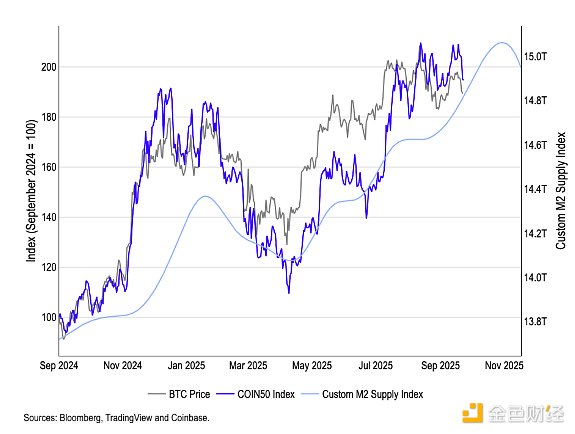
From a more global perspective, Coinbase's customized M2 Liquidity Index suggests that liquidity headwinds will emerge starting in November. Our customized Global M2 Liquidity Index (which optimizes money supply growth and leads Bitcoin by 110 days) has begun to inflect downward in November. Given that the index has a correlation of approximately 0.9 with BTC over a one-month to three-year timeframe, we believe the inflection point is likely to foreshadow liquidity headwinds heading into year-end (Figure 1). However, the index also suggests healthy liquidity conditions in October, which could support risk assets in the short term.

Figure 1. The M2 liquidity index is expected to begin declining in early November.

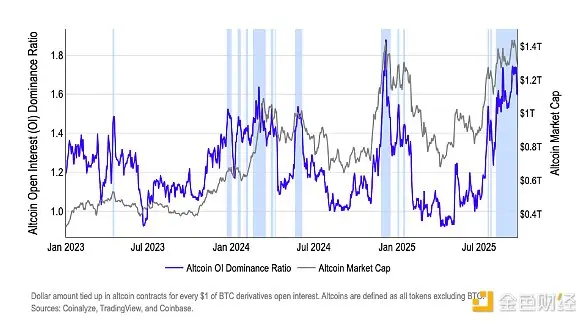
Beyond macro factors, we believe this week's cryptocurrency liquidations were driven by positioning pressure, which has been building for several weeks and is flashing warning signs. As discussed in a previous article, altcoin open interest dominance is well above the 1.4 threshold, which typically signals large-scale liquidations. Last weekend, the ratio reached 1.7, following which we saw approximately $1.8 billion in forced liquidations of long positions as long positions were liquidated across the market (Figure 2).

Even after the unwinding, the ratio remained elevated at 1.6, which we believe highlights the continued need for cautious positioning ahead of upcoming data releases that could impact interest rates and the USD.

Figure 2. Altcoin Open Interest Dominance Ratio

Market Opportunity
Core DAO Logo
Core DAO Price(CORE)
$0.08109
$0.08109$0.08109
-0.27%
USD
Core DAO (CORE) Live Price Chart
Disclaimer: The articles reposted on this site are sourced from public platforms and are provided for informational purposes only. They do not necessarily reflect the views of MEXC. All rights remain with the original authors. If you believe any content infringes on third-party rights, please contact [email protected] for removal. MEXC makes no guarantees regarding the accuracy, completeness, or timeliness of the content and is not responsible for any actions taken based on the information provided. The content does not constitute financial, legal, or other professional advice, nor should it be considered a recommendation or endorsement by MEXC.

You May Also Like

Aave DAO to Shut Down 50% of L2s While Doubling Down on GHO

Aave DAO to Shut Down 50% of L2s While Doubling Down on GHO

The post Aave DAO to Shut Down 50% of L2s While Doubling Down on GHO appeared on BitcoinEthereumNews.com. Aave DAO is gearing up for a significant overhaul by shutting down over 50% of underperforming L2 instances. It is also restructuring its governance framework and deploying over $100 million to boost GHO. This could be a pivotal moment that propels Aave back to the forefront of on-chain lending or sparks unprecedented controversy within the DeFi community. Sponsored Sponsored ACI Proposes Shutting Down 50% of L2s The “State of the Union” report by the Aave Chan Initiative (ACI) paints a candid picture. After a turbulent period in the DeFi market and internal challenges, Aave (AAVE) now leads in key metrics: TVL, revenue, market share, and borrowing volume. Aave’s annual revenue of $130 million surpasses the combined cash reserves of its competitors. Tokenomics improvements and the AAVE token buyback program have also contributed to the ecosystem’s growth. Aave global metrics. Source: Aave However, the ACI’s report also highlights several pain points. First, regarding the Layer-2 (L2) strategy. While Aave’s L2 strategy was once a key driver of success, it is no longer fit for purpose. Over half of Aave’s instances on L2s and alt-L1s are not economically viable. Based on year-to-date data, over 86.6% of Aave’s revenue comes from the mainnet, indicating that everything else is a side quest. On this basis, ACI proposes closing underperforming networks. The DAO should invest in key networks with significant differentiators. Second, ACI is pushing for a complete overhaul of the “friendly fork” framework, as most have been unimpressive regarding TVL and revenue. In some cases, attackers have exploited them to Aave’s detriment, as seen with Spark. Sponsored Sponsored “The friendly fork model had a good intention but bad execution where the DAO was too friendly towards these forks, allowing the DAO only little upside,” the report states. Third, the instance model, once a smart…
Share
BitcoinEthereumNews2025/09/18 02:28
Trump erupts at Fox News reporter during  roundtable: 'What a stupid question'

Trump erupts at Fox News reporter during  roundtable: 'What a stupid question'

An agitated President Donald Trump lashed out at two reporters during his White House “Saving College Sports” roundtable, complaining that the journalists failed
Share
Rawstory2026/03/07 07:19
Lyn Alden Tips Bitcoin Outperforming Gold Through to 2029

Lyn Alden Tips Bitcoin Outperforming Gold Through to 2029

The post Lyn Alden Tips Bitcoin Outperforming Gold Through to 2029 appeared on BitcoinEthereumNews.com. Bitcoin is likely to outperform gold on price performance
Share
BitcoinEthereumNews2026/03/07 07:22
