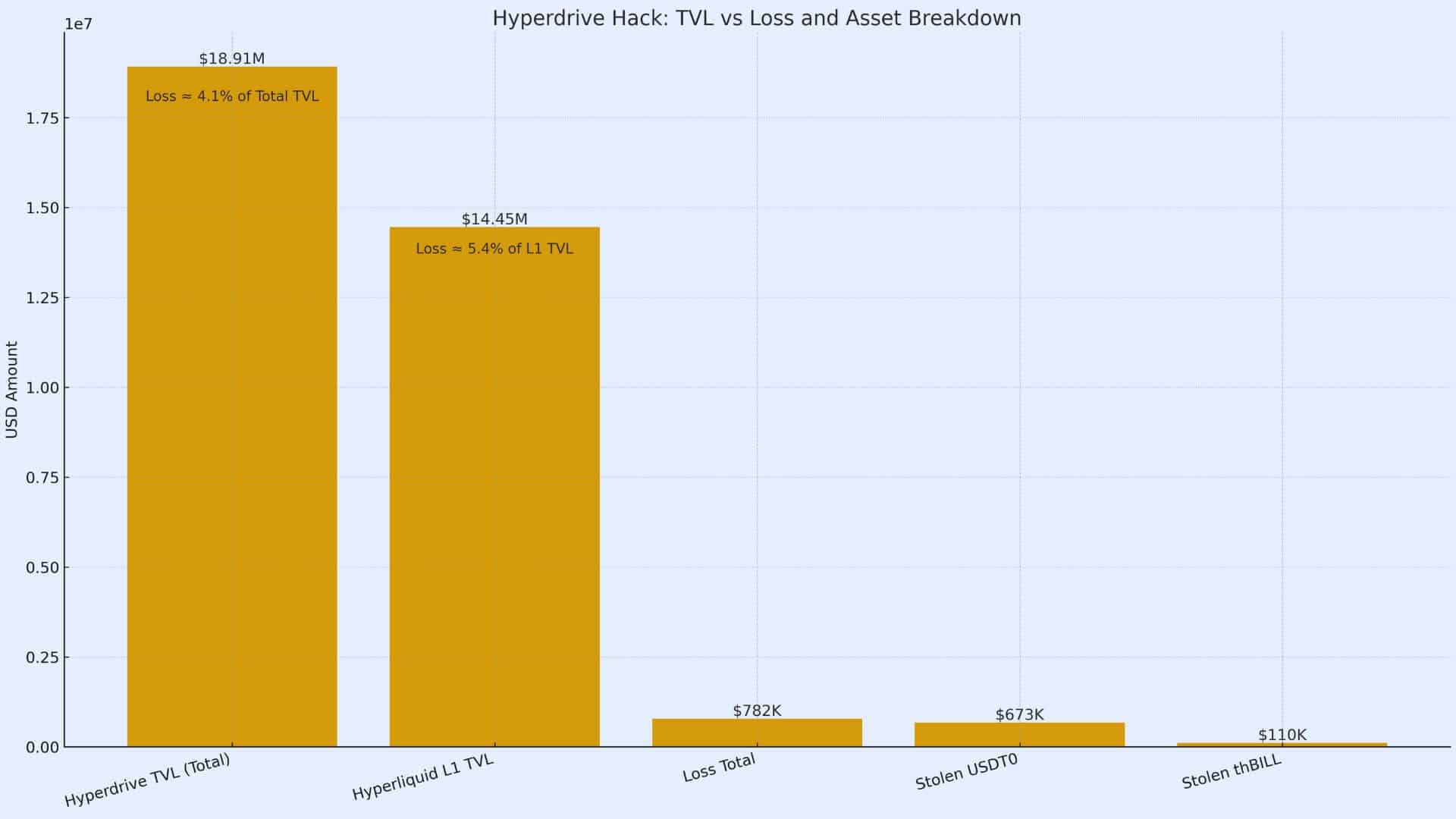
According to incident updates and on-chain traces, the Hyperdrive hack targeted two lending markets on Hyperliquid, resulting in approximately $782,000 in losses. The attacker used an arbitrary call in the router to drain 672,934 USDT0 and 110,244 thBILL, then bridged funds to BNB Chain and Ethereum. Markets paused while the team investigated and outlined compensation steps. Exploit Overview and Impact The Hyperdrive hack focused on two venues: the Primary USDT0 Market and the Treasury USDT Market. Investigators described an arbitrary call path in the router that enabled repeated withdrawals. Funds moved out through deBridge and split across chains before consolidation. Public posts indicate that money markets remain paused, a fix has been shipped, and a compensation plan is in progress, as noted in a breaking report. Read More: Hyperliquid Price Hits $58.78 ATH as Open Interest Tops $10B Why This Matters for Users Router-level permissions can expose pooled assets if checks fail. Traces reveal how quickly value can shift once a route opens, with on-chain paths captured within the same incident coverage. This incident also lands after earlier security pain points in the same ecosystem, which keeps scrutiny high and raises the bar for audits and live risk controls. Hyperdrive Hack at a Glance: TVL vs Loss and Asset Breakdown Price and TVL Context Hyperdrive HL shows TVL about $18.91 million, with around $14.45 million on Hyperliquid L1, which frames the loss in scale terms. Check the live dashboard for current figures and chain splits. As of September 29, 2025, HYPE trades near $47.4, based on a live ticker snapshot in recent coverage, while intraday moves remain volatile. Prices and TVL can fluctuate during active investigations, so confirm trusted dashboards and feeds before taking action. Action Steps for Users Check positions and approvals on a block explorer. Revoke stale approvals associated with the affected pools. Watch official channels for return notices and claim instructions. Keep a simple record of balances and timestamps to support any claim. Avoid links that do not originate from official posts to reduce phishing risk. Key facts and flows remain consistent with this independent recap. Conclusion and Next Moves Based on the latest research, Hyperdrive hack analysis points to a router flaw, quick cross-chain movement, and a fast pause that limited further damage. The path forward depends on the full post-mortem, contract changes, and the final compensation process. Users should avoid paused pools, review approvals, and follow official updates for reopen steps and claim windows, while tracking TVL and market state on DeFiLlama. Also read: Crypto Price Prediction Today: XRP Gains Momentum, Hyperliquid and Pump Tokens Eye Breakouts Summary The Hyperdrive hack drained about $782,000 from two Hyperdrive markets on Hyperliquid via an arbitrary router call, then bridged funds to BNB Chain and Ethereum. Markets paused, a fix shipped, and compensation is planned. The Hyperliquid hack discussion continues with on-chain updates and TVL context. Users should verify approvals, keep records for claims, and follow official recovery notes until operations resume. Glossary of key terms Arbitrary call: a bug that lets a contract execute unintended functions. Router: a contract that forwards calls and swaps between pools. thBILL: tokenized Treasury bill exposure used as collateral. Bridge: infrastructure that moves assets between chains. TVL: total value locked in a protocol. FAQs about Hyperdrive Hack Is the Hyperdrive hack over? Markets remain paused while a fix is live and a compensation plan is prepared. Did the Hyperliquid hack touch exchange reserves? No. Current reports limit impact to two Hyperdrive lending markets, with exchange reserves and core trading operations unaffected. Where did funds go after the Hyperdrive hack? Stolen assets were bridged via deBridge to BNB Chain and Ethereum, then consolidated into receiving addresses on those networks. What should the BILL users do after the Hyperliquid hack? Check positions and revoke stale approvals on affected pools, then wait for official reopen and compensation instructions. Read More: What Hyperliquid Traders Need to Do After the Hyperdrive Exploit">What Hyperliquid Traders Need to Do After the Hyperdrive ExploitAccording to incident updates and on-chain traces, the Hyperdrive hack targeted two lending markets on Hyperliquid, resulting in approximately $782,000 in losses. The attacker used an arbitrary call in the router to drain 672,934 USDT0 and 110,244 thBILL, then bridged funds to BNB Chain and Ethereum. Markets paused while the team investigated and outlined compensation steps. Exploit Overview and Impact The Hyperdrive hack focused on two venues: the Primary USDT0 Market and the Treasury USDT Market. Investigators described an arbitrary call path in the router that enabled repeated withdrawals. Funds moved out through deBridge and split across chains before consolidation. Public posts indicate that money markets remain paused, a fix has been shipped, and a compensation plan is in progress, as noted in a breaking report. Read More: Hyperliquid Price Hits $58.78 ATH as Open Interest Tops $10B Why This Matters for Users Router-level permissions can expose pooled assets if checks fail. Traces reveal how quickly value can shift once a route opens, with on-chain paths captured within the same incident coverage. This incident also lands after earlier security pain points in the same ecosystem, which keeps scrutiny high and raises the bar for audits and live risk controls. Hyperdrive Hack at a Glance: TVL vs Loss and Asset Breakdown Price and TVL Context Hyperdrive HL shows TVL about $18.91 million, with around $14.45 million on Hyperliquid L1, which frames the loss in scale terms. Check the live dashboard for current figures and chain splits. As of September 29, 2025, HYPE trades near $47.4, based on a live ticker snapshot in recent coverage, while intraday moves remain volatile. Prices and TVL can fluctuate during active investigations, so confirm trusted dashboards and feeds before taking action. Action Steps for Users Check positions and approvals on a block explorer. Revoke stale approvals associated with the affected pools. Watch official channels for return notices and claim instructions. Keep a simple record of balances and timestamps to support any claim. Avoid links that do not originate from official posts to reduce phishing risk. Key facts and flows remain consistent with this independent recap. Conclusion and Next Moves Based on the latest research, Hyperdrive hack analysis points to a router flaw, quick cross-chain movement, and a fast pause that limited further damage. The path forward depends on the full post-mortem, contract changes, and the final compensation process. Users should avoid paused pools, review approvals, and follow official updates for reopen steps and claim windows, while tracking TVL and market state on DeFiLlama. Also read: Crypto Price Prediction Today: XRP Gains Momentum, Hyperliquid and Pump Tokens Eye Breakouts Summary The Hyperdrive hack drained about $782,000 from two Hyperdrive markets on Hyperliquid via an arbitrary router call, then bridged funds to BNB Chain and Ethereum. Markets paused, a fix shipped, and compensation is planned. The Hyperliquid hack discussion continues with on-chain updates and TVL context. Users should verify approvals, keep records for claims, and follow official recovery notes until operations resume. Glossary of key terms Arbitrary call: a bug that lets a contract execute unintended functions. Router: a contract that forwards calls and swaps between pools. thBILL: tokenized Treasury bill exposure used as collateral. Bridge: infrastructure that moves assets between chains. TVL: total value locked in a protocol. FAQs about Hyperdrive Hack Is the Hyperdrive hack over? Markets remain paused while a fix is live and a compensation plan is prepared. Did the Hyperliquid hack touch exchange reserves? No. Current reports limit impact to two Hyperdrive lending markets, with exchange reserves and core trading operations unaffected. Where did funds go after the Hyperdrive hack? Stolen assets were bridged via deBridge to BNB Chain and Ethereum, then consolidated into receiving addresses on those networks. What should the BILL users do after the Hyperliquid hack? Check positions and revoke stale approvals on affected pools, then wait for official reopen and compensation instructions. Read More: What Hyperliquid Traders Need to Do After the Hyperdrive Exploit">What Hyperliquid Traders Need to Do After the Hyperdrive Exploit

What Hyperliquid Traders Need to Do After the Hyperdrive Exploit

2025/09/29 22:00

According to incident updates and on-chain traces, the Hyperdrive hack targeted two lending markets on Hyperliquid, resulting in approximately $782,000 in losses.

The attacker used an arbitrary call in the router to drain 672,934 USDT0 and 110,244 thBILL, then bridged funds to BNB Chain and Ethereum. Markets paused while the team investigated and outlined compensation steps.

Exploit Overview and Impact

The Hyperdrive hack focused on two venues: the Primary USDT0 Market and the Treasury USDT Market. Investigators described an arbitrary call path in the router that enabled repeated withdrawals. Funds moved out through deBridge and split across chains before consolidation.

Public posts indicate that money markets remain paused, a fix has been shipped, and a compensation plan is in progress, as noted in a breaking report.

Read More: Hyperliquid Price Hits $58.78 ATH as Open Interest Tops $10B

Why This Matters for Users

Router-level permissions can expose pooled assets if checks fail. Traces reveal how quickly value can shift once a route opens, with on-chain paths captured within the same incident coverage. This incident also lands after earlier security pain points in the same ecosystem, which keeps scrutiny high and raises the bar for audits and live risk controls.
Hyperliquid hackHyperdrive Hack at a Glance: TVL vs Loss and Asset Breakdown

Price and TVL Context

Hyperdrive HL shows TVL about $18.91 million, with around $14.45 million on Hyperliquid L1, which frames the loss in scale terms. Check the live dashboard for current figures and chain splits.

As of September 29, 2025, HYPE trades near $47.4, based on a live ticker snapshot in recent coverage, while intraday moves remain volatile. Prices and TVL can fluctuate during active investigations, so confirm trusted dashboards and feeds before taking action.

Action Steps for Users

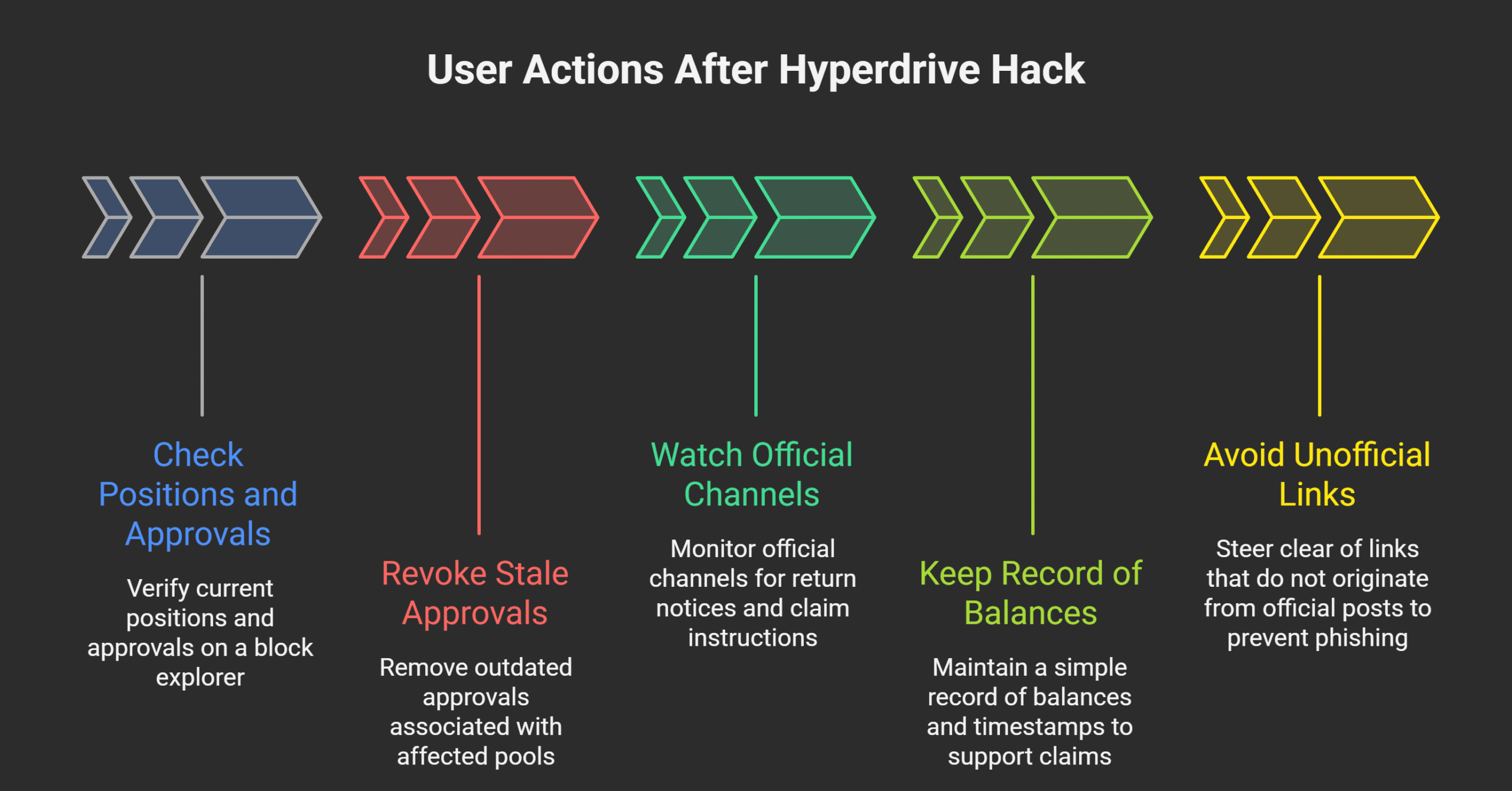
Check positions and approvals on a block explorer. Revoke stale approvals associated with the affected pools. Watch official channels for return notices and claim instructions. Keep a simple record of balances and timestamps to support any claim. Avoid links that do not originate from official posts to reduce phishing risk. Key facts and flows remain consistent with this independent recap.
Hyperdrive Hack

Conclusion and Next Moves

Based on the latest research, Hyperdrive hack analysis points to a router flaw, quick cross-chain movement, and a fast pause that limited further damage. The path forward depends on the full post-mortem, contract changes, and the final compensation process.

Users should avoid paused pools, review approvals, and follow official updates for reopen steps and claim windows, while tracking TVL and market state on DeFiLlama.

Also read: Crypto Price Prediction Today: XRP Gains Momentum, Hyperliquid and Pump Tokens Eye Breakouts

Summary

The Hyperdrive hack drained about $782,000 from two Hyperdrive markets on Hyperliquid via an arbitrary router call, then bridged funds to BNB Chain and Ethereum. Markets paused, a fix shipped, and compensation is planned. The Hyperliquid hack discussion continues with on-chain updates and TVL context. Users should verify approvals, keep records for claims, and follow official recovery notes until operations resume.

Glossary of key terms

Arbitrary call: a bug that lets a contract execute unintended functions.

Router: a contract that forwards calls and swaps between pools.

thBILL: tokenized Treasury bill exposure used as collateral.

Bridge: infrastructure that moves assets between chains.

TVL: total value locked in a protocol.

FAQs about Hyperdrive Hack

Is the Hyperdrive hack over?

Markets remain paused while a fix is live and a compensation plan is prepared.

Did the Hyperliquid hack touch exchange reserves?

No. Current reports limit impact to two Hyperdrive lending markets, with exchange reserves and core trading operations unaffected.

Where did funds go after the Hyperdrive hack?

Stolen assets were bridged via deBridge to BNB Chain and Ethereum, then consolidated into receiving addresses on those networks.

What should the BILL users do after the Hyperliquid hack?

Check positions and revoke stale approvals on affected pools, then wait for official reopen and compensation instructions.

Read More: What Hyperliquid Traders Need to Do After the Hyperdrive Exploit">What Hyperliquid Traders Need to Do After the Hyperdrive Exploit


Disclaimer: The articles reposted on this site are sourced from public platforms and are provided for informational purposes only. They do not necessarily reflect the views of MEXC. All rights remain with the original authors. If you believe any content infringes on third-party rights, please contact [email protected] for removal. MEXC makes no guarantees regarding the accuracy, completeness, or timeliness of the content and is not responsible for any actions taken based on the information provided. The content does not constitute financial, legal, or other professional advice, nor should it be considered a recommendation or endorsement by MEXC.

You May Also Like

Best Crypto to Buy as Saylor & Crypto Execs Meet in US Treasury Council

Best Crypto to Buy as Saylor & Crypto Execs Meet in US Treasury Council

The post Best Crypto to Buy as Saylor & Crypto Execs Meet in US Treasury Council appeared on BitcoinEthereumNews.com. Michael Saylor and a group of crypto executives met in Washington, D.C. yesterday to push for the Strategic Bitcoin Reserve Bill (the BITCOIN Act), which would see the U.S. acquire up to 1M $BTC over five years. With Bitcoin being positioned yet again as a cornerstone of national monetary policy, many investors are turning their eyes to projects that lean into this narrative – altcoins, meme coins, and presales that could ride on the same wave. Read on for three of the best crypto projects that seem especially well‐suited to benefit from this macro shift:  Bitcoin Hyper, Best Wallet Token, and Remittix. These projects stand out for having a strong use case and high adoption potential, especially given the push for a U.S. Bitcoin reserve.   Why the Bitcoin Reserve Bill Matters for Crypto Markets The strategic Bitcoin Reserve Bill could mark a turning point for the U.S. approach to digital assets. The proposal would see America build a long-term Bitcoin reserve by acquiring up to one million $BTC over five years. To make this happen, lawmakers are exploring creative funding methods such as revaluing old gold certificates. The plan also leans on confiscated Bitcoin already held by the government, worth an estimated $15–20B. This isn’t just a headline for policy wonks. It signals that Bitcoin is moving from the margins into the core of financial strategy. Industry figures like Michael Saylor, Senator Cynthia Lummis, and Marathon Digital’s Fred Thiel are all backing the bill. They see Bitcoin not just as an investment, but as a hedge against systemic risks. For the wider crypto market, this opens the door for projects tied to Bitcoin and the infrastructure that supports it. 1. Bitcoin Hyper ($HYPER) – Turning Bitcoin Into More Than Just Digital Gold The U.S. may soon treat Bitcoin as…
Share
BitcoinEthereumNews2025/09/18 00:27