

Why Silver and Gold Price Crashes Shouldn’t Worry Holders, Peter Schiff Weighs In
Military tensions between the United States and Iran escalated this week after reports emerged that U.S. forces carried out strikes against Iranian targets following the downing of a U.S. Army Apache helicopter. Developments like these would normally be expected to support safe-haven assets. Gold and silver, however, moved in the opposite direction.
Gold price extended a multiweek decline, while silver price suffered an even steeper drop. The sharp losses erased trillions of dollars in combined market value from precious metals and left many investors wondering whether the bullish case for gold and silver has started to break down.
That question is exactly where Peter Schiff sees things differently. Reports show that U.S. forces launched three waves of strikes against Iran on Tuesday evening. The strikes reportedly targeted radar and air defense systems after American officials said the action was taken in response to the downing of a U.S. Army AH 64 Apache helicopter.
President Donald Trump told ABC News that the response needed to be “very strong and very powerful.” Iranian Foreign Minister Abbas Araqchi later warned that Iran would leave no attack or threat unanswered.
Amid those developments, precious metals came under heavy pressure. Approximately $1.48 trillion was wiped from the precious metals market within 12 hours. Gold fell 4.1%, removing roughly $1.22 trillion from its market capitalization. Silver dropped 7%, which reduced its market value by around $260 billion.
Safe-haven assets do not always rise immediately during geopolitical crises. Market participants often move capital between asset classes for a variety of reasons, especially during periods of heightened uncertainty.
Peter Schiff Says The Bullish Case For Gold And Silver Has Improved
Peter Schiff believes the recent decline should not be viewed as a sign that the broader precious metals thesis is weakening.
Commenting on the latest move, Schiff noted that gold had fallen below $4,200 and silver was approaching $64. Despite the weakness, he argued that the investment case for both metals has actually become stronger.
Schiff wrote that the longer the conflict lasts, the better it could become for gold and silver.
His argument centers on the economic consequences that often accompany prolonged geopolitical tensions. Extended military conflicts can increase fiscal spending, create inflation concerns, pressure currencies, and introduce uncertainty into financial markets.
Those factors have historically supported demand for precious metals over longer periods, even when short term price action remains volatile.
Read Also: Silver Price Prediction: Final Wave Z Downside Signals a Bigger Bottom Ahead
Gold Price Is Testing A Major Support Zone After Five Weeks Of Losses
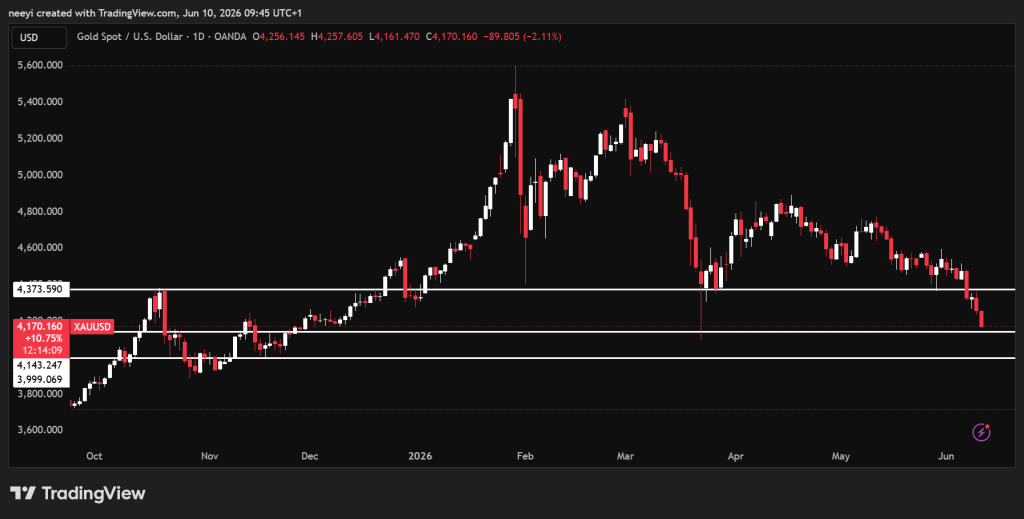
Gold has now recorded 5 consecutive weeks of losses. The metal has fallen from approximately $4,767 to around $4,190 at the time of writing. That marks a decline of roughly 12% in just over a month.
A look at the current gold price structure shows an important support area near $4,143. That level could play a key role in determining the next major move. A decisive break below $4,143 would increase the likelihood of a deeper decline toward the psychological $4,000 level.
 Gold Price Chart / TradingView.com
Current trend conditions still favor sellers. Gold has remained under pressure for several weeks and stronger evidence of stabilization is still needed before a bullish reversal can be confirmed.
Another possibility deserves attention. Gold could begin consolidating near current levels if buyers successfully defend support.
Price movement between $4,000 and $4,300 would not be unusual after such a sharp correction. Markets often pause after extended declines as participants reassess valuations and market conditions.
Silver Price Approaches A Critical Level After Breaking Trendline Support
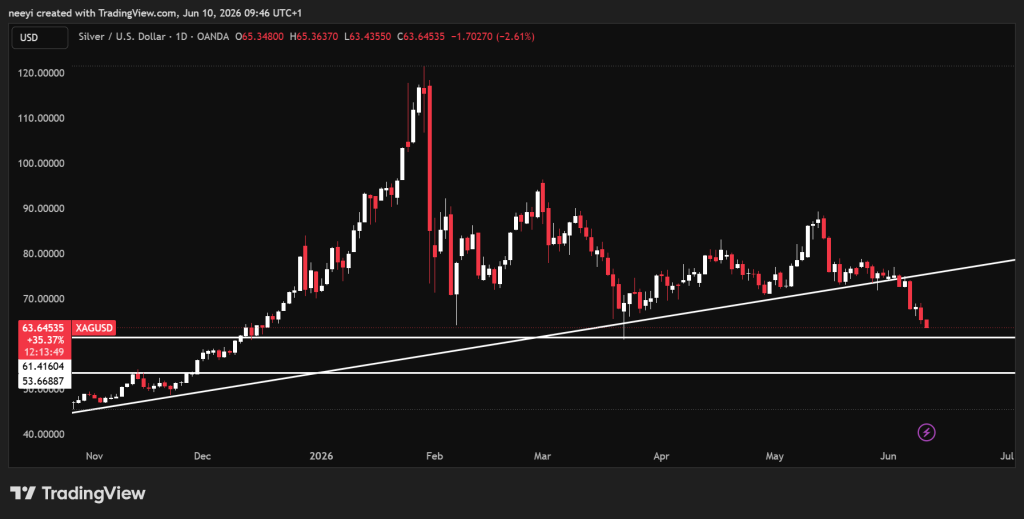
Silver price has experienced an even more dramatic decline. The metal broke below a mid-term ascending trendline around 5 days ago. That technical breakdown weakened a structure that had supported silver’s upward movement for months.
Silver has since fallen from roughly $75 to around $63. Price is now approaching a major support level near $61. That area could become an important test for the market.
 Silver Price Chart / TradingView.com
Successful defense of that support zone could allow silver price to stabilize after the recent selloff. Failure to hold the level would represent a much larger breakdown of the current bullish structure.
Additional downside pressure could then emerge, with the next notable support area located near $53. Silver has historically shown greater volatility than gold. That characteristic often leads to larger gains during rallies and deeper declines during corrections.
Peter Schiff’s view remains focused on the broader macroeconomic picture rather than short-term market swings. His argument is that geopolitical conflict often creates conditions that eventually benefit precious metals.
Subscribe to our YouTube channel for daily crypto updates, market insights, and expert analysis.
The post Why Silver and Gold Price Crashes Shouldn’t Worry Holders, Peter Schiff Weighs In appeared first on CaptainAltcoin.


You May Also Like

Bitcoin World Reveals Top 5 Stunning Gainers And Losers

Solana Price Drops 5.5% Due to Drift Exploit & Market Panic

Egrag Crypto to XRP Investors: You’re Either Early Or You’re Exit Liquidity



