

Is SpaceX IPO Draining Bitcoin Liquidity?
On June 12, 2026, SpaceX shares opened trading at $150 following its $75 billion IPO and merger with xAI. Elon Musk moved closer to becoming the world’s first trillionaire on paper. In crypto trading groups and institutional desks, the immediate question was not about rocket trajectories or AI model benchmarks. It was about capital: where would the money come from, and where would it go next?
Early trading showed classic signs of capital reallocation. Retail speculative flows that had supported crypto markets in prior weeks appeared to pivot toward the new listing. One analyst described the IPO as continuing to “suck the air out of the room.” At the same time, a more constructive view emerged. Standard Chartered’s Geoff Kendrick argued that “winter is over” for crypto, pointing to the SpaceX debut alongside a potential U.S.-Iran diplomatic thaw as markers of improving risk appetite.
This article examines the mechanics behind these reactions. It places the event in historical context, explains how liquidity moves between traditional equities and crypto, weighs the bull and bear cases with data-driven framing, and extracts durable lessons for investors who want to understand—not just react to—cross-asset capital flows.
Capital Rotation: How IPOs Move Money Across Risk Assets
Capital is not infinite. Retail and professional investors operate with finite pools of risk capital that shift toward the highest perceived near-term reward or narrative momentum. When a high-profile IPO arrives with strong momentum, several mechanical effects occur in sequence:
- Attention capture and initial allocation. Marketing, media coverage, and social amplification pull eyeballs and brokerage logins toward the new name. Margin capacity and cash that might have been deployed into crypto order books gets earmarked for the IPO or immediate secondary trading.
- Lock-up and early selling dynamics. Early investors and employees receive shares subject to lock-ups, but the public float begins trading immediately. Profit-taking or rebalancing by institutions that participated in the offering can create short-term supply pressure elsewhere.
- Wealth effect and reallocation. If the stock pops on debut (SpaceX delivered this), holders experience a rapid mark-to-market gain. A portion of those gains typically rotates into other high-beta assets rather than sitting in cash. Crypto has historically been one recipient of such rotations because it offers asymmetric upside narratives and 24/7 liquidity.
- Narrative competition or synergy. The SpaceX/xAI structure blends aerospace execution with frontier AI. In 2024–2025, AI-related equities and crypto AI tokens competed directly for the same speculative dollars. A successful public listing can intensify that competition in the short term or, later, create perceived synergies if decentralized compute or tokenized infrastructure plays gain traction.
These steps are not theoretical. They played out during the 2020–2021 cycle when a wave of tech and crypto-adjacent direct listings and SPACs coincided with Bitcoin’s climb from roughly $10,000 to nearly $69,000. The same capital that chased Coinbase’s April 2021 direct listing also fueled the broader digital asset rally—until macro conditions changed.
Historical Precedents: IPO Windows and Crypto Performance
Major technology listings have repeatedly served as sentiment and liquidity barometers for crypto. Consider three episodes:
- Coinbase direct listing (April 2021): Bitcoin traded near $60,000 at the time. The listing validated crypto as an institutional asset class and coincided with peak retail enthusiasm. Subsequent months saw both Coinbase shares and Bitcoin correct sharply as interest rates rose and liquidity tightened.
- Snowflake and Palantir listings (2020): These occurred during the early pandemic liquidity flood. Risk assets across the board—including Bitcoin—benefited from the same “growth at any price” psychology.
- ARKK and meme-stock episodes (2021): Retail coordination and thematic ETF flows amplified moves in both equities and crypto. When the narrative shifted, capital exited both asset classes in correlated fashion.
Bitcoin’s 60- to 90-day rolling correlation with the Nasdaq-100 has frequently exceeded 0.6–0.8 during risk-on regimes. It behaves like a leveraged technology proxy with additional monetary-premium characteristics. Therefore, any event that materially alters the marginal dollar’s destination—whether an IPO, a rate decision, or a geopolitical de-escalation—tends to register in Bitcoin’s price action faster and with greater amplitude than in blue-chip equities.
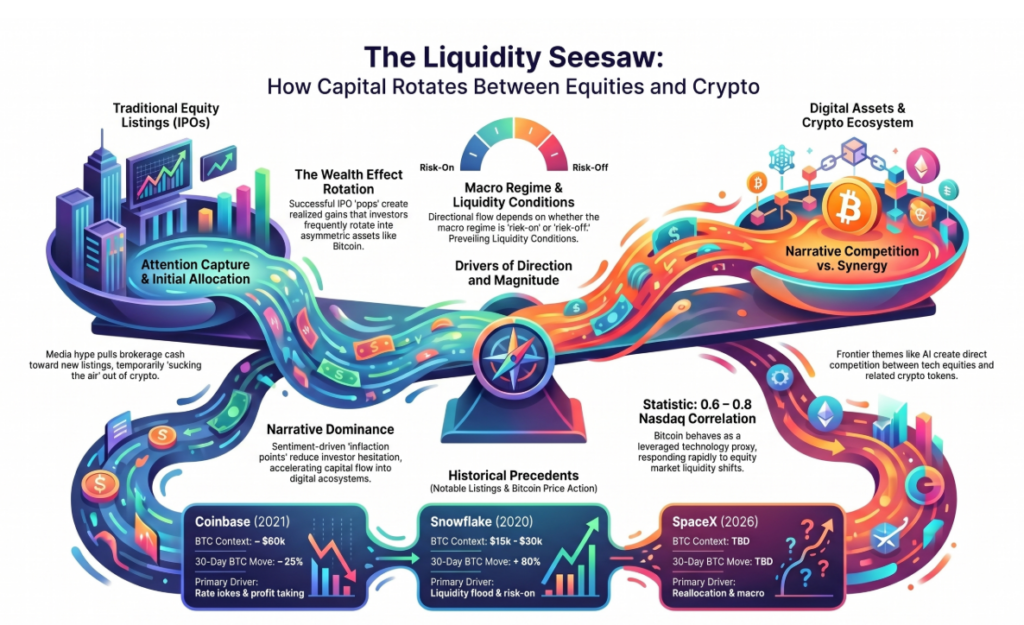 In practice, the direction and magnitude depend on prevailing liquidity conditions and narrative dominance.
Bull Case: Profit Rotation and Sentiment Tailwinds
The constructive scenario rests on three pillars visible in the current setup:
- First-day pop as trigger. SpaceX delivered the classic IPO pop. Realized gains create investable cash. Historical patterns show that after strong tech debuts, a slice of those profits has found its way into crypto within days to weeks—especially when macro conditions are not overtly hostile.
- “Winter is over” narrative reinforcement. Analyst commentary framing the IPO and diplomatic developments as cycle inflection points can become self-reinforcing. Positive sentiment reduces fear-of-missing-out hesitation among sidelined capital.
- Musk ecosystem halo. Musk’s companies have repeatedly moved crypto markets through both direct actions (Tesla’s 2021 Bitcoin purchase and subsequent sale) and indirect signaling. A highly visible public success for SpaceX/xAI keeps Musk in the global conversation, sustaining the cultural and retail attention that crypto has leveraged in prior cycles.
If these elements align, Bitcoin could see renewed buying interest from both retail traders rotating gains and from momentum funds that treat crypto as a high-beta expression of innovation risk appetite.
Bear Case: Liquidity Drain and Narrative Competition
The opposing view is equally grounded in observable mechanics:
- Finite speculative capital. The same retail cohort that drove 2024–2025 memecoin and AI token volumes has limited dry powder. When a new, heavily marketed equity listing appears with clear momentum, some of that powder moves. Crypto order books—shallower than major equity markets—feel the withdrawal more acutely in the short term.
- AI versus crypto mindshare. The xAI component explicitly ties the listing to the AI investment wave that has already competed with crypto for headlines and capital. Sustained outperformance by AI-related equities can keep marginal dollars away from digital assets.
- Broader risk-asset correlation. If the IPO debut coincides with any macro wobble (rate repricing, geopolitical flare-up, or valuation concerns), the resulting risk-off move hits correlated assets—including Bitcoin—regardless of the IPO’s individual success.
In this framing, the IPO does not need to “fail” to pressure crypto; it simply needs to absorb attention and capital for long enough that crypto’s own catalysts (ETF flows, halving-cycle dynamics, regulatory clarity) lose relative urgency.
Comparative Framework: IPO Events and Crypto Outcomes
| Period | Notable Listing(s) | BTC Price Context | Subsequent 30-Day BTC Move | Primary Driver |
|---|---|---|---|---|
| Apr 2021 | Coinbase direct listing | ~$60k | –25% | Rising rates + profit taking |
| Late 2020 | Snowflake, Palantir | $15k–$20k | +80%+ | Liquidity flood + risk-on |
| 2024–2025 (various) | AI/tech momentum names | $60k–$100k range | Mixed | Narrative competition (AI vs crypto) |
| Jun 2026 (current) | SpaceX/xAI | TBD | TBD | Liquidity reallocation + macro |
The table illustrates that outcome depends less on the listing itself and more on the liquidity regime and competing narratives at the time.
Risks, Limitations, and What Does Not Change
Short-term price action around any single corporate event is inherently noisy. Three caveats matter for readers seeking durable understanding:
First, correlation is not causation. Bitcoin’s price on any given week is also influenced by ETF flows, miner selling pressure, regulatory headlines, and global liquidity metrics that have nothing to do with SpaceX. Attributing every move to the IPO would repeat the common error of narrative overfitting.
Second, Musk-related assets carry idiosyncratic volatility. Regulatory scrutiny, executive communications, or operational setbacks at any of his companies can swing sentiment rapidly. Crypto investors already price some of this volatility; adding another public vehicle does not fundamentally alter that exposure profile.
Third, crypto’s maturation path—spot ETF adoption, institutional custody infrastructure, clearer accounting treatment—continues regardless of any single equity listing. The SpaceX IPO is a data point in capital-flow dynamics, not a referendum on Bitcoin’s long-term monetary properties.
Forward Outlook: Integration, Not Isolation
The deeper, more enduring lesson is that crypto has never been fully separate from traditional risk markets. It amplifies moves in growth assets during liquidity-driven phases and occasionally decouples when monetary or geopolitical shocks dominate. Successful high-profile listings like SpaceX’s can accelerate the “wealth effect” channel that funnels incremental capital into the ecosystem. They can also highlight where crypto still competes rather than complements other innovation narratives.
Over multi-year horizons, the more important variables remain Bitcoin’s fixed supply schedule, the growth of institutional on-ramps, and the evolution of decentralized infrastructure. Corporate events supply color and short-term catalysts; they do not rewrite those fundamentals.
Conclusion
SpaceX’s 2026 IPO and xAI merger delivered exactly the kind of cross-asset capital question that sophisticated crypto participants must learn to parse. In the immediate window, some liquidity and attention shifted toward the new listing. Whether that shift proves transient—followed by profit rotation—or more persistent depends on the magnitude of the debut pop, the broader liquidity backdrop, and whether AI and crypto narratives ultimately compete or converge.
For investors, the practical takeaway is not to chase or fade any single headline, but to monitor the marginal destination of risk capital. When traditional markets offer compelling new stories with momentum, crypto feels it. When those stories mature or macro conditions ease, crypto often benefits from the reallocation. Understanding that interplay—rather than treating crypto as an island—remains one of the highest-leverage skills for navigating cycles.
Subscribe to Cryptopress.site for weekly deep dives that connect macro events, capital flows, and on-chain fundamentals. The conversation continues in the comments and on X—bring your data and your questions.
The post Is SpaceX IPO Draining Bitcoin Liquidity? appeared first on Cryptopress.


You May Also Like

Pi Network and Web3 Vision Linked to Global Unity Inspired by World Cup Spirit

BNB slips below $590 as Trump threatens to strike Iranian power plants

Shiba Inu sees 64 billion SHIB move in 24 hours


Trending News
More24/7 Live News
MoreQuick Reads
More
