

The Future of Vaults: How Neobanks Will Hide DeFi
Crypto vaults, once the domain of DeFi power users manually allocating capital across protocols, may be on the verge of disappearing into the background of consumer finance. A growing thesis holds that neobanks will absorb vault technology as invisible infrastructure, delivering yield to everyday users who never interact with a smart contract directly.
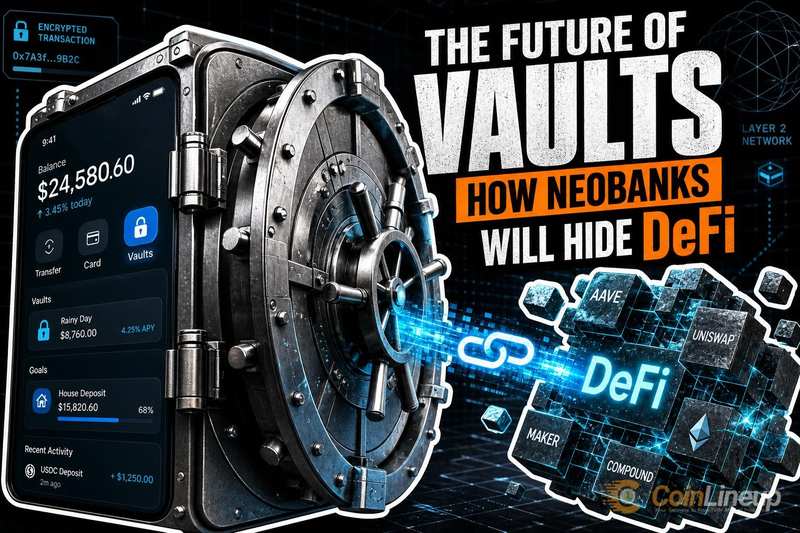
Vaults are shifting from niche tools to background infrastructure
A vault, in DeFi terms, is a smart contract that accepts deposits and executes a yield-generating strategy automatically. Users deposit tokens, the vault allocates capital across lending protocols, liquidity pools, or staking mechanisms, and returns are distributed without manual intervention. Today, using one still requires a self-custody wallet, gas fees, and comfort with on-chain risk.
“Invisible DeFi” describes a future where none of that friction reaches the end user. Instead of connecting a wallet to a protocol dashboard, a user opens a savings product inside a familiar fintech app. The vault runs underneath, but the experience looks like a regulated financial product, not a crypto experiment.
This shift is already beginning. Kraken recently launched its DeFi Earn product across the U.S., EU, and Canada, offering simplified access to DeFi yield through Veda-powered vaults. Users earn rewards without managing wallets, bridges, or protocol selections. The exchange handles custody and strategy execution in the background.
The product advertises yields up to 8% APY on select assets, a rate that would be competitive with most traditional savings accounts. Kraken’s approach strips away the technical complexity while preserving the on-chain yield source, a model that maps closely to how neobanks already package traditional financial products.
The neobank packaging model
Neobanks have already proven that abstraction drives adoption. Millions of users hold fractional shares, earn interest on idle cash, and send international transfers through apps that hide the underlying rails entirely. Applying the same logic to DeFi vaults means a user deposits dollars or stablecoins, sees a yield figure, and withdraws when ready.
Behind the interface, the vault handles allocation, rebalancing, and harvesting across protocols. The neobank layer manages onboarding, KYC, compliance, and customer support. Product formats could range from stablecoin savings accounts to business treasury tools, each powered by the same vault infrastructure with different risk parameters.
This division of labor plays to each side’s strengths. DeFi protocols are efficient at capital allocation. Fintech companies are efficient at user experience and regulatory compliance. The vault becomes a composable backend component rather than a consumer-facing product.
What must change before this model scales
Abstracting complexity does not eliminate risk. Smart contract vulnerabilities, oracle failures, and liquidity crunches still exist whether or not the user sees them. A neobank packaging vault yield as a “savings account” creates consumer expectations around reliability that DeFi protocols were never designed to meet.
Regulatory clarity remains the largest open question. Consumer-facing yield products in most jurisdictions trigger securities, banking, or e-money regulations. Any neobank offering vault-powered returns will need clear disclosure about what is and is not guaranteed, a standard that the broader crypto industry is still negotiating with regulators.
Transparency creates another tension. Invisible DeFi works precisely because it hides protocol-level details, but hiding those details from users who bear the downside risk invites the same trust failures that damaged centralized yield platforms in previous cycles. The credible version of this model would need real-time risk disclosure, proof of reserves, and clear smart contract audit trails.
The vault-neobank thesis is structurally sound: DeFi’s yield generation paired with fintech’s distribution and compliance infrastructure addresses real gaps on both sides. Whether it succeeds depends on whether abstraction is built as a trust layer or merely as a complexity-hiding layer. The distinction will determine whether invisible DeFi becomes mainstream finance or repeats the mistakes of opaque centralized platforms.
Disclaimer: This article is for informational purposes only and does not constitute financial or investment advice. Cryptocurrency and digital asset markets carry significant risk. Always do your own research before making decisions.


You May Also Like

KPMG retracts AI report after hallucinations surface in claims about organizations

Thousands turn out for anti-racism rally after Belfast unrest

Qatar earn first-ever World Cup point with late goal



