

How Vietnam went from post-War poverty to fast-growing powerhouse
We witnessed the end of U.S. involvement in the Vietnam War 50 years ago, on April 30, 1975, with our last helicopter out of Saigon.
But Vietnam’s despair runs deeper than the war we witnessed. The nation had been under attack for 35 years – first by the Japanese, then the French, then Chinese-sponsored northern invaders, then Americans.
They endured 15 million tons of bombs – 10 times the tonnage dropped on Germany in World War II – plus chemical agents, leaving 1.5 million dead in the south, with a million orphans and a million invalids.
Then they endured nationwide famine. Their rice rations dropped by 20% almost immediately, from 240 kilograms per person per year in 1976 to 190 kg in 1978. In 1993, their per capita income was $100 a year, worst in the world – next worst was Somalia (at $130), the dystopia profiled in Black Hawk Down.
This angered even the Communists. In late 1986, the sixth Vietnamese Communist Party Congress decided – much as Deng Xiaoping did in China – to create a parallel capitalist economy, called “Doi Moi” (renewal). An outpouring of self-criticism and reform launched a huge turnaround in Vietnam.
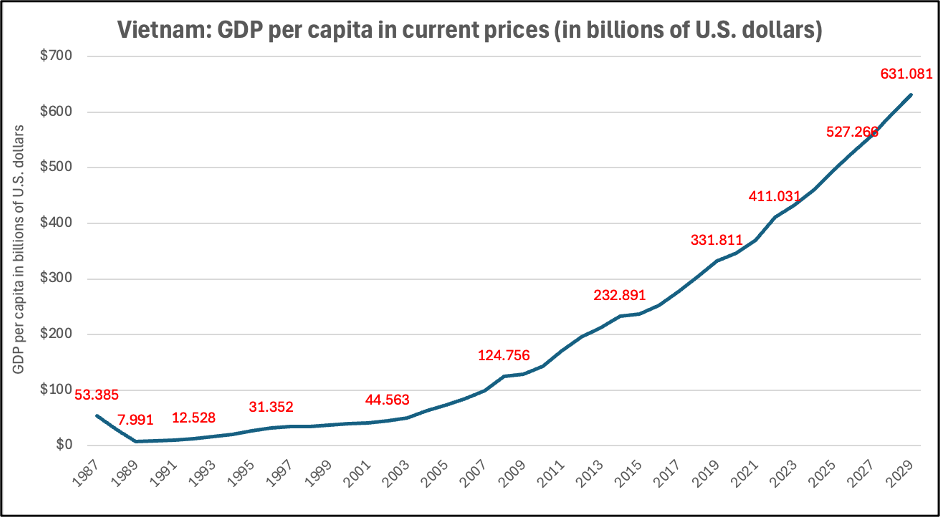 Source: ©IMF, 2026
Recreated graph from IMF 2026 Data
Reform didn’t work very well at first, as this chart shows: Per capita income fell drastically from 1987 to 1990 as inflation soared by nearly 600% and people lost whatever savings they had.
What they were paid each month didn’t last a week, but from 1990 to 1997, Vietnam’s GDP grew by 8% per year, second only to China. From being the poorest nation on earth, Vietnam is now the 33rd richest among 100+ nations.
Vietnam isn’t free yet. Like China, Vietnam still has corrupt state-owned enterprises (SOE’s), given favorable treatment, responsible for about 20% of the economy, and Vietnam doesn’t have freedom of speech or the press, as they can’t criticize their government, but they have basic economic freedom there.
The Vietnamese are Far More Positive About Capitalism and Wealth Than Americans
Historian and sociologist Dr. Rainer Zitelmann’s book “How Nations Escape Poverty: Vietnam, Poland, and the Origins of Prosperity” and film “Vietnam: Beating Poverty with Market Economy” illustrate the positive nature of the Vietnamese people, after all that suffering – and still under nominal Communist control.
They exhibit absolutely no rancor against Americans. They blame their past leaders and neighboring powers for what they suffered, realizing Americans were mostly trying to relieve them from those oppressors, however ineffectively in the end.
Rather than celebrate Vietnam’s success, Western media criticize rising “wealth inequality” in Vietnam, but few within Vietnam complain about this.
As one Vietnamese leader said at the Doi Moi conference in 1986: “We should not be afraid of people becoming affluent, as our country will be strong only when our people are affluent,” echoing Deng Xiaoping, who said, “Let some people get rich first.” After all, when a nation moves from an 80% poverty rate to 3%, those 77% formerly poor have nothing to complain about.
Related: Navellier to SpaceX buyers: wait for escape velocity
In a poll of 800 Vietnamese in 2022, commissioned by Zitelmann, over three in four (76%) Vietnamese said it is important to them to become rich – the highest number among 13 countries surveyed.
Perhaps surprisingly, 80% of women in Vietnam said they wanted to be rich vs. 72% of men.
Zitelmann and his team asked a similar number of people in 13 countries: “For some people it is important to be rich. How important, if it all, is it for you personally to be rich?”
The percentage of those saying “very important” or “somewhat important” reached 76% in Vietnam vs. just 30% average in America and Western Europe.
According to Zitelmann’s interviews and data, rich people are admired, even adored, in Vietnam. That’s mostly because three-fourths want to become one of them. The rich are seen as creative visionaries. In contrast, when asked about the character traits of the rich in the West, most people in Western countries said “greedy” or “ruthless,” but most people in Vietnam focused on the positive traits of the rich: visionary and farsighted (74%), bold and daring (67%), industrious (63%) and imaginative (62%).
By contrast, very few Vietnamese said the rich were greedy (19%), arrogant (17%), or ruthless (12%). Given a list of 10 synonyms or qualities of capitalism, the Vietnamese chose “progress” and “innovation” as #1 and #2 on their list, with “greed,” “corruption,” and “coldness” at the very bottom of their list.
Given 17 statements about capitalism for agreement, #1 on their list was “capitalism means economic freedom” (76%), and the lowest on their list was “capitalism entices people to buy products they don’t need” (23%).
While Americans tend to complain about our sordid mistakes of the past – including greedy robber barons – the Vietnamese shrug off their far more painful history of terrible wars and the poverty they endured.
For instance, Vietnamese entrepreneur Nguyen Xuan told Zitelmann, “I was born in 1987, when the war had already been over for 12 years. My parents and grandparents told me about how terrible the war was, but they never had a bad word to say about Americans. On the contrary, they told me, ‘You have to learn English, dress like Americans, eat what Americans eat, and above all, learn to think like Americans think. Then you will be successful.”
He is not alone. In a 2014 Pew Research Center Poll, 76% of Vietnamese had a positive view of Americans. Among the better educated, the figure reached 89% pro-American.
So, how does a nation get rich? Simple: Open up the economy to ambitious people who want to get rich!
Related: Morgan Stanley drops stunning take on GDP outlook


You May Also Like

One Of Frank Sinatra’s Most Famous Albums Is Back In The Spotlight

Aster is Predicted to Drop to $ 0.477166 By Jun 19, 2026

WikiLeaks lost 95% of income then adopted BTC in 2011



