

Chilean crypto exchange founder wanted for laundering Tren de Aragua funds
Chilean prosecutors have just issued an arrest warrant for Jose Manuel Rios Guaido, the founder of crypto platform Plusspay, after an investigation revealed that his fintech business was connected to a money laundering network run by a criminal organization called Tren de Aragua.
The Southern Metropolitan Regional Prosecutor’s Office conducted the raid as part of a broader crackdown on Tren de Aragua’s financial infrastructure in Chile, also known as “Operación Tokio”.
However, prosecutors have not yet filed formal charges against Ríos Guaidó.
Chilean founder implicated in gang crypto laundering
Detectives from Chile’s Organized Crime Investigation Brigade raided Plusspay’s offices in the Santiago borough of Providencia on June 13, according to CriptoNoticias. The 38-year-old Ríos Guaidó from Zulia state, Venezuela, was not found at the premises or at any of his registered addresses.
Authorities believe he may have left Chile and could be in Venezuela or Colombia.
According to the prosecution’s case file, over $84 million in suspicious financial activity was connected to the Plusspay network.
Apparently, Plusspay accepted transfers in Chilean pesos and converted them into stablecoins, mostly Tether (USDT) and USD Coin (USDC), before diverting the funds to wallets and bank accounts abroad, El Mostrador reported.
The platform operated from a Providencia office and advertised itself as regulated by Chile’s Financial Market Commission (CMF).
Why are prosecutors looking for Plusspay founder?
Prosecutors claim that Ríos Guaidó set up several shell companies, including a group of businesses bearing a “Bex” prefix (BexGroup SpA, BexDigital Services SpA, and Bexpay Business Enterprises SpA) to hide and move illegal funds through Chile’s banking system.
Investigators also discovered a related Florida-based entity that shares the same address with the Chilean organization.
Ríos Guaidó co-founded Inversiones Plusservice SpA in 2021 with his fellow countryman Jesús Alberto Morillo Medina.
In 2023, he launched the Plusspay domain and formally expanded the company’s scope to include crypto custody and brokerage services. By early 2024, the firm was officially registered as a fintech provider with Chile’s Financial Market Commission (CMF).
CMF clarifies that registration does not mean authorization
The CMF quickly tried to clarify its role after El Mostrador published its investigation. According to Chile’s Fintech Law, through a CMF statement issued on June 12, a financial services provider must complete two steps before they can operate: registering in the CMF’s registry and obtaining another separate authorization.
“Registration alone does not enable operations, as the authorization process is required to provide services,” the CMF said. They also noted that Inversiones Plusservice was one of several companies that had failed to update their records as required under General Rule No. 502, and that it was conducting a supervisory review of all registered entities.
Following the raid, Plusspay halted its operations and posted a website banner attributing the shutdown to “legal reasons beyond the platform’s control.”
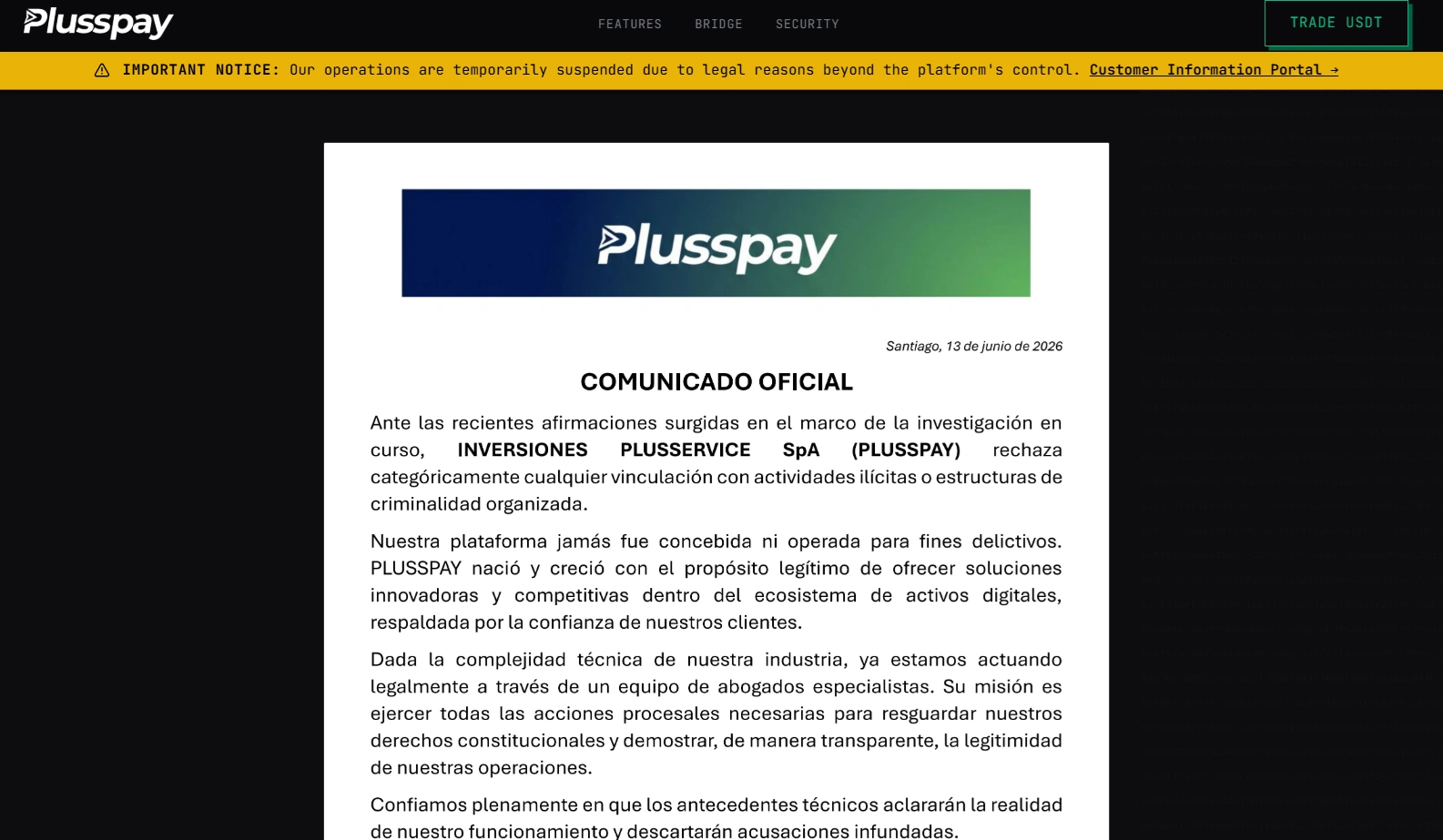 Screenshot of the notice on the Plusspay portal. Source: Plusspay.
The company also issued a public statement where it rejected “any connection to illicit activities or organized crime structures.” It also mentioned that it had retained specialized lawyers to defend itself and prove the legitimacy of its operations.
Chile cracking down on illegal operations
The Plusspay case seems to be the latest enforcement action targeting Tren de Aragua’s finances in Chile.
The Chilean police arrested almost 20 people on June 5 for being linked to another money laundering ring that moved up to $88 million through bank accounts and crypto remittances. Prosecutor Héctor Barros called that operation “one of the largest money laundering cases we have seen in our country” while sharing that authorities froze over 140 bank accounts.
The U.S. Treasury’s Office of Foreign Assets Control sanctioned Tren de Aragua as a global criminal organization in 2024. Recent reports from InSight Crime also claim that the gang has progressively refined its laundering methods, moving from basic wire transfers to complex schemes blending shell companies, multiple bank accounts, and crypto conversions.
If you're reading this, you’re already ahead. Stay there with our newsletter.


You May Also Like

Vitalik Buterin Proposes Self-Sovereign AI Stack To Protect Users From Risks Of AI Agents

Why Businesses Need Professional Machine Design and Development Services

Standard Chartered Sees Tokenization Driving DeFi Toward $2.7 Trillion by 203



