

VTI vs VOO: Which Vanguard ETF is Better?
These two Vanguard funds get compared so often because they sit so close together on paper. Both are cheap, broad U.S. stock ETFs. Both own many of the same companies. Both can work as the main stock fund in a long-term portfolio.
But VTI vs VOO are not the same fund with different tickers. One gives you the S&P 500. The other gives you almost the entire U.S. stock market.
That’s a bigger difference than it might sound. It changes what you own, how diversified you are, and how much the smaller parts of the market matter.
I’ll explain the differences, compare the two ETFs and explain which one is the right fit for you.
Let’s dive in!
Key highlights:
- VOO tracks the S&P 500, so it focuses on the biggest public companies in the U.S.
- VTI owns the same large companies as VOO, plus thousands of mid-cap and small-cap stocks
- Both ETFs have a 0.03% expense ratio, so cost is not a major deciding factor
- VTI is better for total U.S. market exposure, while VOO is better for simple large-cap exposure
What VTI vs VOO actually own
At the highest level, this is the whole debate.
- VOO owns the biggest public companies in the United States
- VTI owns those same giants, plus thousands of mid-size and smaller companies
Let’s look at what these Vanguard ETFs give you.
VOO gives you the biggest U.S. companies
VOO tracks the S&P 500, which is made up of large U.S. companies. These are the names most investors and even everyday people already know, like:
- Apple
- Microsoft
- Amazon
Add Alphabet, Meta, NVIDIA and Berkshire Hathaway, and other giants, and you've got the basic shape of the fund.
That makes VOO simple in a way people like. You’re buying the biggest slice of corporate America, not every corner of it. The fund is still diversified across sectors, but it leans hard on large-cap stocks because that is the point.
For a lot of investors, that focus is enough. The S&P 500 has long been the default benchmark for the U.S. stock market, even though it’s not the whole market. If you want a clean, easy-to-understand fund, VOO is easy to like. You know what you’re buying, and you can follow it without much work.
VTI covers almost the entire U.S. market
VTI starts with those same big companies, then keeps going. It includes large-cap, mid-cap, and small-cap U.S. stocks, which means you are buying a far wider swath of the market.
VTI is closer to saying, "I want U.S. stocks, period." It doesn’t stop at the top 500 names. It adds thousands of smaller businesses that don’t make it into the S&P 500.
That broader reach gives you more diversification inside the U.S. market. If smaller companies have a strong run, VTI is more likely to capture it. If leadership shifts away from the usual mega-cap names, VTI has more places to benefit.
To be clear, VTI is market-cap weighted too. The biggest companies still carry most of the weight. So while VTI owns much more of the market, it doesn’t behave like an equal mix of big, mid, and small stocks. The giants still drive most of the return.
VTI vs VOO performance
| Metric | Vanguard S&P 500 ETF (VOO) | Vanguard Total Stock Market ETF (VTI) |
| Benchmark index | S&P 500 Daily Total Return Index / S&P 500 exposure | CRSP US Total Market Index |
| Expense ratio | 0.03% | 0.03% |
| Inception date | September 7, 2010 | May 24, 2001 |
| Number of holdings | 505–506 holdings, depending on source snapshot | 3,506 holdings |
| Minimum investment | $1 | $1 |
| Price | $681.95 as of June 12, 2026 | $372.43 as of June 15, 2026 |
| AUM | $1,033.50B as of June 12, 2026 | $650.51B as of June 11, 2026 |
| YTD return | 9.14% as of June 12, 2026 | 9.62% as of June 12, 2026 |
| 1-year return | 24.40% as of June 12, 2026 | 30.0% total return as of May 31, 2026 |
| 3-year return | 23.28% annualized | 23.25% annualized |
| 5-year return | 14.10% annualized | 12.88% annualized |
Why VOO vs VTI often feel almost the same
On paper, one fund owns roughly 500 large companies and the other owns almost the whole market. But in practice, their performance often looks close.
Their top holdings are mostly the same
Both funds are dominated by the same mega-cap names.
If Apple, Microsoft, NVIDIA, Amazon, and Alphabet are doing well, both funds usually look good. If those companies struggle, both funds usually feel it. Since the largest stocks make up such a large share of the U.S. market, they pull both ETFs in the same direction most of the time.
Very often, comparing VTI vs VOO performance doesn’t give you much. In fact, the chart comparisons look almost like twins:
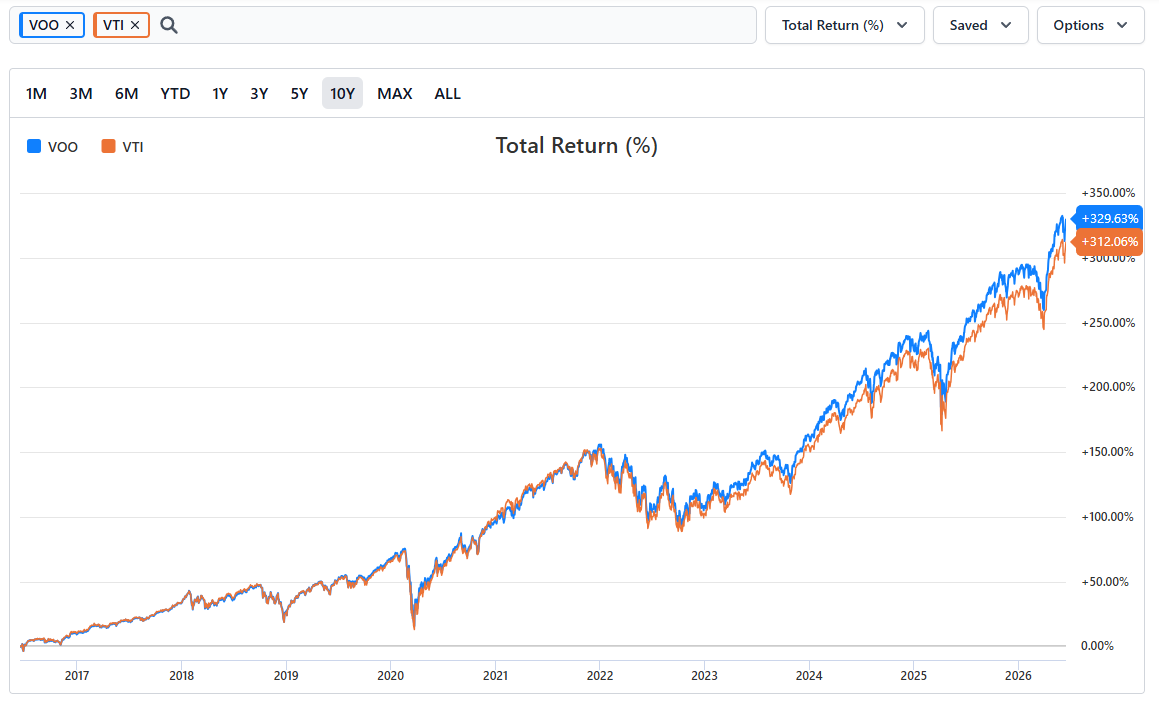
The charts are very similar because the same few giants matter so much in both. Most of the time, the biggest companies do the heavy lifting in both funds. They just do a bit more with VOO.
This overlap also explains why the choice is often less dramatic than people expect. Picking between VTI and VOO is not like choosing between U.S. stocks and bonds. It’s more like choosing between the seats in the front half or the back half of a movie theater. It’s not identical, but in the end, you saw the same movie.
What’s the difference between VTI and VOO ETFs
The gap between the funds is mostly due to the part of VTI that VOO does not own. That means mid-cap and small-cap companies.
Those extra holdings can help when smaller stocks outperform large caps. They can also hurt when smaller companies lag, which happens plenty. Small and mid-size businesses usually swing more than the giants. They can grow faster, but they can also fall harder when the economy gets shaky or investors want safety.
That doesn’t make VTI risky in any extreme way. It’s still a broad U.S. stock fund. The point is smaller stocks add a different flavor, not a different asset class.
So yes, VTI is more diversified. But the extra diversification comes from a part of the market that is smaller and often bumpier. Whether that matters to you depends on how complete you want your U.S. stock exposure to be.
Costs, risk, and performance: which ETF has the edge?
Here’s the quick side-by-side view:
| ETF | Main focus | Expense ratio | How it usually feels |
| VOO | S&P 500, large U.S. companies | 0.03% | Slightly steadier |
| VTI | Total U.S. stock market | 0.03% | Slightly more volatile |
There is no obvious winner on cost.
Expense ratio is a tie, so fees should not decide it
The charge of 0.03% for both of these is extremely cheap.
If you invest $10,000, the annual fund cost is $3.
That’s good news. You don’t have to contort your choice around cost because Vanguard priced both funds at the same low level. You can focus on what really matters, which is what you want to own.
VTI is a bit more diversified, VOO may feel a bit smoother
- VTI gives you more diversification because it includes more of the U.S. market. You are not only relying on the biggest companies. You also get exposure to mid-size firms and smaller businesses that could grow into tomorrow's leaders.
- VOO may feel a little smoother because it stays with large companies. Bigger businesses usually have more established earnings, stronger balance sheets, and less dramatic price swings than small caps.
Which Vanguard ETF is better for different types of investors?
So which one wins? Depends on what you want the fund to do for you.
Choose VOO if you want a simple large-cap core
VOO is a strong fit if you want the classic S&P 500 approach. It gives you broad exposure to the biggest U.S. companies in one clean package. It’s the Bitcoin of funds.
That works well for beginners because it’s super easy to understand. It also works well for experienced investors who do not feel any need to own every small public company in America.
If your goal is a simple core stock holding that tracks the names most people recognize, VOO does the job without clutter.
There’s also a mental benefit here. Many investors stick with a plan better when the fund is simple and familiar. VOO has that advantage.
Choose VTI if you want the widest U.S. market coverage
VTI makes more sense if you want one fund that captures nearly the whole U.S. stock market. You get the big names, plus the mid-cap and small-cap exposure that VOO leaves out.
That can appeal to long-term index investors who want the broadest one-fund U.S. stock solution. You do not need to buy separate mid-cap or small-cap funds to fill in the gaps. VTI already includes them.
If you like the idea of owning "the market" rather than a major slice of it, VTI is the cleaner answer.
If you already own one, you probably do not need both
Owning both VTI and VOO sounds more diversified than it usually is. Since the overlap is so large, holding both often means you are doubling up on the same major companies without getting much extra benefit.
Most investors can keep it simple. Pick one. Build around it if needed. Then move on.
If you already own one and like it, there is usually no urgent reason to switch.
The bottom line
Neither fund is a bad choice. Both are low-cost, diversified U.S. stock ETFs from Vanguard, and both can anchor a long-term portfolio.
The easy way to remember it is this:
- Choose VOO for S&P 500 and the biggest companies in the U.S.
- Choose VTI for total-market coverage
If you are torn and want the broadest one-fund answer, VTI has a slight edge. If you want the cleanest, most familiar version of U.S. stocks, go with VOO.


You May Also Like

Ondo Finance Shakes Up Solana With 200+ Tokenized Stocks Surge

Metaplanet buys 5,075 Bitcoin in Q1 to become 3rd-largest treasury

Exclusive interview with Smokey The Bera, co-founder of Berachain: How the innovative PoL public chain solves the liquidity problem and may be launched in a few months



