

Shopify vs Block: Which Beaten-Down Commerce Stock Has More Upside?
Key Takeaways
- Headline revenue comparisons mislead: Block’s $6.1 billion quarterly revenue looks dominant over Shopify’s $3.2 billion, but Block keeps less than half of it as gross profit, the number that actually drives profitability.
- Shopify stock is growing gross profit at 32% year-over-year versus Block stock’s 27%, with Wall Street pricing in 31% upside for Shopify against 21% for Block.
- TIKR’s model targets approximately $294 for Shopify stock and approximately $153 for Block stock by end of 2030, a 6-point IRR gap that makes Shopify the higher-conviction setup from current prices.
- The key risk in Shopify stock is AI-channel disruption threatening storefront attach rates; the key risk in Block stock is Cash App active user growth stalling while Borrow growth normalizes.
Shopify Inc. (SHOP) Key Stats
- Price (June 16, 2026): $113
- 52-Week Range: $94 to $182
- Market Cap: $147.3B
- Enterprise Value: $141.0B
- Analyst Mean Target: $148.22
- Analyst Consensus: 28 Buys, 10 Outperforms, 12 Holds, 1 Sell
Block, Inc. (XYZ) Key Stats
- Price (June 16, 2026): $75
- 52-Week Range: $48 to $83
- Market Cap: $44.9B
- Enterprise Value: $45.6B
- Analyst Mean Target: $90
- Analyst Consensus: 28 Buys, 8 Outperforms, 7 Holds, 0 Sells
Both stocks are down from their highs, and the raw numbers look very different at first glance. TIKR lets you pull up Shopify stock and Block stock side by side with the same institutional-grade data professional analysts use to cut through that noise, for free →
Shopify’s Platform Bet vs. Block’s Ecosystem Bet
Shopify (SHOP) is the operating system for commerce. Merchants pay a monthly subscription to run their online store, and Shopify earns more as those merchants grow by taking a cut of payments processed through Shopify Payments, charging for shipping and capital tools, and earning platform fees as merchants scale.
The model compounds: every new merchant that joins adds to the cohort stack, and CFO Jeff Hoffmeister confirmed in Q1 2026 that almost 90% of revenue came from merchants on the platform for more than a year.
Q1 GMV hit $101 billion, the second straight quarter above that threshold, and Shopify Payments penetration reached 67% of GMV, three points higher than a year earlier.
Block (XYZ) on the other hand operates two separate businesses under one ticker. Square serves small and mid-sized businesses that need to accept card payments at a counter, online, or in the field.
Cash App serves consumers moving money, sending peer-to-peer payments, borrowing short-term cash through its Borrow product, and spending via the Cash App Card.
Afterpay, the buy-now-pay-later platform Block acquired in 2022, is being integrated across both sides. Bitcoin remains a meaningful revenue line but generates very little gross profit.
The headline revenue number $6.1 billion in Q1 2026 includes the full dollar value of Bitcoin transactions and payments flowing through the network, which means Block keeps less than half of every dollar it reports as revenue.
That structural difference is the central valuation tension.
Shopify’s model means every incremental dollar of merchant GMV creates proportionally more gross profit as Payments penetration rises. Block’s model means gross profit growth requires either more active users spending more, a higher monetization rate, or both across two ecosystems that are still early in their convergence through the Neighborhoods program connecting Square sellers to Cash App buyers.
See the exact moment Wall Street upgrades a stock before the rest of the market piles in — track analyst rating changes in real time with TIKR for free →
Wall Street’s Take on Shopify’s Growth Premium vs. Block’s Ecosystem Discount
The difference in business models flows directly into how analysts price the next two years.
Shopify’s revenue is growing because merchants are growing, payments penetration is rising, and new channels including B2B and enterprise are adding incremental GMV.
Block’s gross profit is growing because Cash App lending volumes are up sharply and Square is accelerating through new go-to-market channels, but headline revenue growth is stuck in low single digits because the Bitcoin and payments flow-through math barely moves the needle.
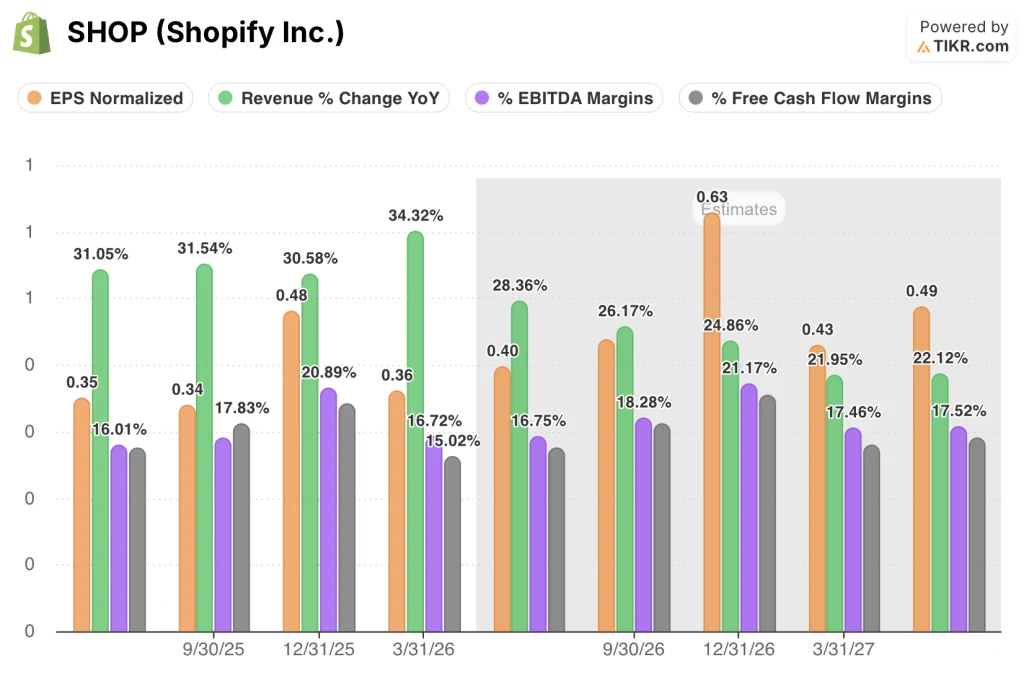 SHOP Stock EPS, Revenue, EBITDA Margins, and FCF Margins Actuals & Estimates (TIKR)
Shopify stock consensus calls for revenue growth of 28% in Q2 2026, decelerating modestly to around 25% by Q4 2026, with EBITDA margins expanding toward 21% as operating leverage continues.
EPS is forecast at $0.40 for Q2 2026, growing 14% year-over-year, and free cash flow margins are expected to hold in the 16% to 20% range across the next four quarters.
 BLOCK Stock EPS, Revenue, FCF Margins, and EBITDA Margins Actuals & Estimates (TIKR)
Meanwhile, Block stock consensus targets revenue growth of just 7% to 8% for 2026, with EBITDA margins expanding toward 20% by year end as profitability outpaces the top line.
EPS is forecast at $0.87 for Q2 2026, growing 40% year-over-year, and full-year adjusted diluted EPS guidance was raised to $3.85, up 62%.
Free cash flow margins are expected to run in the 8% to 12% range through most of 2026, a meaningful step below Shopify’s 16% to 20% band and a reminder that faster EPS growth does not yet translate into equivalent cash generation.
 SHOP Stock Street Analysts Target (TIKR)
Coverage on Shopify stock sits at 38 buys and outperforms against 12 holds and one sell, with the mean analyst target at $148, implying 31% upside from the June 16 close of $113.
 XYZ Stock Street Analysts Target (TIKR)
Meanwhile, Block stock draws 36 buys and outperforms against seven holds and no active sells, with a mean target of $90, implying 21% upside from the $75 close.
Shopify carries the stronger consensus lean and the wider implied upside, a gap that reflects the Street’s preference for a cleaner, faster-growing platform over a complex, two-sided ecosystem still proving its convergence thesis.
Wall Street is watching both setups closely right now. Track every analyst upgrade and earnings estimate revision for Shopify stock and Block stock the moment it hits with TIKR for free →
Financials: Where Shopify’s Gross Profit Edge Over Block Actually Shows Up
Comparing Shopify and Block on revenue is one of the more misleading exercises in publicly traded commerce.
 XYZ Stock Revenues vs SHOP Stock (TIKR)
Block reported $6.06 billion in Q1 2026 revenue to Shopify’s $3.17 billion, a gap that suggests Block is nearly twice the business.
 SHOP Stock Gross Profit and Gross Margins vs XYZ Stock (TIKR)
The income statement corrects that immediately: Shopify generated $1.55 billion in gross profit at a 49% margin, while Block generated $2.92 billion at a 48% margin. Block’s gross profit is larger, but the structural difference disappears when margins are nearly identical and Shopify is growing its gross profit base 32% year-over-year versus Block’s 27%.
The operating income line tells the more important story about where each business stands on the path to profitability.
 SHOP Stock Operating Income and Operating Margins vs XYZ Stock (TIKR)
Shopify’s operating income in Q1 2026 was $500 million, representing a 16% operating margin on revenue and continuing a four-quarter trend of expanding leverage. A year prior, in Q1 2025, Shopify’s operating margin was 12%.
Block’s GAAP operating loss of $160 million in Q1 2026 requires context: a one-time $852 million restructuring charge from the company’s decision to cut roughly 40% of its workforce and pivot toward AI distorted the headline figure. Strip that out and Block posted an all-time high $728 million in adjusted operating income, a 25% adjusted margin, which actually puts the two companies closer on underlying profitability than the GAAP line suggests.
The gross margin trajectory is where Shopify’s advantage becomes structural.
 SHOP Stock Gross Margins vs XYZ Stock (TIKR)
Shopify’s gross margins have held between 46% and 52% over the past eight quarters despite rapid growth in Merchant Solutions, the lower-margin payments segment.
Block’s gross margins have improved sharply, from 37% in Q2 2024 to 48% in Q1 2026, as gross profit has outrun flat headline revenue.
Both companies are converging toward similar gross margin levels: Shopify through structural software leverage that generates operating income at scale, and Block through aggressive cost discipline that delivered a 25% adjusted operating margin in Q1 2026.
Shopify vs Block: What TIKR’s Valuation Model Says
TIKR’s model values Shopify Inc. at approximately $294 by December 2030, implying around 160% total return from the current price of $113, or roughly 23% per year.
 SHOP Stock Valuation Model Results (TIKR)
The target rests on Shopify sustaining the trajectory it has now delivered for four consecutive quarters: 30%-plus revenue growth alongside mid-to-high-teens free cash flow margins.
If Shopify Payments penetration continues rising and B2B and enterprise add incremental GMV layers, the operating leverage that pushed margins from 12% to 16% in a single year accelerates further.
Shopify stock appears undervalued at current prices, with Street consensus already implying 31% upside to $148 and TIKR’s longer-dated model pointing to approximately $294.
TIKR’s model values Block, Inc. at approximately $153 by December 2030, implying around 104% total return from the current price of $75, or roughly 17% per year.
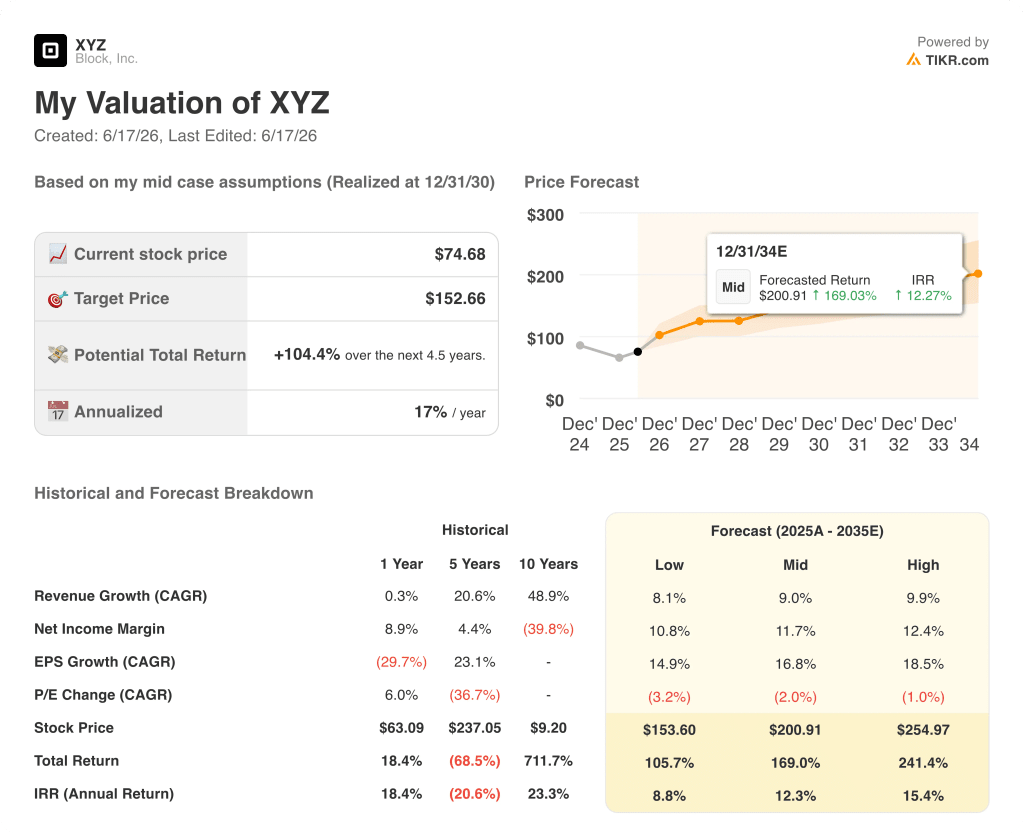 XYZ Stock Valuation Model Results (TIKR)
The target assumes Block sustains the gross profit trajectory CFO Amrita Ahuja outlined for the full year: 19% gross profit growth expanding toward a 27% adjusted operating income margin.
If the Neighborhoods program begins driving Cash App active growth in the second half of 2026 as management expects, the Square and Cash App convergence starts contributing incremental gross profit the current model does not fully price.
Block stock appears modestly undervalued at current prices, with adjusted EPS expected to grow 62% in 2026 and the Street’s mean target of $90 implying 21% upside.
TIKR’s model implies roughly a 6-point IRR advantage for Shopify stock over Block stock through 2030, a gap wide enough to favor Shopify for investors choosing one, but not so wide that Block’s cheaper entry on gross profit and faster EPS growth can be dismissed.
Both TIKR models are based on assumptions you can adjust yourself. Pull up Shopify stock and Block stock on TIKR, run your own scenarios, and see which setup fits your return target, for free
Should You Invest in Shopify Inc. or Block, Inc.?
The only way to really know is to look at the numbers yourself. TIKR gives you free access to the same institutional-quality financial data that professional analysts use to answer exactly that question.
Pull up Shopify Inc. stock and Block, Inc. stock and you’ll see years of historical financials, what Wall Street analysts expect for revenue and earnings in the quarters ahead, how valuation multiples have moved over time, and whether price targets are trending up or down for both companies.
You can build a free watchlist to track Shopify Inc. and Block, Inc. alongside every other stock on your radar. No credit card required. Just the data you need to decide for yourself.
Access Professional Tools to Analyze SHOP and XYZ stock on TIKR for Free →


You May Also Like

Blue Sage Solutions Expands Embedded AI Capabilities Across the Mortgage Lifecycle

South Korea Stablecoin Legislation: FSC Accelerates Crucial Regulatory Framework and Tax Review

Defying Trump’s Hopes of a Rate Cut, Warsh Holds Rates Steady at 3.75%



