Pavel Durov, the founder and CEO of Telegram, used a wide-ranging conversation on the Lex Fridman Podcast to make one of his clearest long-term calls on Bitcoin yet: “I believe it will come to a point when Bitcoin is worth $1 million.” The remarks appear on Fridman’s newly released episode with Durov. Why Bitcoin Will Reach $1 Million: Pavel Durov Pressed by Fridman on why he kept accumulating Bitcoin and whether he sees further upside, Durov traced his conviction to the asset’s earliest days and to its monetary design. “I was a big believer in Bitcoin since more or less the start of it,” he said, recalling that he bought “my first few thousand of Bitcoin in 2013,” around “$700 per Bitcoin,” and refused to sell even as the price later fell toward $300. Related Reading: Will October Crown Bitcoin Or Break It? Key Levels In Play “And my response to them was, I don’t care. I’m not going to sell it. I believe in this thing.” For Durov, the crux is Bitcoin’s censorship resistance and predictable issuance: “Nobody can confiscate your Bitcoin from you. Nobody can censor you for political reasons. This is the ultimate means of exchange… The governments keep printing money like no tomorrow. Nobody’s printing Bitcoin. There is a predictable inflation and then it stops at a certain point. Bitcoin is here to stay.” Durov also drew a sharp line between his personal finances and Telegram’s operating economics, saying Bitcoin appreciation has effectively financed his lifestyle, not profits from the company. “Telegram is a money losing operation for me personally. Bitcoin is something that allowed me to stay afloat,” he noted, adding that his long-term horizon on the asset has not changed since his early purchases more than a decade ago. The timing of Durov’s $1 million thesis is notable given Telegram’s expanding role at crypto’s consumer edge. The company has progressively integrated the TON ecosystem into its product and business model, committing to Toncoin-based ad payments and revenue sharing for channel owners and opening its advertising platform to a broad set of markets. That TON-denominated ad infrastructure has been credited with catalyzing user and developer activity across Telegram’s mini-app economy. Related Reading: Bitcoin Short-Term Holders At Cost Basis: SOPR At 1 Signals Mareket Equilibrium On the wallet side, Telegram’s crypto functionality—first rolled out internationally—extended to the United States in July 2025, with the TON community’s wallet mini-app enabling in-app transfers and payments. The US expansion followed what Telegram described as nine-figure global wallet activation metrics in 2024, underscoring the scale of a potential distribution channel for on-chain payments and games. As for the $1 million number itself, Durov anchored it in supply discipline and fiat debasement rather than in short-term market catalysts. His reasoning tracks with hard-cap arguments long advanced by Bitcoin’s most committed holders: issuance is programmatic and terminal, while fiscal and monetary expansion remains discretionary. JUST IN: Telegram CEO says he thinks Bitcoin will go to $1,000,000 👀 “The governments keeps printing money like no tomorrow. Nobody is printing bitcoin.” 🚀 pic.twitter.com/AiDwr7xVkQ — Bitcoin Magazine (@BitcoinMagazine) September 30, 2025 Whether that macro narrative alone can deliver seven-figure prices is a market question; what Durov made clear is that his own positioning reflects a decade of conviction. “Just look at the trends,” he told Fridman. “Bitcoin is here to stay. All the fiat currencies remain to be seen.” At press time, Bitcoin traded at $114,372. Featured image created with DALL.E, chart from TradingView.comPavel Durov, the founder and CEO of Telegram, used a wide-ranging conversation on the Lex Fridman Podcast to make one of his clearest long-term calls on Bitcoin yet: “I believe it will come to a point when Bitcoin is worth $1 million.” The remarks appear on Fridman’s newly released episode with Durov. Why Bitcoin Will Reach $1 Million: Pavel Durov Pressed by Fridman on why he kept accumulating Bitcoin and whether he sees further upside, Durov traced his conviction to the asset’s earliest days and to its monetary design. “I was a big believer in Bitcoin since more or less the start of it,” he said, recalling that he bought “my first few thousand of Bitcoin in 2013,” around “$700 per Bitcoin,” and refused to sell even as the price later fell toward $300. Related Reading: Will October Crown Bitcoin Or Break It? Key Levels In Play “And my response to them was, I don’t care. I’m not going to sell it. I believe in this thing.” For Durov, the crux is Bitcoin’s censorship resistance and predictable issuance: “Nobody can confiscate your Bitcoin from you. Nobody can censor you for political reasons. This is the ultimate means of exchange… The governments keep printing money like no tomorrow. Nobody’s printing Bitcoin. There is a predictable inflation and then it stops at a certain point. Bitcoin is here to stay.” Durov also drew a sharp line between his personal finances and Telegram’s operating economics, saying Bitcoin appreciation has effectively financed his lifestyle, not profits from the company. “Telegram is a money losing operation for me personally. Bitcoin is something that allowed me to stay afloat,” he noted, adding that his long-term horizon on the asset has not changed since his early purchases more than a decade ago. The timing of Durov’s $1 million thesis is notable given Telegram’s expanding role at crypto’s consumer edge. The company has progressively integrated the TON ecosystem into its product and business model, committing to Toncoin-based ad payments and revenue sharing for channel owners and opening its advertising platform to a broad set of markets. That TON-denominated ad infrastructure has been credited with catalyzing user and developer activity across Telegram’s mini-app economy. Related Reading: Bitcoin Short-Term Holders At Cost Basis: SOPR At 1 Signals Mareket Equilibrium On the wallet side, Telegram’s crypto functionality—first rolled out internationally—extended to the United States in July 2025, with the TON community’s wallet mini-app enabling in-app transfers and payments. The US expansion followed what Telegram described as nine-figure global wallet activation metrics in 2024, underscoring the scale of a potential distribution channel for on-chain payments and games. As for the $1 million number itself, Durov anchored it in supply discipline and fiat debasement rather than in short-term market catalysts. His reasoning tracks with hard-cap arguments long advanced by Bitcoin’s most committed holders: issuance is programmatic and terminal, while fiscal and monetary expansion remains discretionary. JUST IN: Telegram CEO says he thinks Bitcoin will go to $1,000,000 👀 “The governments keeps printing money like no tomorrow. Nobody is printing bitcoin.” 🚀 pic.twitter.com/AiDwr7xVkQ — Bitcoin Magazine (@BitcoinMagazine) September 30, 2025 Whether that macro narrative alone can deliver seven-figure prices is a market question; what Durov made clear is that his own positioning reflects a decade of conviction. “Just look at the trends,” he told Fridman. “Bitcoin is here to stay. All the fiat currencies remain to be seen.” At press time, Bitcoin traded at $114,372. Featured image created with DALL.E, chart from TradingView.com

Bitcoin Will Go To $1 Million, Telegram Founder Durov Predicts

2025/10/01 20:00

Pavel Durov, the founder and CEO of Telegram, used a wide-ranging conversation on the Lex Fridman Podcast to make one of his clearest long-term calls on Bitcoin yet: “I believe it will come to a point when Bitcoin is worth $1 million.” The remarks appear on Fridman’s newly released episode with Durov.

Why Bitcoin Will Reach $1 Million: Pavel Durov

Pressed by Fridman on why he kept accumulating Bitcoin and whether he sees further upside, Durov traced his conviction to the asset’s earliest days and to its monetary design. “I was a big believer in Bitcoin since more or less the start of it,” he said, recalling that he bought “my first few thousand of Bitcoin in 2013,” around “$700 per Bitcoin,” and refused to sell even as the price later fell toward $300.

“And my response to them was, I don’t care. I’m not going to sell it. I believe in this thing.” For Durov, the crux is Bitcoin’s censorship resistance and predictable issuance: “Nobody can confiscate your Bitcoin from you. Nobody can censor you for political reasons. This is the ultimate means of exchange… The governments keep printing money like no tomorrow. Nobody’s printing Bitcoin. There is a predictable inflation and then it stops at a certain point. Bitcoin is here to stay.”

Durov also drew a sharp line between his personal finances and Telegram’s operating economics, saying Bitcoin appreciation has effectively financed his lifestyle, not profits from the company. “Telegram is a money losing operation for me personally. Bitcoin is something that allowed me to stay afloat,” he noted, adding that his long-term horizon on the asset has not changed since his early purchases more than a decade ago.

The timing of Durov’s $1 million thesis is notable given Telegram’s expanding role at crypto’s consumer edge. The company has progressively integrated the TON ecosystem into its product and business model, committing to Toncoin-based ad payments and revenue sharing for channel owners and opening its advertising platform to a broad set of markets. That TON-denominated ad infrastructure has been credited with catalyzing user and developer activity across Telegram’s mini-app economy.

On the wallet side, Telegram’s crypto functionality—first rolled out internationally—extended to the United States in July 2025, with the TON community’s wallet mini-app enabling in-app transfers and payments. The US expansion followed what Telegram described as nine-figure global wallet activation metrics in 2024, underscoring the scale of a potential distribution channel for on-chain payments and games.

As for the $1 million number itself, Durov anchored it in supply discipline and fiat debasement rather than in short-term market catalysts. His reasoning tracks with hard-cap arguments long advanced by Bitcoin’s most committed holders: issuance is programmatic and terminal, while fiscal and monetary expansion remains discretionary.

Whether that macro narrative alone can deliver seven-figure prices is a market question; what Durov made clear is that his own positioning reflects a decade of conviction. “Just look at the trends,” he told Fridman. “Bitcoin is here to stay. All the fiat currencies remain to be seen.”

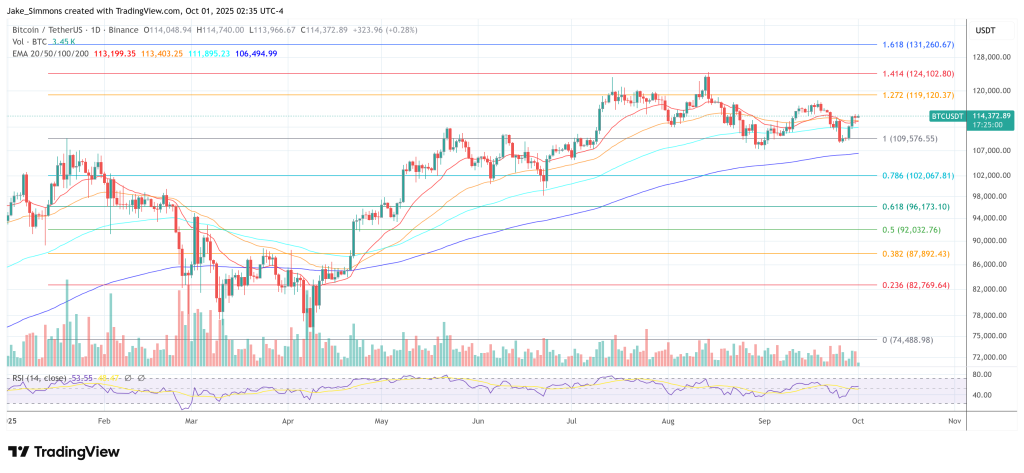
At press time, Bitcoin traded at $114,372.

Bitcoin price
Market Opportunity
Moonveil Logo
Moonveil Price(MORE)
$0.001907
$0.001907$0.001907
-1.08%
USD
Moonveil (MORE) Live Price Chart
Disclaimer: The articles reposted on this site are sourced from public platforms and are provided for informational purposes only. They do not necessarily reflect the views of MEXC. All rights remain with the original authors. If you believe any content infringes on third-party rights, please contact [email protected] for removal. MEXC makes no guarantees regarding the accuracy, completeness, or timeliness of the content and is not responsible for any actions taken based on the information provided. The content does not constitute financial, legal, or other professional advice, nor should it be considered a recommendation or endorsement by MEXC.

You May Also Like

BitGo wins BaFIN nod to offer regulated crypto trading in Europe

BitGo wins BaFIN nod to offer regulated crypto trading in Europe

                                                                               BitGo’s move creates further competition in a burgeoning European crypto market that is expected to generate $26 billion revenue this year, according to one estimate.                     BitGo, a digital asset infrastructure company with more than $100 billion in assets under custody, has received an extension of its license from Germany’s Federal Financial Supervisory Authority (BaFin), enabling it to offer crypto services to European investors. The company said its local subsidiary, BitGo Europe, can now provide custody, staking, transfer, and trading services. Institutional clients will also have access to an over-the-counter (OTC) trading desk and multiple liquidity venues.The extension builds on BitGo’s previous Markets-in-Crypto-Assets (MiCA) license, also issued by BaFIN, and adds trading to the existing custody, transfer and staking services. BitGo acquired its initial MiCA license in May 2025, which allowed it to offer certain services to traditional institutions and crypto native companies in the European Union.Read more
Share
Coinstats2025/09/18 06:02
Trump Filed a Lawsuit Against JPMorgan Chase And Its CEO Over Debanking

Trump Filed a Lawsuit Against JPMorgan Chase And Its CEO Over Debanking

U.S. President Donald Trump filed a lawsuit against JPMorgan Chase and its CEO Jamie Dimon personally, accusing the institution of deliberate debanking. The politician
Share
Incrypted2026/01/23 15:59
Here’s why Polygon price is at risk of a 25% plunge

Here’s why Polygon price is at risk of a 25% plunge

Polygon price continued its freefall, reaching its lowest level since April 21, as the broader crypto sell-off gained momentum. Polygon (POL) dropped to $0.1915, down 32% from its highest point in May and 74% below its 2024 peak. The crash…
Share
Crypto.news2025/06/19 00:56