

The $1 Million Retirement Mistake: Counting Income You’ll Never Get to Spend
The post The $1 Million Retirement Mistake: Counting Income You’ll Never Get to Spend appeared first on 24/7 Wall St..
- A $1 million portfolio yielding 3% sounds like $30,000 annual income, but Johnson & Johnson (JNJ) and similar dividend stocks leave most of it actually spendable after taxes.
- The real retirement killer isn't yield—it's distributions that stay flat or cut when credit cycles turn, eroding principal while the headline percentage looks unchanged.
- Are you ahead, or behind on retirement? SmartAsset's free tool can match you with a financial advisor in minutes to help you answer that today. Each advisor has been carefully vetted, and must act in your best interests. Don't waste another minute; learn more here.
A $1 million portfolio is often discussed as though the balance itself answers the retirement question. It does not. What matters is the amount of income that ultimately reaches your bank account after taxes. The yield displayed on a brokerage statement is only the starting point. Federal taxes, state taxes, and the type of income produced by the portfolio all determine how much is actually available to spend.
That distinction has become more important as household finances tighten. The U.S. personal savings rate has fallen to 3.7%, its lowest level in two years, while inflation continues to erode purchasing power. Retirees who focus solely on gross yield can find themselves overestimating their true income. A portfolio generating $50,000 a year on paper may deliver considerably less once taxes take their share. Retirement is funded with spendable dollars, not headline yields.
Three Retirees, Same $1 Million, Three Different Outcomes
Picture three single filers, each with a $1 million portfolio, each using the 2026 standard deduction of $16,100, each living in a state with a 5% income tax.
Retiree A owns a qualified-dividend portfolio: blue chips like Johnson & Johnson (NYSE:JNJ) and Procter & Gamble (NYSE:PG). JNJ yields about 2.3% and PG about 3%. Blended yield: 3%. Gross income: $30,000.
Retiree B mixes qualified dividends with REITs and preferreds, anchored by Realty Income (NYSE:O) at a 5.4% yield. Blended yield: 5.5%. Gross income: $55,000, split roughly evenly between qualified dividends and ordinary-income REIT distributions.
Retiree C chases yield with business development companies like Main Street Capital (NYSE:MAIN) at 5.9%, mortgage REITs, leveraged covered-call funds, and high-yield bond funds. Blended yield: 9%. Gross income: $90,000. Every dollar is ordinary income.
What Actually Hits the Checking Account
Now run the 2026 tax math. Qualified dividends ride the long-term capital gains schedule, with a 0% bracket up to $48,350 in taxable income for singles. Ordinary income runs the regular bracket ladder topped out at 37%.
| Retiree | Gross | Federal | State (5%) | Net | Monthly |
|---|---|---|---|---|---|
| A (qualified) | $30,000 | $0 | $1,500 | $28,500 | $2,375 |
| B (mixed) | $55,000 | $1,420 | $2,750 | $50,830 | $4,236 |
| C (high-yield) | $90,000 | $10,970 | $4,500 | $74,530 | $6,211 |
Retiree A pays zero federal tax because qualified dividends fall inside the 0% capital gains bracket. Retiree C, despite collecting three times the gross income, surrenders nearly 17% of it to combined taxes. The headline 9% yield becomes an effective 7.5%. The headline 3% yield stays at 2.9%. The gap between strategies narrows on the way to the checking account, and it narrows more in a high-tax state. New York’s adjusted state and local burden runs more than double Florida’s or Tennessee’s.
The Income Growth Factor Most Yield Screens Ignore
After-tax income is only part of the equation. The other question is whether that income will grow. Companies with long records of dividend increases have historically provided a measure of protection against inflation by steadily raising the cash they pay shareholders. A portfolio yielding 3% to 4% today can look far more attractive a decade from now if its distributions continue growing while living costs rise.
That is where the highest-yielding investments often face a trade-off. Business development companies, mortgage REITs, and other income-focused vehicles can produce impressive cash flow today, but those distributions are often more sensitive to interest rates, credit conditions, and economic cycles. When conditions deteriorate, supplemental distributions may be reduced, special dividends may disappear, and share prices can come under pressure even if the headline yield remains elevated.
Investors should also remember that yields do not exist in a vacuum. When Treasury yields rise, income investments must compete against increasingly attractive low-risk alternatives. A double-digit yield may still be worthwhile, but only if the underlying business can support it through changing market conditions. The goal is not simply to find the highest yield available. It is to find income that remains durable, grows over time, and preserves purchasing power.
Do This Before You Chase a High Yield
- Recalculate in net dollars. Take your projected gross income, subtract federal tax using the actual character of each distribution (qualified vs. ordinary), then subtract your state rate. Divide by 12. That monthly number is your real retirement paycheck.
- Stress-test the distribution, not just the yield. Pull five years of dividend history on every income holding. A flat or cut distribution at a 9% yield can underperform a 3% yield that compounds 7% annually within a decade.
- Locate accounts by tax character. Hold ordinary-income payers (REITs, BDCs, bond funds) inside IRAs where the ordinary-income hit is deferred. Keep qualified-dividend stocks in taxable accounts where the 0% or 15% rate applies.
The $1 million mistake is counting income that goes to someone else before it ever reaches you.
If You’ve Been Thinking About Retirement, Pay Attention (sponsor)
Retirement planning doesn’t have to feel overwhelming. The key is finding expert guidance, and SmartAsset’s simple quiz makes it easier than ever for you to connect with a vetted financial advisor. Here’s how:
-
Answer a Few Simple Questions.
-
Get Matched with Vetted Advisors
-
Choose Your Fit
Why wait? Start building the retirement you’ve always dreamed of. Get started today! (sponsor)
The post The $1 Million Retirement Mistake: Counting Income You’ll Never Get to Spend appeared first on 24/7 Wall St..


You May Also Like
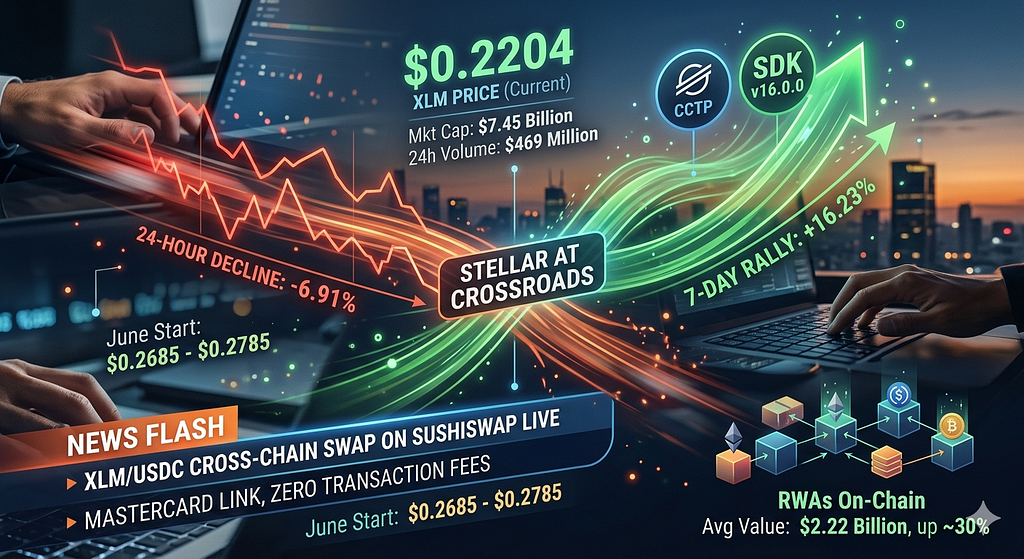
Stellar (XLM) Trading at a Crossroads: Analyzing the 24-Hour Decline vs. 7-Day Rally

Why Isn’t Robert Kiyosaki Buying the Dip in BTC, ETH, Gold, and Silver?

CZ: “I’m Not Going to Exit” as Bitcoin Cycle Still Outperforms Despite 50% Drop



