

Bitcoin's Smallest Transactions Are Booming as Micro-Payments Take Bigger Share of Network Activity
Key highlights:
- Microtransactions now account for a growing share of Bitcoin network activity, signaling expanding real-world usage.
- The trend is being driven by Lightning Network adoption, gaming applications, tipping platforms, and low-value payments.
- The shift comes as Bitcoin continues balancing its role as both a store of value and a payments network.
Bitcoin's smallest transfers are becoming increasingly important
Bitcoin's network activity is evolving.
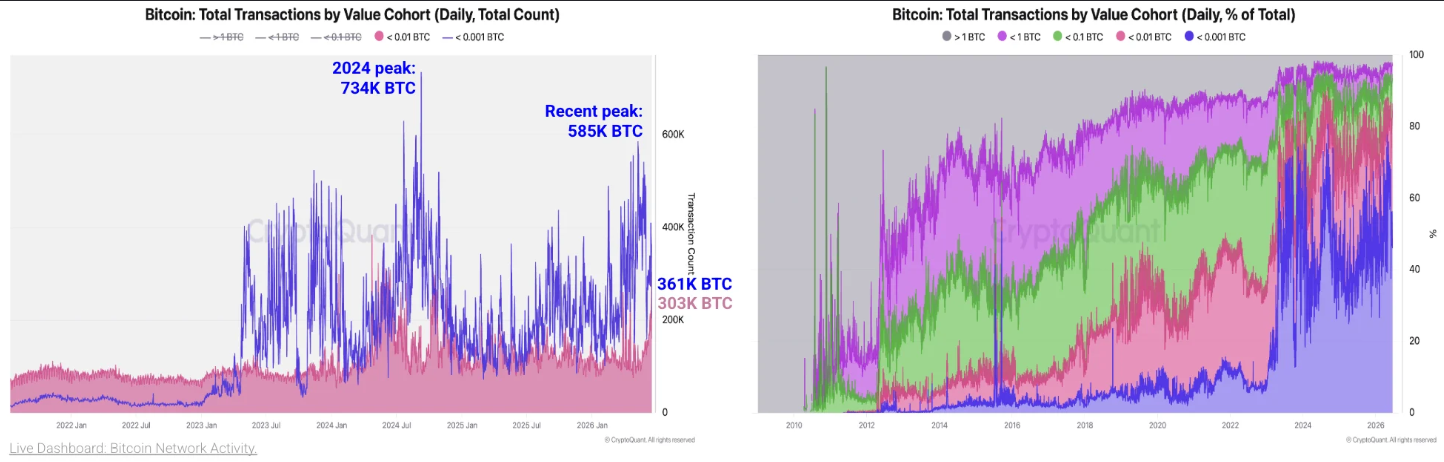
While institutional adoption and Bitcoin digital asset treasuries continue dominating headlines, blockchain data suggests that microtransactions are accounting for a growing share of network activity. The trend points to increasing use of Bitcoin for everyday payments rather than solely as a long-term investment asset.
The transaction surge is concentrated almost entirely in the lowest value cohorts, with sub-0.01 BTC transactions commanding approximately 80% of daily counts. The sub-0.001 BTC and sub-0.01 BTC cohorts each skyrocketed in 2026 and are approaching the prior peak of 2024.
Microtransactions typically involve relatively small transfers that are often facilitated through the Lightning Network, Bitcoin's layer-two scaling solution. These transactions are commonly used for online purchases, content payments, gaming rewards, remittances, and tipping services.
The rise in smaller transfers highlights a different side of Bitcoin's ecosystem—one focused on utility rather than speculation.
Lightning adoption continues expanding
Much of the growth appears to be tied to the Lightning Network. The value of the transactions tied to lightning has trailed above $200 million since the beginning of 2026.
The payment protocol enables near-instant Bitcoin transfers with significantly lower fees than on-chain transactions, making small payments economically viable.
Over the past several years, Lightning has expanded across exchanges, payment providers, gaming applications, and social platforms. The technology is increasingly being used in regions where traditional payment infrastructure remains expensive or inaccessible.
The trend supports the long-standing argument that Bitcoin can function as both a store of value and a medium of exchange.
Bitcoin's utility narrative is gaining traction
The increase in microtransactions comes at a time when investors are debating Bitcoin's primary use case.
Institutional adoption has strengthened the "digital gold" narrative, particularly following the success of spot Bitcoin ETFs and the rise of corporate treasury strategies.
However, growing transaction activity suggests payment-related demand remains alive and well.
Supporters argue that rising microtransaction volumes demonstrate that Bitcoin is becoming more useful as a financial network rather than merely a speculative asset. Critics, meanwhile, note that much of the activity still occurs through scaling layers rather than directly on the base chain.
Regardless of the debate, the data points toward a broader ecosystem than the one that existed just a few years ago.
What it means for Bitcoin
The growing role of microtransactions may become increasingly important as Bitcoin adoption expands globally.
While large institutional transfers continue moving billions of dollars across the network, smaller payments represent a different form of growth—one tied to everyday usage and practical utility.
For Bitcoin bulls, the trend provides evidence that the network is supporting a wider range of economic activity than simple buy-and-hold investing.
As Lightning adoption grows and transaction costs remain low, microtransactions could become an increasingly important component of Bitcoin's long-term value proposition.
The development also serves as a reminder that Bitcoin's future may not be defined solely by ETF flows, treasury purchases, or price speculation. Increasingly, it may also depend on how effectively the network facilitates millions of small transactions occurring every day.


You May Also Like

GE Vernova and Vertiv: Why AI Power Stocks Are Becoming the New Data-Center Bottleneck Trade

World Cup teams will be paid a record $871 million: Each team will get $12.5 million as a bare minimum for playing and ‘preparation money’

Senate moves on coinbase CLARITY Act as stablecoin



