This ablation study on AdaMix highlights the factors driving its efficiency in parameter-efficient fine-tuning. Results show that adaptation merging consistently outperforms random or fixed routing, while consistency regularization proves essential to maintaining strong performance. Module sharing is particularly effective in low-resource tasks, boosting convergence speed and lowering training loss compared to models without sharing. Experiments with adaptation module count and bottleneck dimension reveal diminishing returns, stressing the importance of balance over brute force scaling. Overall, AdaMix demonstrates how thoughtful design choices yield superior results to full model tuning.This ablation study on AdaMix highlights the factors driving its efficiency in parameter-efficient fine-tuning. Results show that adaptation merging consistently outperforms random or fixed routing, while consistency regularization proves essential to maintaining strong performance. Module sharing is particularly effective in low-resource tasks, boosting convergence speed and lowering training loss compared to models without sharing. Experiments with adaptation module count and bottleneck dimension reveal diminishing returns, stressing the importance of balance over brute force scaling. Overall, AdaMix demonstrates how thoughtful design choices yield superior results to full model tuning.

The Role of Consistency and Sharing in Efficient Fine-Tuning

2025/10/01 21:00

Abstract and 1. Introduction

  1. Background

    2.1 Mixture-of-Experts

    2.2 Adapters

  2. Mixture-of-Adaptations

    3.1 Routing Policy

    3.2 Consistency regularization

    3.3 Adaptation module merging and 3.4 Adaptation module sharing

    3.5 Connection to Bayesian Neural Networks and Model Ensembling

  3. Experiments

    4.1 Experimental Setup

    4.2 Key Results

    4.3 Ablation Study

  4. Related Work

  5. Conclusions

  6. Limitations

  7. Acknowledgment and References

Appendix

A. Few-shot NLU Datasets B. Ablation Study C. Detailed Results on NLU Tasks D. Hyper-parameter

4.3 Ablation Study

We perform all the ablation analysis on AdaMix with adapters for parameter-efficient fine-tuning.

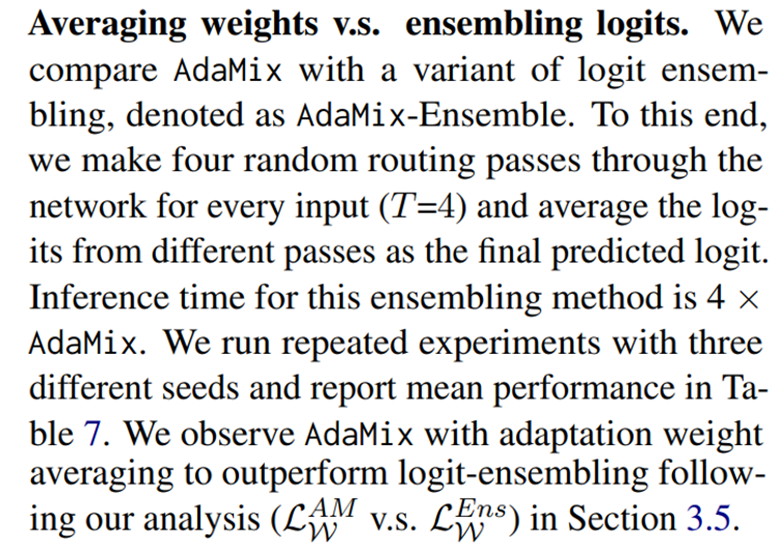
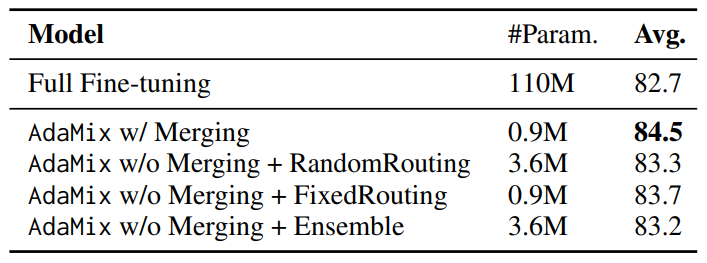
\ Analysis of adaptation merging. In this ablation study, we do not merge adaptation modules and consider two different routing strategies at inference time: (a) randomly routing input to any adaptation module, and (b) fixed routing where we route all the input to the first adaptation module in AdaMix. From Table 7, we observe AdaMix with adaptation merging to perform better than any of the other variants without the merging mechanism. Notably, all of the AdaMix variants outperform full model tuning.

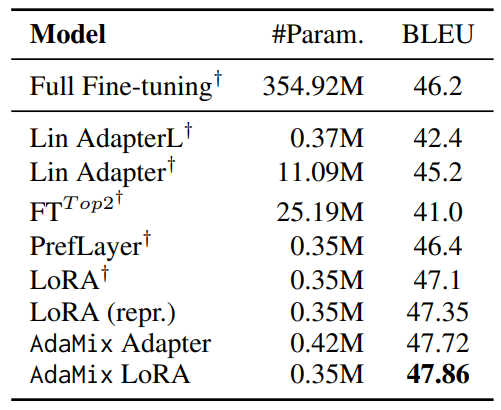
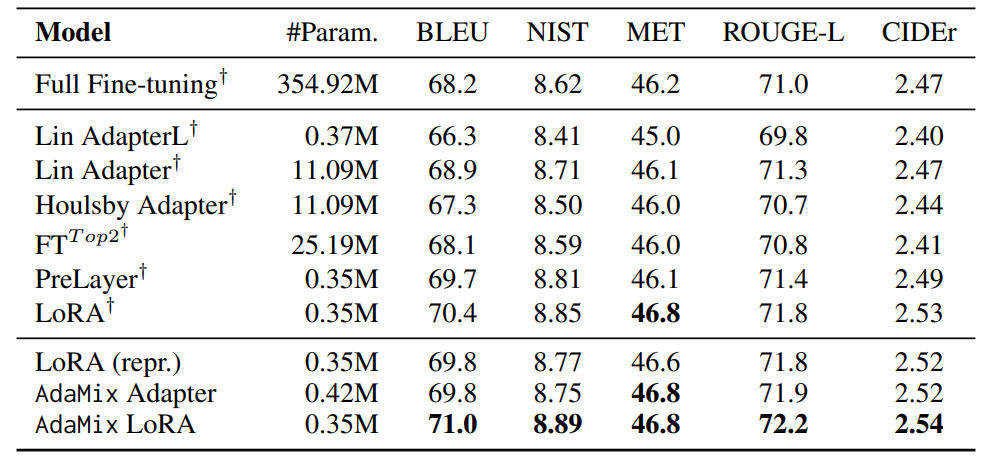
\ Table 3: Results on E2E NLG Challenge with GPT-2 medium backbone. Best result on each task is in bold. We report AdaMix results with both adapters and LoRA as underlying PEFT method. AdaMix outperforms all competing methods as well as fully fine-tuned large model with only 0.1% tunable parameters.† denotes results reported from (Hu et al., 2021) and repr. denotes reproduced results. #Param. denotes the number of tunable adaptation parameters used during inference. Results on DART and WebNLG presented in Tables 4 and 5 in Appendix
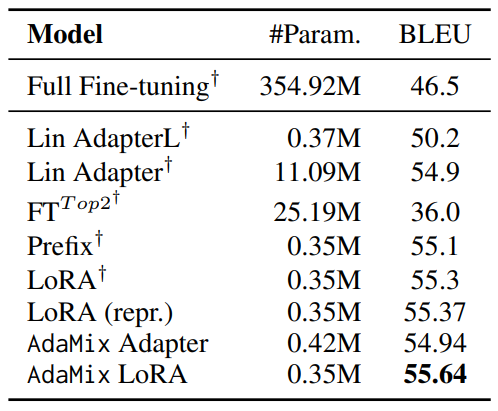
\ Table 4: Results on DART with GPT-2 backbone encoder. Best result on each task is in bold. We report AdaMix results with both adapters and LoRA as underlying PEFT method. AdaMix outperforms all competing methods as well as fully fine-tuned large model with only 0.1% tunable parameters.† denotes results reported from (Hu et al., 2021) and repr. denotes reproduced results. #Param. denotes the number of tunable adaptation parameters used during inference.

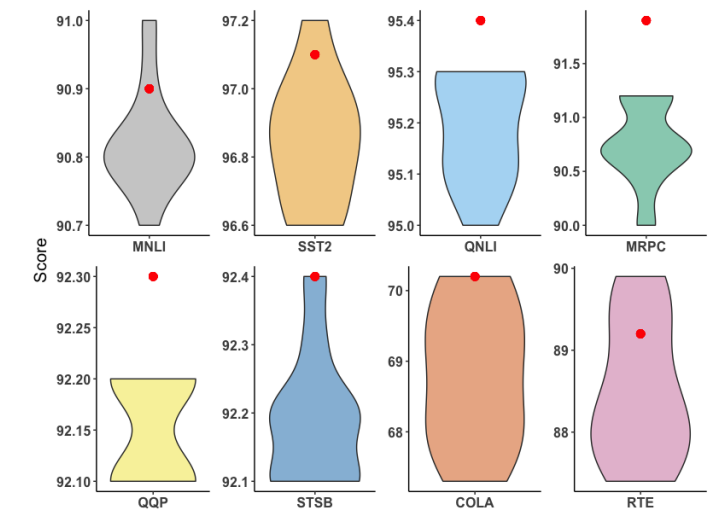
\ Moreover, Figure 5 shows that the performance of merging mechanism is consistently better than the average performance of random routing and comparable to the best performance of random routing.

\ \ \ Table 5: Results on WebNLG with GPT-2 medium backbone. The results are based on all categories in the test set of WebNLG. Best result on each task is in bold. We report AdaMix results with both adapters and LoRA as underlying PEFT method. AdaMix outperforms all competing methods as well as fully fine-tuned large model with only 0.1% tunable parameters.† denotes results reported from (Hu et al., 2021) and repr. denotes reproduced results. #Param. denotes the number of tunable adaptation parameters used during inference.
\

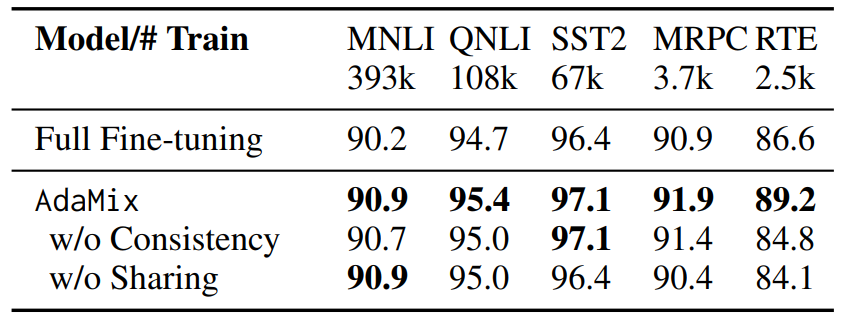
\ Analysis of consistency regularization. We drop consistency regularization during training for ablation and demonstrate significant performance degradation in Table 8.

\ Analysis of adaptation module sharing. We remove adaptation module sharing in AdaMix for ablation and keep four different copies of projectdown and four project-up FFN layers. From Table 8 we observe the performance gap between AdaMix and AdaMix w/o sharing to increase with decrease in the dataset size demonstrating the importance of parameter sharing for low-resource tasks (e.g.,

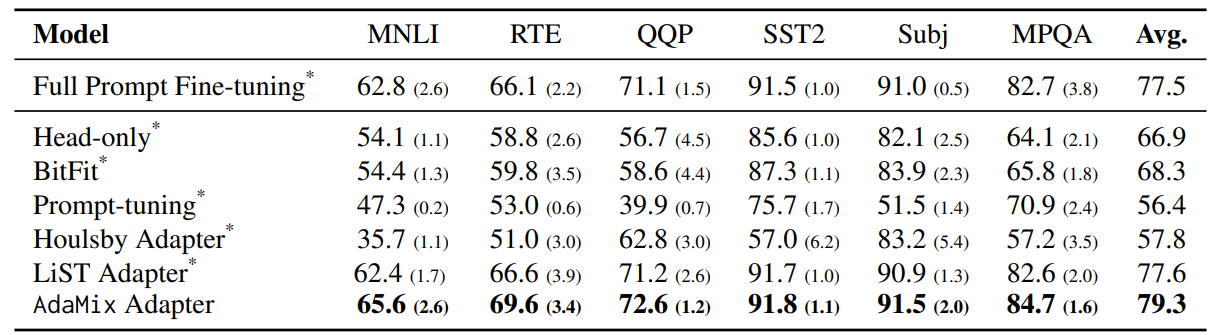
\ Table 6: Average performance and standard deviation of several parameter-efficient fine-tuning strategies based on RoBERTa-large with |K| = 30 training labels. The best performance is shown in bold. Prompt-tuning, Head-only and BitFit tune 1M model parameters during inference. Houlsby Adapter, LiST Adapter and AdaMix Adapter tune 14M model parameters. * denotes that the results are taken from (Wang et al., 2021).
\ Table 7: AdaMix without adaptation merging and different routing and ensembling strategies. Average results are presented on GLUE development set with BERTbase encoder. Detailed task results in Table 14 of Appendix for BERT-base and RoBERTa-large encoders.

\ Figure 5: Violin plot of AdaMix-RandomRouting performance distribution with RoBERTa-large encoders. Red dot denotes the performance of AdaMix.

\ Table 8: Ablation study demonstrating the impact of consistency regularization and sharing in AdaMix.

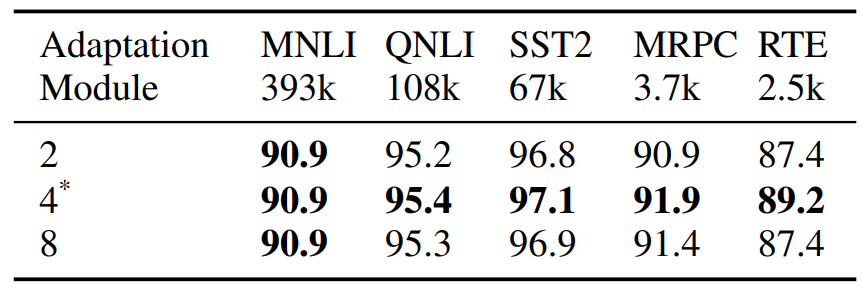
\ RTE, MRPC). This is further demonstrated in Figure 7 in Appendix which shows a faster convergence and lower training loss of AdaMix with sharing compared to that without given the same number of training steps. We explore which adaptation module to share (project-up v.s. project-down) in Table 11 in Appendix that depict similar results. Impact of the number of adaptation modules. In this study, we vary the number of adaptation modules in AdaMix as 2, 4 and 8 during training. Table 9 shows diminishing returns on aggregate task performance with increasing number of modules. As we increase sparsity and the number of tunable parameters by increasing the number of adaptation modules, low-resource tasks like RTE and SST-2 – with limited amount of labeled data for fine-tuning – degrade in performance compared to high-resource tasks like MNLI and QNLI.

\ Table 9: Varying the number of adaptation modules in AdaMix with RoBERTa-large encoder. * denotes the number of modules used in AdaMix with adapters.
\ Impact of adapter bottleneck dimension. Table 10 shows the impact of bottleneck dimension of adapters with different encoders in AdaMix. The model performance improves with increase in the number of trainable parameters by increasing the bottleneck dimension with diminishing returns after a certain point.

\

:::info Authors:

(1) Yaqing Wang, Purdue University ([email protected]);

(2) Sahaj Agarwal, Microsoft ([email protected]);

(3) Subhabrata Mukherjee, Microsoft Research ([email protected]);

(4) Xiaodong Liu, Microsoft Research ([email protected]);

(5) Jing Gao, Purdue University ([email protected]);

(6) Ahmed Hassan Awadallah, Microsoft Research ([email protected]);

(7) Jianfeng Gao, Microsoft Research ([email protected]).

:::


:::info This paper is available on arxiv under CC BY 4.0 DEED license.

:::

\

Disclaimer: The articles reposted on this site are sourced from public platforms and are provided for informational purposes only. They do not necessarily reflect the views of MEXC. All rights remain with the original authors. If you believe any content infringes on third-party rights, please contact [email protected] for removal. MEXC makes no guarantees regarding the accuracy, completeness, or timeliness of the content and is not responsible for any actions taken based on the information provided. The content does not constitute financial, legal, or other professional advice, nor should it be considered a recommendation or endorsement by MEXC.

You May Also Like

SEC urges caution on crypto wallets in latest investor guide

SEC urges caution on crypto wallets in latest investor guide

The SEC’s Office of Investor Education and Assistance issued a bulletin warning retail investors about crypto asset custody risks. The guidance covers how investors
Share
Crypto.news2025/12/15 01:45
Crucial Fed Rate Cut: October Probability Surges to 94%

Crucial Fed Rate Cut: October Probability Surges to 94%

BitcoinWorld Crucial Fed Rate Cut: October Probability Surges to 94% The financial world is buzzing with a significant development: the probability of a Fed rate cut in October has just seen a dramatic increase. This isn’t just a minor shift; it’s a monumental change that could ripple through global markets, including the dynamic cryptocurrency space. For anyone tracking economic indicators and their impact on investments, this update from the U.S. interest rate futures market is absolutely crucial. What Just Happened? Unpacking the FOMC Statement’s Impact Following the latest Federal Open Market Committee (FOMC) statement, market sentiment has decisively shifted. Before the announcement, the U.S. interest rate futures market had priced in a 71.6% chance of an October rate cut. However, after the statement, this figure surged to an astounding 94%. This jump indicates that traders and analysts are now overwhelmingly confident that the Federal Reserve will lower interest rates next month. Such a high probability suggests a strong consensus emerging from the Fed’s latest communications and economic outlook. A Fed rate cut typically means cheaper borrowing costs for businesses and consumers, which can stimulate economic activity. But what does this really signify for investors, especially those in the digital asset realm? Why is a Fed Rate Cut So Significant for Markets? When the Federal Reserve adjusts interest rates, it sends powerful signals across the entire financial ecosystem. A rate cut generally implies a more accommodative monetary policy, often enacted to boost economic growth or combat deflationary pressures. Impact on Traditional Markets: Stocks: Lower interest rates can make borrowing cheaper for companies, potentially boosting earnings and making stocks more attractive compared to bonds. Bonds: Existing bonds with higher yields might become more valuable, but new bonds will likely offer lower returns. Dollar Strength: A rate cut can weaken the U.S. dollar, making exports cheaper and potentially benefiting multinational corporations. Potential for Cryptocurrency Markets: The cryptocurrency market, while often seen as uncorrelated, can still react significantly to macro-economic shifts. A Fed rate cut could be interpreted as: Increased Risk Appetite: With traditional investments offering lower returns, investors might seek higher-yielding or more volatile assets like cryptocurrencies. Inflation Hedge Narrative: If rate cuts are perceived as a precursor to inflation, assets like Bitcoin, often dubbed “digital gold,” could gain traction as an inflation hedge. Liquidity Influx: A more accommodative monetary environment generally means more liquidity in the financial system, some of which could flow into digital assets. Looking Ahead: What Could This Mean for Your Portfolio? While the 94% probability for a Fed rate cut in October is compelling, it’s essential to consider the nuances. Market probabilities can shift, and the Fed’s ultimate decision will depend on incoming economic data. Actionable Insights: Stay Informed: Continue to monitor economic reports, inflation data, and future Fed statements. Diversify: A diversified portfolio can help mitigate risks associated with sudden market shifts. Assess Risk Tolerance: Understand how a potential rate cut might affect your specific investments and adjust your strategy accordingly. This increased likelihood of a Fed rate cut presents both opportunities and challenges. It underscores the interconnectedness of traditional finance and the emerging digital asset space. Investors should remain vigilant and prepared for potential volatility. The financial landscape is always evolving, and the significant surge in the probability of an October Fed rate cut is a clear signal of impending change. From stimulating economic growth to potentially fueling interest in digital assets, the implications are vast. Staying informed and strategically positioned will be key as we approach this crucial decision point. The market is now almost certain of a rate cut, and understanding its potential ripple effects is paramount for every investor. Frequently Asked Questions (FAQs) Q1: What is the Federal Open Market Committee (FOMC)? A1: The FOMC is the monetary policymaking body of the Federal Reserve System. It sets the federal funds rate, which influences other interest rates and economic conditions. Q2: How does a Fed rate cut impact the U.S. dollar? A2: A rate cut typically makes the U.S. dollar less attractive to foreign investors seeking higher returns, potentially leading to a weakening of the dollar against other currencies. Q3: Why might a Fed rate cut be good for cryptocurrency? A3: Lower interest rates can reduce the appeal of traditional investments, encouraging investors to seek higher returns in alternative assets like cryptocurrencies. It can also be seen as a sign of increased liquidity or potential inflation, benefiting assets like Bitcoin. Q4: Is a 94% probability a guarantee of a rate cut? A4: While a 94% probability is very high, it is not a guarantee. Market probabilities reflect current sentiment and data, but the Federal Reserve’s final decision will depend on all available economic information leading up to their meeting. Q5: What should investors do in response to this news? A5: Investors should stay informed about economic developments, review their portfolio diversification, and assess their risk tolerance. Consider how potential changes in interest rates might affect different asset classes and adjust strategies as needed. Did you find this analysis helpful? Share this article with your network to keep others informed about the potential impact of the upcoming Fed rate cut and its implications for the financial markets! To learn more about the latest crypto market trends, explore our article on key developments shaping Bitcoin price action. This post Crucial Fed Rate Cut: October Probability Surges to 94% first appeared on BitcoinWorld.
Share
Coinstats2025/09/18 02:25
Bitcoin’s Battle with Market Pressures Sparks Concerns

Bitcoin’s Battle with Market Pressures Sparks Concerns

Throughout the weekend, Bitcoin exhibited a degree of stability. Yet, it is once again challenging the critical support level of $88,000.Continue Reading:Bitcoin
Share
Coinstats2025/12/15 01:35