

Did the RBI Ban Crypto in India – and Is That Ban Still Active in 2026?
BitcoinWorld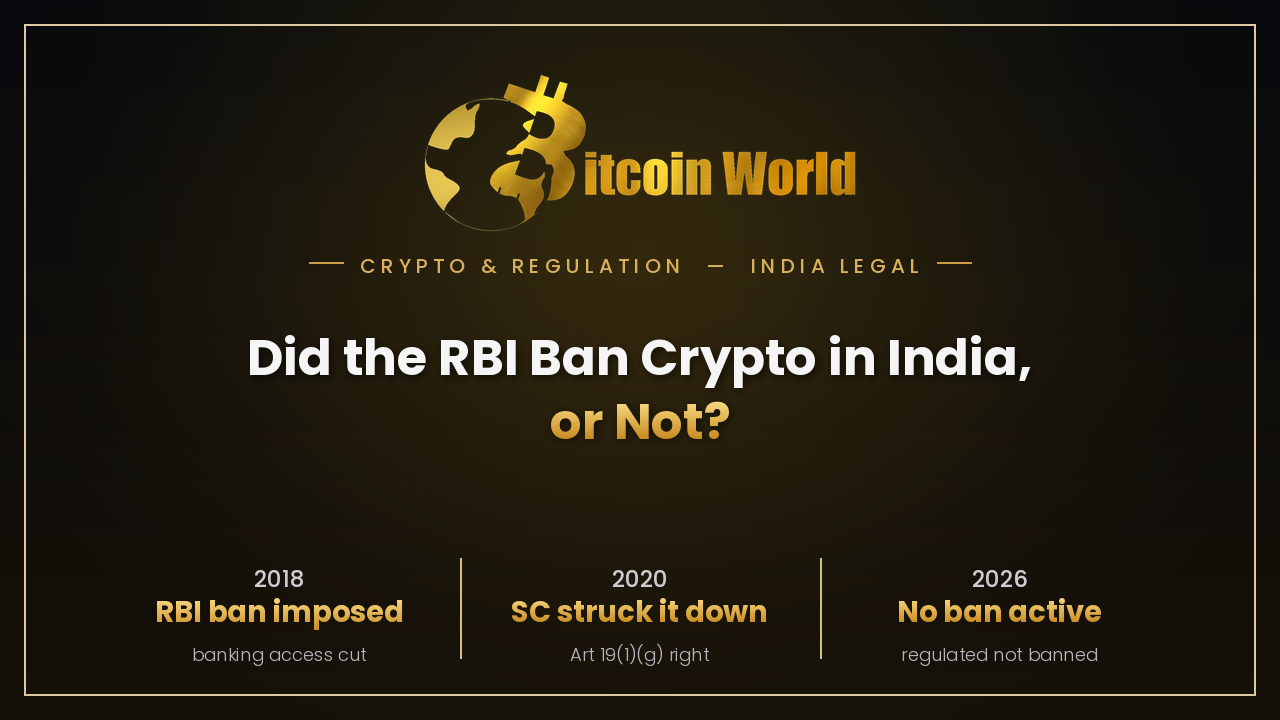
Did the RBI Ban Crypto in India – and Is That Ban Still Active in 2026?
Did the RBI Ban Crypto in India, or Not?
The RBI did ban crypto in India in 2018 – but that ban was struck down by the Supreme Court in March 2020 and has not been reinstated. What persists is not a ban but a cautious, restrictive regulatory posture from the RBI, which continues to view private cryptocurrencies as a risk to monetary stability while simultaneously promoting its own Digital Rupee (e-Rupee). This article explains exactly what the 2018 RBI ban involved, why the Supreme Court overturned it, what position the RBI holds in 2026, how banks currently interact with crypto, and what the RBI’s Digital Rupee strategy means for the future of private crypto in India. Verified against current sources; accurate as of June 2026.
What Was the RBI’s 2018 Crypto Ban – What Did It Actually Prohibit?
The RBI’s 2018 crypto ban was not a prohibition on owning or trading crypto – it was a directive cutting off the banking system from crypto businesses.
- The circular: On 6 April 2018, the RBI issued a circular directing all entities it regulates – banks, NBFCs, and payment processors – not to “deal in or provide services” for virtual currencies.
- Practical effect: Indian exchanges lost access to bank accounts, UPI, and payment gateways overnight. Most exchanges shut down or moved operations abroad. P2P trading surged as the only viable workaround.
- What it did not ban: Personal ownership of crypto was never made illegal – holding Bitcoin in a wallet was not prohibited. The ban targeted the financial rails, not the assets themselves.
- Market impact: India’s exchange ecosystem collapsed almost immediately in 2018 – volumes dropped by over 99% on some platforms within weeks of the circular.
Why Did the Supreme Court Strike Down the RBI Ban in 2020?
The Supreme Court’s 2020 ruling in Internet and Mobile Association of India v. Reserve Bank of India is the single most important legal decision in India’s crypto history.
- Ruling date: 4 March 2020 – a three-judge bench of the Supreme Court unanimously struck down the RBI’s 2018 circular.
- Constitutional basis: The Court ruled the RBI had violated Article 19(1)(g) of the Constitution – the fundamental right to practise any profession or carry on any trade or business.
- Proportionality test failed: The Court held that the RBI could not demonstrate that the harm posed by crypto businesses was severe enough to justify cutting off their access to the entire banking system.
- Immediate effect: Banking access was restored immediately. Exchanges reopened. Volume recovered rapidly.
- Lasting significance: The ruling established a constitutional floor – any future attempt to restrict crypto access must pass a proportionality test before the courts.
What Is the RBI’s Position on Crypto in India in 2026?
The RBI in 2026 does not support private crypto but cannot reimpose the 2018-style banking ban without fresh legislative authority.
- Official stance: The RBI has consistently described private cryptocurrencies as a “serious concern” for macroeconomic stability, monetary policy transmission, and financial system integrity.
- Recommendations to government: The RBI has repeatedly recommended a blanket prohibition on private crypto – but the government has chosen the taxation-and-regulation path instead.
- No current ban: There is no RBI circular banning banks from servicing crypto in 2026. Banks may engage with FIU-registered crypto businesses within the compliance framework.
- Promoting the e-Rupee: The RBI is actively developing its Central Bank Digital Currency (CBDC), the e-Rupee (e₹), as its alternative to private crypto – it is legal tender, fully centralised, and RBI-controlled.
- e-Rupee scale: By April 2026, the government was routing portions of its approximately $80 billion welfare system through the e₹ in pilot programs across Maharashtra and Gujarat; the RBI is pushing e₹ integration across BRICS economies.
How Do Indian Banks Currently Interact With Crypto in 2026?
Indian banks and crypto in 2026 operate in a cautious, compliance-heavy relationship – not a ban, but not an embrace.
- Banking services permitted: Banks may provide accounts and payment services to FIU-registered crypto exchanges – they are not prohibited from doing so.
- Banks cannot hold crypto: Banks are restricted from directly owning or investing in cryptocurrencies – they can service crypto businesses, not become crypto investors themselves.
- Enhanced due diligence: Banks must apply Enhanced Due Diligence (EDD) to crypto-related accounts, including transaction monitoring and STR filing for suspicious activity.
- Separation of accounts: Banks are required to maintain separate accounts for crypto-related business flows and monitor them closely.
- Inward remittances restricted: Receiving funds from unregistered foreign crypto platforms via banking channels carries FEMA contravention risk – up to 3x the amount as a penalty.
Frequently Asked Questions
Is the RBI crypto ban still active in India in 2026?
No – the RBI crypto ban was struck down by the Supreme Court on 4 March 2020 and has not been reinstated. The ruling in IAMAI v. RBI established that a blanket banking restriction on crypto businesses violated Article 19(1)(g) of the Constitution. As of June 2026, no equivalent circular is in force – banks may service FIU-registered crypto businesses, and Indian residents may legally buy, hold, and sell crypto on compliant exchanges.
Can the RBI reimpose a crypto ban in 2026 without a new law?
An executive-level RBI circular banning banks from servicing crypto would face the same constitutional challenge that defeated the 2018 ban. The 2020 Supreme Court ruling requires that any such restriction pass a proportionality test – the RBI would need to demonstrate harm severe enough to justify the banking exclusion. A formal legislative ban through Parliament is theoretically possible but would require a majority vote and would itself likely face constitutional challenge. No such legislation is under active consideration as of June 2026.
Is the Digital Rupee (e-Rupee) the same as crypto in India?
No – the e-Rupee is completely different from private cryptocurrency. The e-Rupee is India’s Central Bank Digital Currency (CBDC), issued and controlled by the RBI, backed by the government, and designated as legal tender – meaning merchants must accept it for payment. Private cryptocurrencies like Bitcoin and Ethereum are decentralised, not issued by any government, and not legal tender in India. The RBI promotes the e-Rupee precisely as an alternative to private crypto that it can fully monitor and control.
Conclusion: Why the RBI’s History With Crypto Matters for Every Indian Investor in 2026
The RBI did ban crypto in India in 2018 – and the Supreme Court reversed it in 2020. That sequence is not ancient history; it is the constitutional and legal foundation on which every Indian crypto user’s rights rest today. The RBI remains hostile to private crypto in principle, the government has chosen regulation over prohibition, and a future legislative ban – while theoretically possible – faces constitutional, practical, and now economic obstacles given India’s 107 million+ crypto users. For Indian investors, the takeaway is to use FIU-registered platforms, bank through compliant channels, and understand that India’s regulatory direction in 2026 is toward control and compliance – not the kind of sudden reversal to prohibition that would require a new law, a Supreme Court fight, and a reversal of five years of policy investment. Know the history; it tells you where things are going.
This post Did the RBI Ban Crypto in India – and Is That Ban Still Active in 2026? first appeared on BitcoinWorld.


You May Also Like

Silver’s Stalemate: An Equilibrium Waiting to Break?

PMI-ACP Exam Preparation: How to Use a Simulator and Practice Questions Effectively

Franklin Templeton CEO Dismisses 50bps Rate Cut Ahead FOMC



