Pi Network has taken another step in its cautious but calculated journey toward mainstream adoption. The project recently introduced a decentralized exchange (DEX) and automated market maker (AMM) on its testnet, a move that allows its vast community to interact with decentralized finance features in a controlled environment. The development, paired with new support for token creation on testnet, has sparked conversations about whether Pi is finally ready to pivot from a community-building experiment to a serious contender in the DeFi space. Pi Network Brings DeFi Tools to Testnet The rollout enables developers and Pioneers to experiment with liquidity pools, swaps, and token issuance, hallmarks of DeFi ecosystems. By keeping these functions on testnet, Pi Network reduces risk while encouraging community participation. Dr. Chengdiao Fan, Pi’s cofounder, emphasized during the TOKEN2049 event that “features like DEX and AMM will remain in testnet until governance, security, and utility measures are fully tested.” This careful approach mirrors strategies seen in traditional finance, where pilot projects often precede full-scale deployment. For Pi, which claims tens of millions of engaged users, the testnet launch is less about short-term hype and more about laying the foundation for real utility. Balancing Utility and Speculation One of the strongest criticisms Pi has faced is the lack of genuine utility beyond its mobile mining app. The launch of a testnet DEX and AMM directly addresses this by offering tangible tools for users and developers. Analysts note that while Pi has not yet bridged to major trading venues, these experiments can help the ecosystem grow organically. Community reactions have been divided. Some Pioneers see this as proof that the project is moving toward substance. Others remain cautious, pointing out that testnet success doesn’t always translate to mainnet traction. Source: X On X, one community developer wrote, “DEX is fun to test, but the real impact comes only when Pi tokens are live in mainnet liquidity pools.” The statement reflects both optimism and realism, a balance the project must manage carefully. Market Implications and Early Indicators Price watchers link the announcement to recent stability in PI Network’s market behavior. Trading data shows the token hovering near $0.27, holding a support zone despite broader market volatility. If Pi leverages its DeFi tools successfully, analysts suggest it could drive sustained demand rather than fleeting speculation. At the same time, risks remain. Token concentration among a small number of wallets, potential supply shocks from future unlocks, and uncertainty about regulatory positioning create hurdles. However, compared with meme-driven projects that often implode under scrutiny, Pi network appears intent on building layer by layer. A Slow but Strategic Road Ahead The introduction of DEX and AMM on testnet underscores Pi’s philosophy: move slowly, involve the community, and test before scaling. If Pi can convert testnet lessons into mainnet resilience, it may emerge as a unique hybrid, part grassroots social experiment, part serious DeFi contender. As one industry analyst remarked, “The DeFi space doesn’t need another flashy token; it needs projects that can scale utility safely. Pi’s testnet launch is a step in that direction.” Conclusion Pi Network’s decision to release DeFi tools on testnet is more than a technical milestone, it’s a statement of intent. By offering token creation, swaps, and liquidity pools in a safe environment, Pi shows it is serious about utility and community engagement. Whether this step translates into real adoption depends on how well the project handles governance, demand, and eventual mainnet integration. For now, the experiment is underway, and all eyes are on Pi to see if it can transform hype into lasting impact. FAQs Q1: What did Pi Network recently launch?Pi Network introduced a decentralized exchange (DEX) and automated market maker (AMM) on its testnet, along with token creation support. Q2: Why is this launch significant?It moves Pi closer to real-world utility, allowing developers and users to engage with DeFi features before they roll out on mainnet. Q3: How has the community reacted?Reactions are mixed. Some praise the move as progress, while others argue the real test will come with mainnet implementation. Q4: What risks should investors consider?Risks include token concentration in large wallets, regulatory challenges, and uncertainty about whether testnet experiments will scale. Glossary of Key Terms DEX (Decentralized Exchange): A platform for peer-to-peer crypto trading without intermediaries. AMM (Automated Market Maker): A system that uses liquidity pools instead of traditional order books to enable trading. Testnet: A blockchain environment for testing features without risking real assets. Liquidity Pool: A pool of crypto tokens locked in a smart contract to facilitate trading. Token Unlock: The release of previously restricted tokens into circulation, often creating price pressure. Mainnet: The fully launched blockchain network where real transactions and tokens exist. Read More: Will Pi’s New DEX and AMM Finally Silence the Critics?">Will Pi’s New DEX and AMM Finally Silence the Critics?Pi Network has taken another step in its cautious but calculated journey toward mainstream adoption. The project recently introduced a decentralized exchange (DEX) and automated market maker (AMM) on its testnet, a move that allows its vast community to interact with decentralized finance features in a controlled environment. The development, paired with new support for token creation on testnet, has sparked conversations about whether Pi is finally ready to pivot from a community-building experiment to a serious contender in the DeFi space. Pi Network Brings DeFi Tools to Testnet The rollout enables developers and Pioneers to experiment with liquidity pools, swaps, and token issuance, hallmarks of DeFi ecosystems. By keeping these functions on testnet, Pi Network reduces risk while encouraging community participation. Dr. Chengdiao Fan, Pi’s cofounder, emphasized during the TOKEN2049 event that “features like DEX and AMM will remain in testnet until governance, security, and utility measures are fully tested.” This careful approach mirrors strategies seen in traditional finance, where pilot projects often precede full-scale deployment. For Pi, which claims tens of millions of engaged users, the testnet launch is less about short-term hype and more about laying the foundation for real utility. Balancing Utility and Speculation One of the strongest criticisms Pi has faced is the lack of genuine utility beyond its mobile mining app. The launch of a testnet DEX and AMM directly addresses this by offering tangible tools for users and developers. Analysts note that while Pi has not yet bridged to major trading venues, these experiments can help the ecosystem grow organically. Community reactions have been divided. Some Pioneers see this as proof that the project is moving toward substance. Others remain cautious, pointing out that testnet success doesn’t always translate to mainnet traction. Source: X On X, one community developer wrote, “DEX is fun to test, but the real impact comes only when Pi tokens are live in mainnet liquidity pools.” The statement reflects both optimism and realism, a balance the project must manage carefully. Market Implications and Early Indicators Price watchers link the announcement to recent stability in PI Network’s market behavior. Trading data shows the token hovering near $0.27, holding a support zone despite broader market volatility. If Pi leverages its DeFi tools successfully, analysts suggest it could drive sustained demand rather than fleeting speculation. At the same time, risks remain. Token concentration among a small number of wallets, potential supply shocks from future unlocks, and uncertainty about regulatory positioning create hurdles. However, compared with meme-driven projects that often implode under scrutiny, Pi network appears intent on building layer by layer. A Slow but Strategic Road Ahead The introduction of DEX and AMM on testnet underscores Pi’s philosophy: move slowly, involve the community, and test before scaling. If Pi can convert testnet lessons into mainnet resilience, it may emerge as a unique hybrid, part grassroots social experiment, part serious DeFi contender. As one industry analyst remarked, “The DeFi space doesn’t need another flashy token; it needs projects that can scale utility safely. Pi’s testnet launch is a step in that direction.” Conclusion Pi Network’s decision to release DeFi tools on testnet is more than a technical milestone, it’s a statement of intent. By offering token creation, swaps, and liquidity pools in a safe environment, Pi shows it is serious about utility and community engagement. Whether this step translates into real adoption depends on how well the project handles governance, demand, and eventual mainnet integration. For now, the experiment is underway, and all eyes are on Pi to see if it can transform hype into lasting impact. FAQs Q1: What did Pi Network recently launch?Pi Network introduced a decentralized exchange (DEX) and automated market maker (AMM) on its testnet, along with token creation support. Q2: Why is this launch significant?It moves Pi closer to real-world utility, allowing developers and users to engage with DeFi features before they roll out on mainnet. Q3: How has the community reacted?Reactions are mixed. Some praise the move as progress, while others argue the real test will come with mainnet implementation. Q4: What risks should investors consider?Risks include token concentration in large wallets, regulatory challenges, and uncertainty about whether testnet experiments will scale. Glossary of Key Terms DEX (Decentralized Exchange): A platform for peer-to-peer crypto trading without intermediaries. AMM (Automated Market Maker): A system that uses liquidity pools instead of traditional order books to enable trading. Testnet: A blockchain environment for testing features without risking real assets. Liquidity Pool: A pool of crypto tokens locked in a smart contract to facilitate trading. Token Unlock: The release of previously restricted tokens into circulation, often creating price pressure. Mainnet: The fully launched blockchain network where real transactions and tokens exist. Read More: Will Pi’s New DEX and AMM Finally Silence the Critics?">Will Pi’s New DEX and AMM Finally Silence the Critics?

Will Pi’s New DEX and AMM Finally Silence the Critics?

Pi Network has taken another step in its cautious but calculated journey toward mainstream adoption. The project recently introduced a decentralized exchange (DEX) and automated market maker (AMM) on its testnet, a move that allows its vast community to interact with decentralized finance features in a controlled environment.

The development, paired with new support for token creation on testnet, has sparked conversations about whether Pi is finally ready to pivot from a community-building experiment to a serious contender in the DeFi space.

Pi Network Brings DeFi Tools to Testnet

The rollout enables developers and Pioneers to experiment with liquidity pools, swaps, and token issuance, hallmarks of DeFi ecosystems. By keeping these functions on testnet, Pi Network reduces risk while encouraging community participation. Dr. Chengdiao Fan, Pi’s cofounder, emphasized during the TOKEN2049 event that “features like DEX and AMM will remain in testnet until governance, security, and utility measures are fully tested.”

This careful approach mirrors strategies seen in traditional finance, where pilot projects often precede full-scale deployment. For Pi, which claims tens of millions of engaged users, the testnet launch is less about short-term hype and more about laying the foundation for real utility.

Balancing Utility and Speculation

One of the strongest criticisms Pi has faced is the lack of genuine utility beyond its mobile mining app. The launch of a testnet DEX and AMM directly addresses this by offering tangible tools for users and developers. Analysts note that while Pi has not yet bridged to major trading venues, these experiments can help the ecosystem grow organically.

Community reactions have been divided. Some Pioneers see this as proof that the project is moving toward substance. Others remain cautious, pointing out that testnet success doesn’t always translate to mainnet traction.
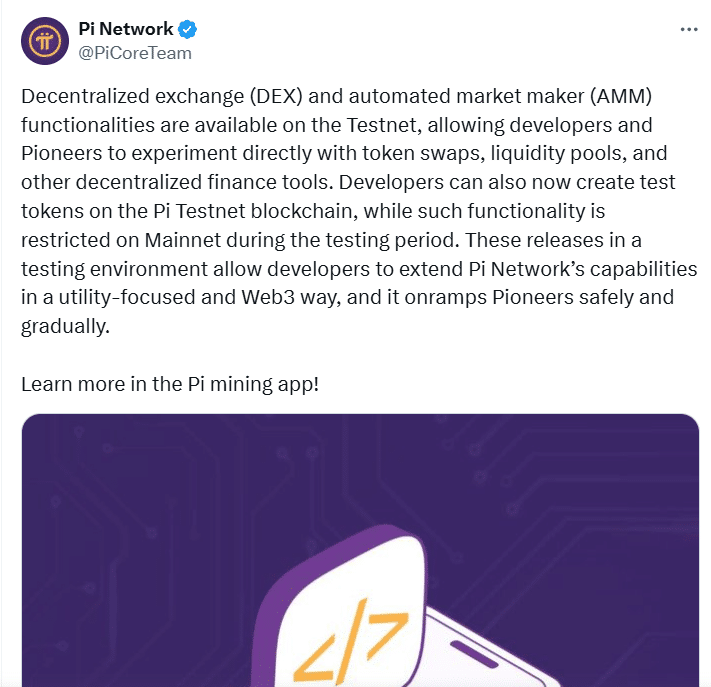
Pi network DEX and AMMSource: X

On X, one community developer wrote, “DEX is fun to test, but the real impact comes only when Pi tokens are live in mainnet liquidity pools.” The statement reflects both optimism and realism, a balance the project must manage carefully.

Market Implications and Early Indicators

Price watchers link the announcement to recent stability in PI Network’s market behavior. Trading data shows the token hovering near $0.27, holding a support zone despite broader market volatility. If Pi leverages its DeFi tools successfully, analysts suggest it could drive sustained demand rather than fleeting speculation.

At the same time, risks remain. Token concentration among a small number of wallets, potential supply shocks from future unlocks, and uncertainty about regulatory positioning create hurdles. However, compared with meme-driven projects that often implode under scrutiny, Pi network appears intent on building layer by layer.

A Slow but Strategic Road Ahead

The introduction of DEX and AMM on testnet underscores Pi’s philosophy: move slowly, involve the community, and test before scaling. If Pi can convert testnet lessons into mainnet resilience, it may emerge as a unique hybrid, part grassroots social experiment, part serious DeFi contender.

As one industry analyst remarked, “The DeFi space doesn’t need another flashy token; it needs projects that can scale utility safely. Pi’s testnet launch is a step in that direction.”

Conclusion

Pi Network’s decision to release DeFi tools on testnet is more than a technical milestone, it’s a statement of intent. By offering token creation, swaps, and liquidity pools in a safe environment, Pi shows it is serious about utility and community engagement.

Whether this step translates into real adoption depends on how well the project handles governance, demand, and eventual mainnet integration. For now, the experiment is underway, and all eyes are on Pi to see if it can transform hype into lasting impact.

FAQs

Q1: What did Pi Network recently launch?
Pi Network introduced a decentralized exchange (DEX) and automated market maker (AMM) on its testnet, along with token creation support.

Q2: Why is this launch significant?
It moves Pi closer to real-world utility, allowing developers and users to engage with DeFi features before they roll out on mainnet.

Q3: How has the community reacted?
Reactions are mixed. Some praise the move as progress, while others argue the real test will come with mainnet implementation.

Q4: What risks should investors consider?
Risks include token concentration in large wallets, regulatory challenges, and uncertainty about whether testnet experiments will scale.

Glossary of Key Terms

DEX (Decentralized Exchange): A platform for peer-to-peer crypto trading without intermediaries.

AMM (Automated Market Maker): A system that uses liquidity pools instead of traditional order books to enable trading.

Testnet: A blockchain environment for testing features without risking real assets.

Liquidity Pool: A pool of crypto tokens locked in a smart contract to facilitate trading.

Token Unlock: The release of previously restricted tokens into circulation, often creating price pressure.

Mainnet: The fully launched blockchain network where real transactions and tokens exist.

Read More: Will Pi’s New DEX and AMM Finally Silence the Critics?">Will Pi’s New DEX and AMM Finally Silence the Critics?

Market Opportunity
Pi Network Logo
Pi Network Price(PI)
$0.20619
$0.20619$0.20619
-0.77%
USD
Pi Network (PI) Live Price Chart
Disclaimer: The articles reposted on this site are sourced from public platforms and are provided for informational purposes only. They do not necessarily reflect the views of MEXC. All rights remain with the original authors. If you believe any content infringes on third-party rights, please contact [email protected] for removal. MEXC makes no guarantees regarding the accuracy, completeness, or timeliness of the content and is not responsible for any actions taken based on the information provided. The content does not constitute financial, legal, or other professional advice, nor should it be considered a recommendation or endorsement by MEXC.

You May Also Like

The Channel Factories We’ve Been Waiting For

The Channel Factories We’ve Been Waiting For

The post The Channel Factories We’ve Been Waiting For appeared on BitcoinEthereumNews.com. Visions of future technology are often prescient about the broad strokes while flubbing the details. The tablets in “2001: A Space Odyssey” do indeed look like iPads, but you never see the astronauts paying for subscriptions or wasting hours on Candy Crush.  Channel factories are one vision that arose early in the history of the Lightning Network to address some challenges that Lightning has faced from the beginning. Despite having grown to become Bitcoin’s most successful layer-2 scaling solution, with instant and low-fee payments, Lightning’s scale is limited by its reliance on payment channels. Although Lightning shifts most transactions off-chain, each payment channel still requires an on-chain transaction to open and (usually) another to close. As adoption grows, pressure on the blockchain grows with it. The need for a more scalable approach to managing channels is clear. Channel factories were supposed to meet this need, but where are they? In 2025, subnetworks are emerging that revive the impetus of channel factories with some new details that vastly increase their potential. They are natively interoperable with Lightning and achieve greater scale by allowing a group of participants to open a shared multisig UTXO and create multiple bilateral channels, which reduces the number of on-chain transactions and improves capital efficiency. Achieving greater scale by reducing complexity, Ark and Spark perform the same function as traditional channel factories with new designs and additional capabilities based on shared UTXOs.  Channel Factories 101 Channel factories have been around since the inception of Lightning. A factory is a multiparty contract where multiple users (not just two, as in a Dryja-Poon channel) cooperatively lock funds in a single multisig UTXO. They can open, close and update channels off-chain without updating the blockchain for each operation. Only when participants leave or the factory dissolves is an on-chain transaction…
Share
BitcoinEthereumNews2025/09/18 00:09
SUI Price Eyes Breakout, Targets $11 Says Analyst

SUI Price Eyes Breakout, Targets $11 Says Analyst

The post SUI Price Eyes Breakout, Targets $11 Says Analyst appeared on BitcoinEthereumNews.com. SUI price shows a technical setup for a macro breakout with analyst Dan Gambardello targeting $10-$11 levels. Recent partnership with Google’s Agentic Payments Protocol adds fundamental support to the technical analysis as SUI moves closer to potential breakout levels. SUI Price Analysis Points to $10-$11 Breakout Target Dan Gambardello has identified a clear ascending triangle formation on SUI price daily chart with upside targets around $10.79. The analyst simplified this target range to $10-$11 for practical trading purposes. The pattern shows sustained higher lows meeting resistance at current levels before a potential breakout. VanEck maintains more aggressive SUI crypto targets ranging from $13-$25 according to Gambardello’s research. SUI Price Analysis | Source: Dan Gambardello, X The $10 level is a more conservative higher high area for the current cycle. Midterm targets point to $7.50 in the 1.618 Fibonacci extension zone before longer-term objectives. The monthly RSI shows extreme compression that Gambardello describes as “screaming for a macro breakout to the upside.” This momentum oscillator behavior typically precedes major price movements in the crypto market. SUI crypto risk model currently sits at 51 and matches pre-bull market levels seen in coins like Ethereum. Gambardello compared this to Ethereum’s December 2020 reading of 51 before its major breakout. The March 2017 Ethereum reading of 53 preceded that cycle’s parabolic move. The analyst also noted that SUI price trades near the same levels from almost a year ago in November 2024. Bollinger Bands Signal Historic Compression CryptoBullet has identified the tightest Bollinger Bands in SUI’s entire trading history on the weekly chart. The BBW indicator compression reached levels that were historically followed by major price movements. This setup mirrors conditions before SUI’s previous major rallies. Historical data shows SUI price delivered +253% gains between December 2023 and March 2024 following similar compression. SUI…
Share
BitcoinEthereumNews2025/09/18 11:32
How Zero Knowledge Proof Is Changing Blockchain Performance Forever

How Zero Knowledge Proof Is Changing Blockchain Performance Forever

The post How Zero Knowledge Proof Is Changing Blockchain Performance Forever appeared on BitcoinEthereumNews.com. Crypto Projects Learn how Zero Knowledge Proof
Share
BitcoinEthereumNews2026/01/13 04:11