

Must Read
On the scorecard President Ferdinand Marcos Jr. handed us himself, most of the boxes are still unchecked four years onOn the scorecard President Ferdinand Marcos Jr. handed us himself, most of the boxes are still unchecked four years on
[In This Economy] Four years on, Marcos failed to deliver on his economic promises
For feedback or concerns regarding this content, please contact us at [email protected]
If you go back to President Ferdinand Marcos Jr.’s first State of the Nation Address (SONA) in July 2022, you will find a tidy list of headline numbers. (Which many people also found quite boring.)
Real GDP growth of 6.5 to 8% every year. Single-digit poverty by 2028. Upper middle-income status by 2024. A deficit down to 3% of GDP by 2028, and debt below 60% of GDP by 2025.
It was, Marcos told Congress, an anchor for the whole six-year plan, a “credible commitment” to the country.
Four years later, that anchor has mostly failed to hold. With the 2026 SONA coming up, now is as good a time as any to check the promises against the record.
Anemic growth
Let’s start with growth, because everything else depends on it. The economy grew by just 4.4% in 2025, the weakest year outside the pandemic, and well short of the 6.5 to 8% the administration kept promising.
We are not only off the pre-pandemic trend, when growth routinely topped 6%, we are being dragged down on two fronts at once.
At home, the flood control corruption scandal that broke in 2025 froze a large chunk of public construction, the very infrastructure spending the SONA called the “backbone of an economy.” Abroad, the US–Iran war pushed up oil prices and rattled an already cautious global environment.
The investment story is just as deflating. The SONA promised that the Philippines would “become an investment destination,” riding the CREATE law and the newly liberalized Public Service and Foreign Investments Acts.
Instead, foreign direct investment (FDI) slumped to $7.79 billion in 2025, the lowest in a decade if you set aside the pandemic. FDI did not fall in a straight line: it dipped in 2023, recovered in 2024, then dropped sharply last year. But the trend is unmistakable. Many of the splashy investment pledges from the administration’s early roadshows (supposedly amounting to trillions of pesos) never materialized.
Then there is inflation, which the SONA treated almost as an afterthought, something that would “return to the target range” by 2024.
In reality, prices spiked twice and hard since Marcos took office. The first surge in 2022 to 2023, peaking near 8.7% in early 2023, was driven largely by Russia’s invasion of Ukraine and the supply shocks that followed. A second, smaller episode came in 2025 alongside the US-Iran war and renewed oil pressure.
For ordinary households, the cost of the basket of goods and services simply ratcheted up and stayed there, even as the headline rate cooled down.
The poverty target was supposed to be the human payoff for all this. The first SONA pledged single-digit poverty, 9%, by 2028.
But this is now impossible. The World Bank’s most recent assessment projects poverty falling only to around 12.3% by 2028 if the pre-COVID growth-poverty relationship holds, comfortably above target.
One senior economist put it bluntly: “As of this moment we are not projecting poverty in single digits by 2028.” Far from a forecasting quibble, it means roughly one in eight Filipinos still poor at the end of the term, despite Marcos’ promise.
The fiscal scoreboard
The country’s economic status upgrade has slipped too.
The SONA set upper middle-income status for 2024. I’m afraid we missed it. As of 2024, gross national income per capita stood at about $4,470, leaving the country roughly $26 short of the World Bank’s threshold, and still in the lower middle-income bracket where it has sat since 1987.
Socioeconomic Planning Secretary Arsenio Balisacan now says the upgrade can still come “within the term” of President Marcos. Maybe. But a target hit two years late, by a hair, is not the same as a target met.
Vietnam has largely overtaken us not just in terms of growth but also investments. They are the true darling of investors these days. Recent data suggest that Vietnam overtook us not during the pandemic but even way earlier (in the late 2000s) if we take into account a version of national income statistics that incorporate differences in purchasing power across different countries.
Finally, the public finances. Marcos’ first SONA promised debt below 60% of GDP by 2025. Instead it closed 2025 at about 63.2%, a 21-year high, and is only projected to inch down slowly from here. The deficit, meanwhile, meant to fall to 3% of GDP by 2028, was still running more than 5.6% in 2025, with the year’s actual shortfall breaching its own ceiling.
None of this is to say the administration did nothing, or that every miss is its fault. War and global oil prices are beyond Manila’s control. But the 2022 SONA did not present these as aspirations. It presented them as commitments, numbers the President asked Congress to adopt by resolution and hold him to.
And so we should hold him to them. Growth is anemic, poverty is stuck in double digits, the income upgrade is late, and the debt and deficit targets have slipped. On the scorecard he handed us himself, most of the boxes are still unchecked four years on. – Rappler.com
Jan Carlo “JC” Punongbayan, PhD is an associate professor at the University of the Philippines School of Economics (UPSE). His professional experience includes the Securities and Exchange Commission, the World Bank Office in Manila, the Far Eastern University Public Policy Center, and the National Economic and Development Authority. JC writes a weekly economics column for Rappler.com. He is also co-founder of UsapangEcon.com and co-host of Usapang Econ Podcast.
His first book, False Nostalgia: The Marcos “Golden Age” Myths and How to Debunk Them, was published by Ateneo de Manila University Press in February 2023. His second book, Twin Plagues: How Duterte and Covid-19 Wrecked the Philippine Economy, will be published by Penguin Random House SEA in June 2026. Follow him on Instagram (@jcpunongbayan).
Click here for other In This Economy articles.


Disclaimer: The articles reposted on this site are sourced from public platforms and are provided for informational purposes only. They do not necessarily reflect the views of MEXC. All rights remain with the original authors. If you believe any content infringes on third-party rights, please contact [email protected] for removal. MEXC makes no guarantees regarding the accuracy, completeness, or timeliness of the content and is not responsible for any actions taken based on the information provided. The content does not constitute financial, legal, or other professional advice, nor should it be considered a recommendation or endorsement by MEXC.
You May Also Like

What is On-Demand Liquidity? How Ripple uses XRP to move money
On-Demand Liquidity is Ripple’s flagship use of XRP, a way to settle cross-border payments in seconds without banks pre-funding accounts around the world. This
Share
Crypto.news2026/06/26 23:00
Goldman Sachs’ 1 Delta Desk Warns AI’s Greatest Threat Is the Reflexive Loop
BitcoinWorld Goldman Sachs’ 1 Delta Desk Warns AI’s Greatest Threat Is the Reflexive Loop Goldman Sachs’ proprietary trading unit, the 1 Delta desk, has issued
Share
bitcoinworld2026/06/26 23:00
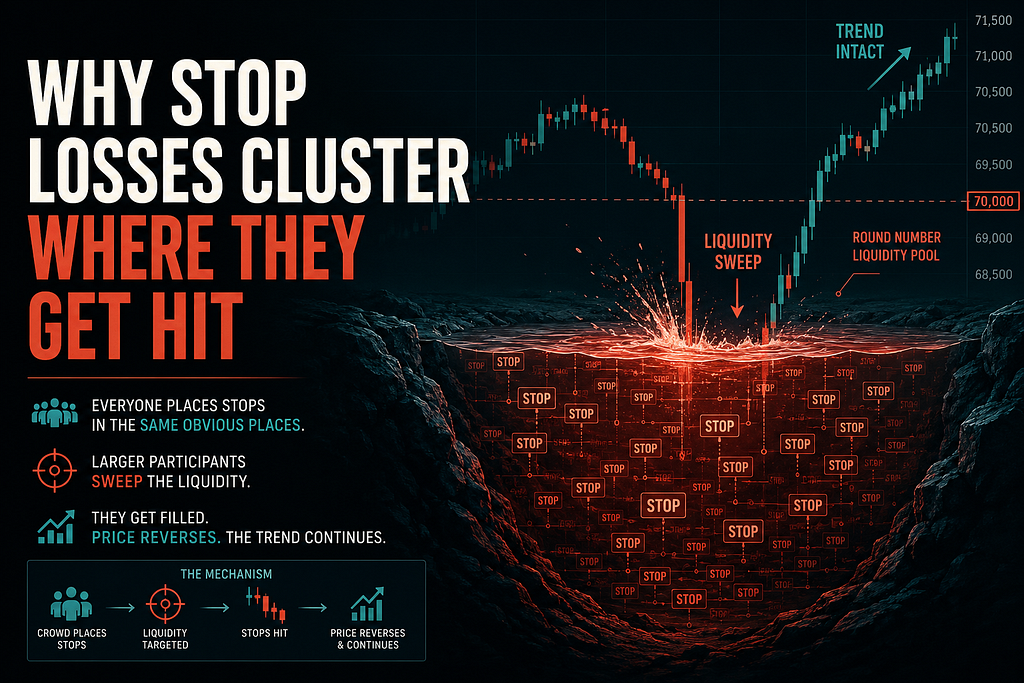
Why Stop Losses Cluster Where They Get Hit
Stop losses don’t get hit randomly. They get hit because they were placed where everyone else placed theirs. The trader who placed the stop did the work. T
Share
Medium2026/06/26 22:51



