📑 Table of Contents What Makes Uniswap a DeFi Giant? The Origins and Background of Uniswap Inside the Technology: How Uniswap Works Ecosystem & Strategic Partnerships Practical Use Cases of Uniswap UNI Tokenomics Explained Latest Uniswap News & Developments Final Thoughts on Uniswap FAQ: 10 Unanswered Questions About Uniswap 🚀 What Makes Uniswap a DeFi [...]]]>📑 Table of Contents What Makes Uniswap a DeFi Giant? The Origins and Background of Uniswap Inside the Technology: How Uniswap Works Ecosystem & Strategic Partnerships Practical Use Cases of Uniswap UNI Tokenomics Explained Latest Uniswap News & Developments Final Thoughts on Uniswap FAQ: 10 Unanswered Questions About Uniswap 🚀 What Makes Uniswap a DeFi [...]]]>

Uniswap (UNI) Explained 2025: How the Leading DEX is Shaping DeFi

📑 Table of Contents

  • What Makes Uniswap a DeFi Giant?
  • The Origins and Background of Uniswap
  • Inside the Technology: How Uniswap Works
  • Ecosystem & Strategic Partnerships
  • Practical Use Cases of Uniswap
  • UNI Tokenomics Explained
  • Latest Uniswap News & Developments
  • Final Thoughts on Uniswap
  • FAQ: 10 Unanswered Questions About Uniswap

🚀 What Makes Uniswap a DeFi Giant?

Uniswap is one of the largest decentralized exchanges (DEX) built on the Ethereum blockchain. It enables users worldwide to trade cryptocurrencies without centralized intermediaries or order books. Instead, Uniswap uses an Automated Market Maker (AMM) powered by liquidity pools. The governance token UNI allows holders to vote on protocol changes. Since its launch in 2018, Uniswap’s trading volume has exceeded $1.5 trillion, making it one of the most influential platforms in the DeFi space.


📜 The Origins and Background of Uniswap

Uniswap was founded in 2018 by engineer Hayden Adams, inspired by Ethereum co-founder Vitalik Buterin. In 2020, the UNI governance token was launched and distributed to more than 250,000 platform users. The project was funded by the Ethereum Foundation, Uniswap Labs, and various venture capital firms. Today, the platform manages assets worth between $4–5 billion, cementing its place among the largest DEXs in the DeFi ecosystem.

⚙ Inside the Technology: How Uniswap Works

The core of Uniswap is the Automated Market Maker (AMM). Users deposit tokens into liquidity pools and receive a proportional share of the 0.3% fee generated by every swap. The system uses the constant product formula (x * y = k) to ensure liquidity is always available while determining token prices. Built on Ethereum, Uniswap also supports Layer-2 solutions such as Base, Arbitrum, and Optimism, significantly reducing fees. All operations are handled by smart contracts, ensuring that users retain full control of their wallets without centralized intermediaries.

Constant Product Formula:x * y = k

(Ensures liquidity and pricing across Uniswap pools)

🌐 Ecosystem & Strategic Partnerships

Uniswap and UNI tokens are deeply embedded in the DeFi sector. Leading protocols such as Compound, Aave, and MakerDAO leverage Uniswap’s liquidity pools for lending and stablecoin issuance. Major wallets like Coinbase, MetaMask, and Trust Wallet integrate Uniswap directly for token swaps. Through multi-chain deployment, millions of users worldwide can access Uniswap. Institutional adoption is growing too, with partnerships involving Fireblocks and Anchorage to offer secure access for regulated financial institutions.
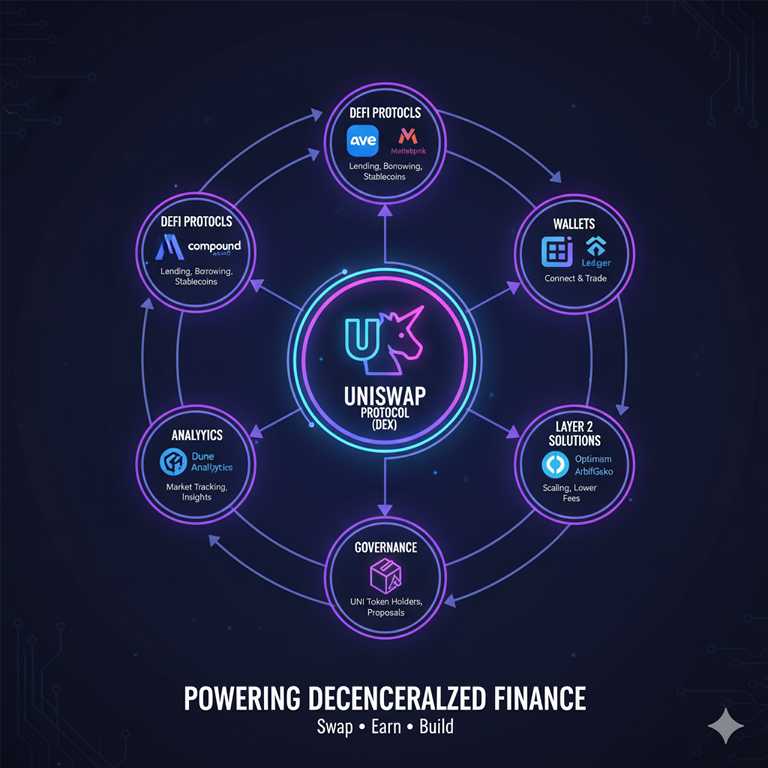
infographic showing Uniswap ecosystem connections with DeFi protocols and wallets

💡 Practical Use Cases of Uniswap

Uniswap plays a vital role in the DeFi landscape, with multiple real-world applications:

  • Token Swaps: Instantly exchange cryptocurrencies, with stablecoins like USDC, DAI, and USDT among the most traded pairs.
  • Liquidity Provision: Users deposit assets into pools and earn fees and yield-farming rewards, with potential returns of up to 30% annually.
  • Arbitrage Opportunities: Traders exploit price differences between centralized exchanges and DEX liquidity pools.

💰 UNI Tokenomics Explained

The UNI token has a fixed supply of 1 billion tokens distributed over four years. Allocation includes 60% to the community, 21.5% to the Uniswap team, 17.8% to investors, and 0.7% to advisors. Token holders vote on governance issues such as fee adjustments and new integrations. UNI also incentivizes liquidity providers, accelerating the growth of Uniswap’s pools and overall adoption.

CategoryAllocation
Community60%
Team21.5%
Investors17.8%
Advisors0.7%

📰 Latest Uniswap News & Developments

Despite significant volatility in the UNI token price, Uniswap continues to grow thanks to multi-chain adoption. In 2024, Uniswap recorded daily trading volumes exceeding $1 billion on Arbitrum alone. However, regulatory scrutiny is rising. Both U.S. and European regulators are debating whether DEX operators should face the same regulatory frameworks as centralized exchanges, which could shape Uniswap’s future trajectory.

❓ FAQ: 10 Unanswered Questions About Uniswap

1. How will Uniswap adapt to stricter global regulations?
Uniswap may need to adopt compliance layers such as on-chain KYC solutions, regional restrictions, or integrate optional compliance modules. Governance votes could also shift toward balancing decentralization with regulatory requirements.
2. Can Uniswap remain dominant against other DEXs like Curve or SushiSwap?
Yes, but competition is increasing. Curve dominates stablecoin swaps, while SushiSwap targets multi-chain adoption. Uniswap’s brand, user trust, and deep liquidity pools still give it a significant edge.
3. How does Uniswap handle front-running and MEV attacks?
Uniswap is exploring solutions like TWAMM (Time-Weighted Average Market Maker), batch auctions, and MEV-resistant relayers. These aim to reduce sandwich attacks and ensure fairer execution for traders.
4. Will UNI become a deflationary token?
Currently, UNI is not deflationary. It is used for governance and incentives. However, governance proposals could one day introduce token burns or fee redistributions that make UNI deflationary.
5. How sustainable are 30% yield farming returns?
Such high yields are usually temporary and linked to incentive programs. As liquidity grows and competition increases, returns typically decline to single-digit percentages.
6. Can Uniswap expand beyond Ethereum and L2s?
Yes, cross-chain deployments are being tested. While Ethereum and Layer-2s remain primary, expansion to non-EVM chains could increase Uniswap’s reach if technical and governance challenges are overcome.
7. How will institutions influence Uniswap’s governance?
Institutions could provide stability, liquidity, and credibility. However, their influence might also raise centralization concerns if voting power becomes concentrated. Balancing this will be a key governance challenge.
8. What risks exist for liquidity providers?
Liquidity providers face impermanent loss when asset prices diverge, smart contract vulnerabilities, regulatory risks, and declining yield incentives as pools mature.
9. Could Uniswap integrate with CBDCs in the future?
Potentially yes. If CBDCs become interoperable with DeFi, Uniswap could integrate them into its pools. This would require strong regulatory clarity and secure bridging solutions.
10. What’s next for Uniswap’s Layer-2 growth?
Adoption on Layer-2 networks like Arbitrum, Optimism, and Base will likely expand further, offering cheaper and faster transactions. This could bring in more retail and institutional users alike.
]]>
Market Opportunity
UNISWAP Logo
UNISWAP Price(UNI)
$4.979
$4.979$4.979
-5.89%
USD
UNISWAP (UNI) Live Price Chart
Disclaimer: The articles reposted on this site are sourced from public platforms and are provided for informational purposes only. They do not necessarily reflect the views of MEXC. All rights remain with the original authors. If you believe any content infringes on third-party rights, please contact [email protected] for removal. MEXC makes no guarantees regarding the accuracy, completeness, or timeliness of the content and is not responsible for any actions taken based on the information provided. The content does not constitute financial, legal, or other professional advice, nor should it be considered a recommendation or endorsement by MEXC.

You May Also Like

BFX Presale Raises $7.5M as Solana Holds $243 and Avalanche Eyes $1B Treasury — Best Cryptos to Buy in 2025

BFX Presale Raises $7.5M as Solana Holds $243 and Avalanche Eyes $1B Treasury — Best Cryptos to Buy in 2025

BFX presale hits $7.5M with tokens at $0.024 and 30% bonus code BLOCK30, while Solana holds $243 and Avalanche builds a $1B treasury to attract institutions.
Share
Blockchainreporter2025/09/18 01:07
Trading time: Tonight, the US GDP and the upcoming non-farm data will become the market focus. Institutions are bullish on BTC to $120,000 in the second quarter.

Trading time: Tonight, the US GDP and the upcoming non-farm data will become the market focus. Institutions are bullish on BTC to $120,000 in the second quarter.

Daily market key data review and trend analysis, produced by PANews.
Share
PANews2025/04/30 13:50
BlackRock boosts AI and US equity exposure in $185 billion models

BlackRock boosts AI and US equity exposure in $185 billion models

The post BlackRock boosts AI and US equity exposure in $185 billion models appeared on BitcoinEthereumNews.com. BlackRock is steering $185 billion worth of model portfolios deeper into US stocks and artificial intelligence. The decision came this week as the asset manager adjusted its entire model suite, increasing its equity allocation and dumping exposure to international developed markets. The firm now sits 2% overweight on stocks, after money moved between several of its biggest exchange-traded funds. This wasn’t a slow shuffle. Billions flowed across multiple ETFs on Tuesday as BlackRock executed the realignment. The iShares S&P 100 ETF (OEF) alone brought in $3.4 billion, the largest single-day haul in its history. The iShares Core S&P 500 ETF (IVV) collected $2.3 billion, while the iShares US Equity Factor Rotation Active ETF (DYNF) added nearly $2 billion. The rebalancing triggered swift inflows and outflows that realigned investor exposure on the back of performance data and macroeconomic outlooks. BlackRock raises equities on strong US earnings The model updates come as BlackRock backs the rally in American stocks, fueled by strong earnings and optimism around rate cuts. In an investment letter obtained by Bloomberg, the firm said US companies have delivered 11% earnings growth since the third quarter of 2024. Meanwhile, earnings across other developed markets barely touched 2%. That gap helped push the decision to drop international holdings in favor of American ones. Michael Gates, lead portfolio manager for BlackRock’s Target Allocation ETF model portfolio suite, said the US market is the only one showing consistency in sales growth, profit delivery, and revisions in analyst forecasts. “The US equity market continues to stand alone in terms of earnings delivery, sales growth and sustainable trends in analyst estimates and revisions,” Michael wrote. He added that non-US developed markets lagged far behind, especially when it came to sales. This week’s changes reflect that position. The move was made ahead of the Federal…
Share
BitcoinEthereumNews2025/09/18 01:44