In a significant development for the future of blockchain-based financial infrastructure, SWIFT has announced plans to develop its upcoming blockchain payment settlement platform on the Ethereum Layer 2 scaling solution, Linea. This move signals a major integration of traditional banking infrastructure with innovative decentralized technology, potentially transforming cross-border payments by leveraging blockchain’s efficiencies and cost [...]In a significant development for the future of blockchain-based financial infrastructure, SWIFT has announced plans to develop its upcoming blockchain payment settlement platform on the Ethereum Layer 2 scaling solution, Linea. This move signals a major integration of traditional banking infrastructure with innovative decentralized technology, potentially transforming cross-border payments by leveraging blockchain’s efficiencies and cost [...]

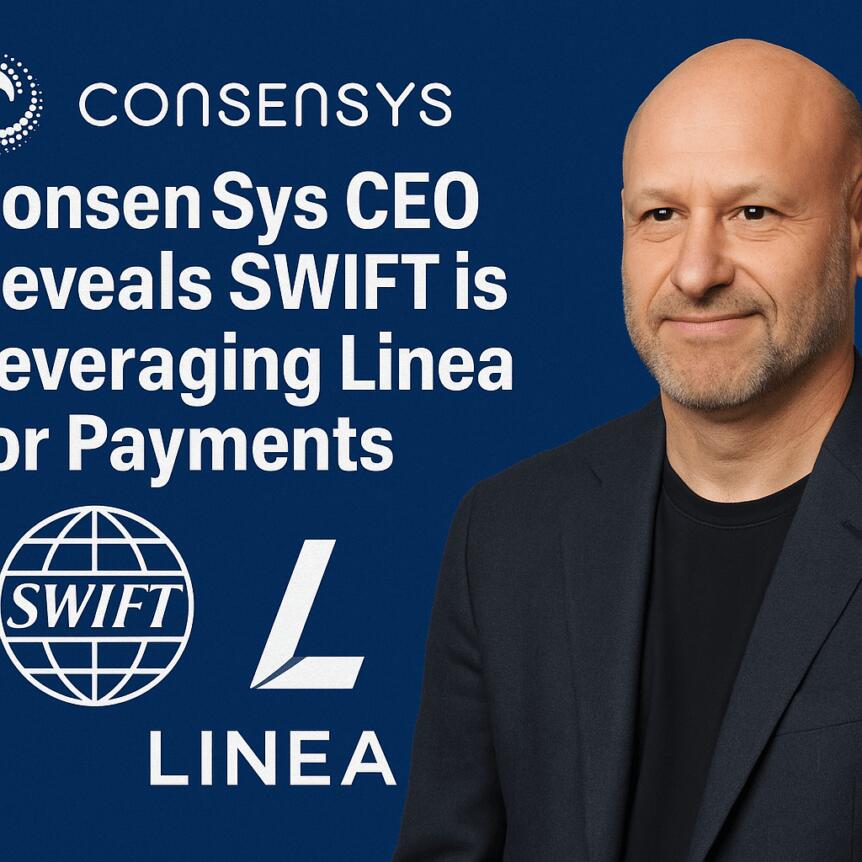
ConsenSys CEO Reveals SWIFT is Leveraging Linea for Payments
4 min read
Consensys Ceo Reveals Swift Is Leveraging Linea For Payments
In a significant development for the future of blockchain-based financial infrastructure, SWIFT has announced plans to develop its upcoming blockchain payment settlement platform on the Ethereum Layer 2 scaling solution, Linea. This move signals a major integration of traditional banking infrastructure with innovative decentralized technology, potentially transforming cross-border payments by leveraging blockchain’s efficiencies and cost advantages.
  • SWIFT will build its new blockchain payment system on Ethereum Layer 2 Linea, confirmed by Consensys CEO Joe Lubin.
  • The platform aims to facilitate 24/7 real-time crypto payments, involving over 30 traditional financial institutions.
  • Linea, developed by Consensys, offers high transaction throughput at a fraction of Ethereum costs, with over $2.2 billion in total value locked.
  • Major banks including Bank of America, Citi, JPMorgan Chase, and Toronto-Dominion Bank are participating in trial phases.
  • This initiative could challenge existing blockchain-based payment systems like Ripple’s XRP Ledger, emphasizing widespread crypto adoption in banking.

SWIFT, the global messaging network responsible for overseeing around $150 trillion in international payments annually, is taking a significant step into blockchain technology. The organization plans to develop its new blockchain payment settlement platform on Ethereum’s Layer 2 scaling solution, Linea. This development was confirmed by Consensys CEO Joe Lubin during a recent conference, marking a notable collaboration between traditional finance (TradFi) and blockchain innovators.

Initially, SWIFT announced that over 30 traditional financial institutions would be involved in building infrastructure for a 24/7, real-time crypto payments system, though it did not specify the blockchain chain involved. Lubin clarified during the Token2049 conference in Singapore that Linea was the chosen platform, highlighting the strategic importance of this move. The announcement was deliberately “soft rolled out” to the banking sector, which Lubin said was received positively as a step toward bridging the gap between DeFi and TradFi.

Developed by Consensys, Linea utilizes zk-EVM rollup technology, offering processing speeds of around 1.5 transactions per second at approximately one-fifteenth the cost of Ethereum mainnet transactions. It currently boasts over $2.27 billion in total value locked (TVL), ranking as the fourth-largest Ethereum Layer 2 solution behind Arbitrum One, Base Chain, and OP Mainnet, according to L2BEAT data.

This move could have transformative implications for global finance, particularly because SWIFT manages a vast network of financial messaging that facilitates international transactions. Involving major banks such as Bank of America, Citi, JPMorgan Chase, and Toronto-Dominion Bank, SWIFT’s trial on Linea aims to pioneer near-instant settlement and reduce intermediaries, costs, and errors in cross-border payments. The initiative could emerge as a significant competitor to Ripple’s XRP Ledger, which is already being adopted by some banks for blockchain-based transactions.

Some of the biggest banks involved

Leading financial institutions like Bank of America, Citi, JPMorgan Chase, and Toronto-Dominion Bank are participating in SWIFT’s blockchain trial efforts. Their involvement underscores the industry’s growing acceptance of blockchain technology for secure, efficient payments. This collaboration might accelerate the adoption of decentralized blockchain systems in mainstream banking, challenging existing payment solutions like Ripple’s.

For years, the integration of blockchain into traditional finance has been anticipated, promising benefits such as instant settlement, lower fees, and reduced settlement errors. The collaboration between SWIFT and Linea could also inspire broader adoption of blockchain infrastructure in global payment networks, ushering a new era of financial operations.

Linea’s broader potential

Beyond payments, Lubin described Linea as a platform capable of supporting a “user-generated civilization,” where content and infrastructure can be built collectively. By leveraging Ethereum’s trustless settlement layer, communities could develop decentralized applications, rules, and frameworks from the ground up — a stark contrast to the top-down approach of traditional hierarchies.

Decentralized autonomous organizations (DAOs) are already experimenting with decentralized governance and smart contracts, aiming to operate without centralized control. While few have scaled successfully, the potential for a bottom-up digital society is rapidly evolving, with blockchain technologies like Linea playing a central role.

This article was originally published as ConsenSys CEO Reveals SWIFT is Leveraging Linea for Payments on Crypto Breaking News – your trusted source for crypto news, Bitcoin news, and blockchain updates.

Market Opportunity
LINEA Logo
LINEA Price(LINEA)
$0,004048
$0,004048$0,004048
-4,95%
USD
LINEA (LINEA) Live Price Chart
Disclaimer: The articles reposted on this site are sourced from public platforms and are provided for informational purposes only. They do not necessarily reflect the views of MEXC. All rights remain with the original authors. If you believe any content infringes on third-party rights, please contact [email protected] for removal. MEXC makes no guarantees regarding the accuracy, completeness, or timeliness of the content and is not responsible for any actions taken based on the information provided. The content does not constitute financial, legal, or other professional advice, nor should it be considered a recommendation or endorsement by MEXC.

You May Also Like

Galaxy Digital’s 2025 Loss: SOL Bear Market

Galaxy Digital’s 2025 Loss: SOL Bear Market

The post Galaxy Digital’s 2025 Loss: SOL Bear Market appeared on BitcoinEthereumNews.com. Galaxy Digital, a digital assets and artificial intelligence infrastructure
Share
BitcoinEthereumNews2026/02/04 09:49
FCA, crackdown on crypto

FCA, crackdown on crypto

The post FCA, crackdown on crypto appeared on BitcoinEthereumNews.com. The regulation of cryptocurrencies in the United Kingdom enters a decisive phase. The Financial Conduct Authority (FCA) has initiated a consultation to set minimum standards on transparency, consumer protection, and digital custody, in order to strengthen market confidence and ensure safer operations for exchanges, wallets, and crypto service providers. The consultation was published on May 2, 2025, and opened a public discussion on operational responsibilities and safeguarding requirements for digital assets (CoinDesk). The goal is to make the rules clearer without hindering the sector’s evolution. According to the data collected by our regulatory monitoring team, in the first weeks following the publication, the feedback received from professionals and operators focused mainly on custody, incident reporting, and insurance requirements. Industry analysts note that many responses require technical clarifications on multi-sig, asset segregation, and recovery protocols, as well as proposals to scale obligations based on the size of the operator. FCA Consultation: What’s on the Table The consultation document clarifies how to apply rules inspired by traditional finance to the crypto perimeter, balancing innovation, market integrity, and user protection. In this context, the goal is to introduce minimum standards for all firms under the supervision of the FCA, an essential step for a more transparent and secure sector, with measurable benefits for users. The proposed pillars Obligations towards consumers: assessment on the extension of the Consumer Duty – a requirement that mandates companies to provide “good outcomes” – to crypto services, with outcomes for users that are traceable and verifiable. Operational resilience: introduction of continuity requirements, incident response plans, and periodic testing to ensure the operational stability of platforms even in adverse scenarios. Financial Crime Prevention: strengthening AML/CFT measures through more stringent transaction monitoring and structured counterpart checks. Custody and safeguarding: definition of operational methods for the segregation of client assets, secure…
Share
BitcoinEthereumNews2025/09/18 05:40
HKMA Launches Fintech Blueprint with AI, DLT, Quantum and Cybersecurity Focus

HKMA Launches Fintech Blueprint with AI, DLT, Quantum and Cybersecurity Focus

The Hong Kong Monetary Authority (HKMA) published a Fintech Promotion Blueprint to support responsible innovation and fintech development in the banking sector.
Share
Fintechnews2026/02/04 10:20