

Workday Rose 9% Today. Here’s How Much the Stock Could Rise in 2026
Key Stats for Workday Stock
- Today’s Performance: 9%
- 52-Week Range: $110 to $250
- Valuation Model Target Price: Around $170
- Implied Upside: Around 40%
Analyze your favorite stocks like Workday with TIKR (It’s free) >>>
What Happened?
Workday Inc. stock rose about 9% today, trading near $124 per share as investors rotated back into beaten-down software stocks and became more comfortable with the company’s AI growth story.
The stock moved higher because software names rebounded after a sharp selloff, and Monness Crespi & Hardt upgraded Workday from Neutral to Buy with a $150 price target. Workday also benefited as investors revisited enterprise software peers such as ServiceNow, Salesforce, and Oracle, where the market is trying to separate durable software platforms from companies that could be disrupted by AI.
Recent earnings also gave the rally more support. Workday reported Q1 revenue of $2.54 billion, up 13.5%, subscription revenue of $2.35 billion, up 14.3%, and 12-month subscription backlog of $8.81 billion, up 15.5%, while CEO Aneel Bhusri said it was the company’s “best first quarter of new ACV growth in 5 years.”
AI remained the key growth story. Workday said new ACV from agentic AI products grew more than 200% year over year, the company is approaching $500 million in ARR from agentic AI solutions, and more than 4,000 customers now use at least one organically developed agent. The main risk is that Workday must face a California lawsuit over alleged AI bias in job-screening tools, creating a legal overhang as AI becomes a bigger part of the company’s strategy.
 Workday Guided Valuation Model
Value Workday instantly (Free with TIKR) >>>
Is Workday Undervalued?
Under valuation assumptions, the stock is modeled using:
- Revenue Growth (CAGR): Around 11%
- Operating Margins: Around 32%
- Exit P/E Multiple: Around 11x
Workday’s revenue chart shows growth slowing from the high-teens and low-20% rates of prior years, with analysts expecting revenue growth to settle closer to the low double digits over the next several years.
That slowdown matters, but it does not make the business weak. Workday sells cloud software for human resources and finance, which helps large companies manage employees, payroll, recruiting, planning, and financial operations, and those systems tend to be sticky once customers build them into daily workflows.
The company’s $8.81 billion 12-month subscription backlog gives it solid revenue visibility, while expansion beyond core HR into finance, planning, analytics, and AI agents gives Workday more ways to grow inside existing customers.
Peer context matters because Workday is being compared with enterprise software leaders such as ServiceNow and Salesforce. ServiceNow recently reported 22% revenue growth and 22% subscription revenue growth, while Salesforce reported Q1 revenue growth of 11% and non-GAAP operating margin near 35%, so Workday needs to prove that AI can support growth while still protecting profitability.
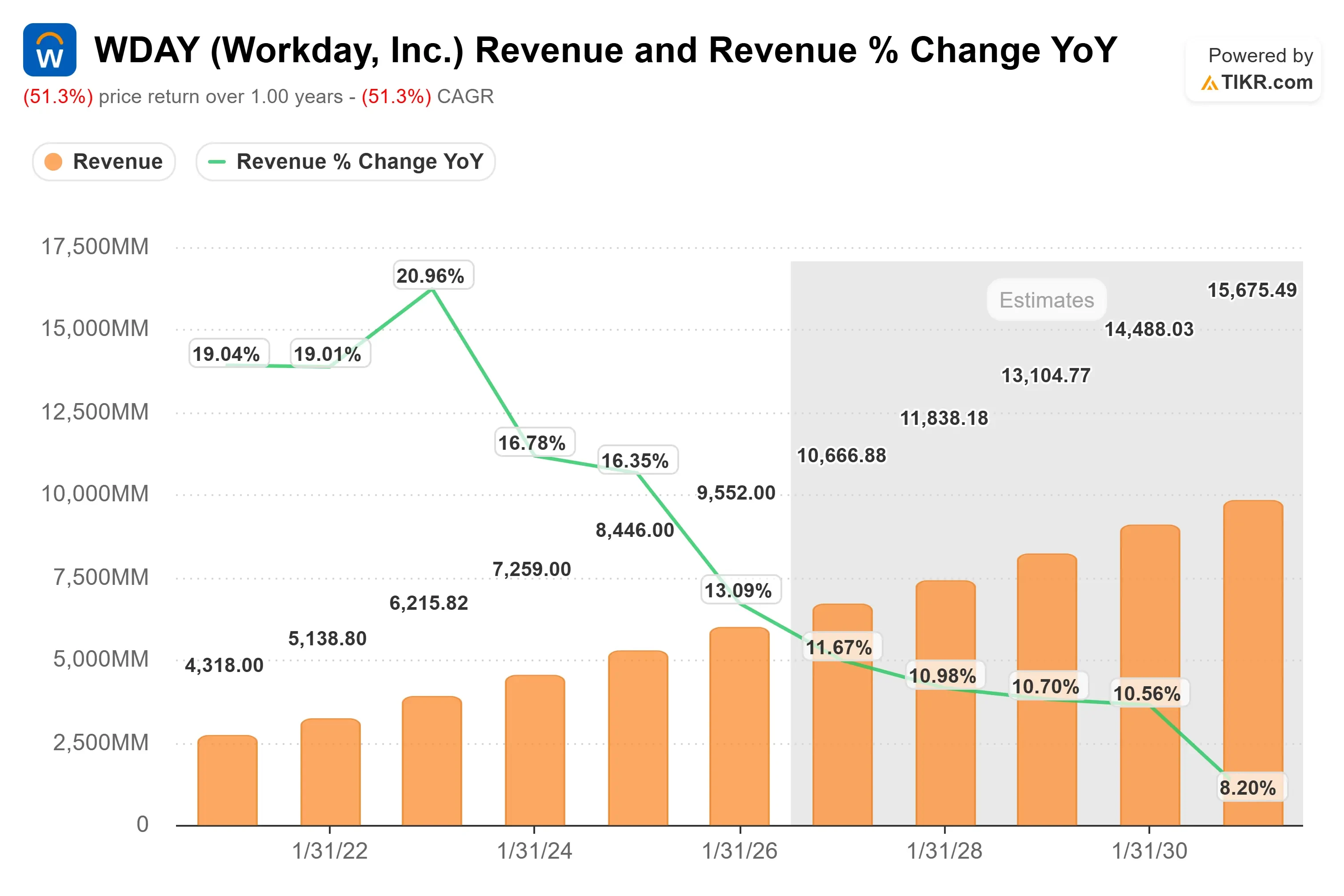 Workday Revenue & Analyst Growth Estimates Over Five Years
See analysts’ growth forecasts and price targets for Workday (It’s free) >>>
Based on these inputs, the model estimates a target price of around $170, implying about 40% upside from the current price near $124, suggesting Workday appears undervalued if revenue growth stays durable and margins keep improving.
Results through 2026 will likely depend on backlog conversion, customer expansion, and whether AI features help Workday increase product usage rather than become a margin drag.
Finance and planning adoption is especially important because it gives Workday another growth lever beyond its core HR software business.
AI tools in recruiting, workforce planning, and finance automation could support stronger customer retention if they create measurable productivity gains for large enterprises.
Margin discipline also matters because the model already assumes operating margins rising to around 32%, so Workday needs to scale AI investment without letting costs grow faster than revenue.
At current levels, Workday appears undervalued, with future performance likely driven by subscription revenue durability, AI adoption, finance software expansion, and margin execution rather than a simple rebound from a beaten-down stock price.
How Much Upside Does WDAY Stock Have From Here?
Investors can estimate Workday’s potential share price, or what any stock could be worth, in under a minute using TIKR’s New Valuation Model tool.
All it takes is three simple inputs:
- Revenue Growth
- Operating Margins
- Exit P/E Multiple
From there, TIKR calculates the potential share price and total returns under Bull, Base, and Bear scenarios so you can quickly see whether a stock looks undervalued or overvalued.
If you’re not sure what to enter, TIKR automatically fills in each input using analysts’ consensus estimates, giving you a quick, reliable starting point.
Value Workday in under 60 seconds with TIKR (It’s free) >>>
You May Also Like

Phemex Publishes April 2026 Proof of Reserves, Reporting 131% Total Reserve Ratio

Colombia and Portugal advance after no-bore draw

Beijing's Trojan Horse Rolls Into Canada: National Security Expert Warns Carney's Chinese EV Deals Embeds Sabotage Risk

