

How Model Predictive Control Stabilizes Token Prices
Table of Links
Abstract and 1. Introduction
- A Primer on Optimal Control
- The Token Economy as a Dynamical System
- Control Design Methodology
- Strategic Pricing: A Game-Theoretic Analysis
- Experiments
- Discussion and Future Work, and References
\
6 Experiments
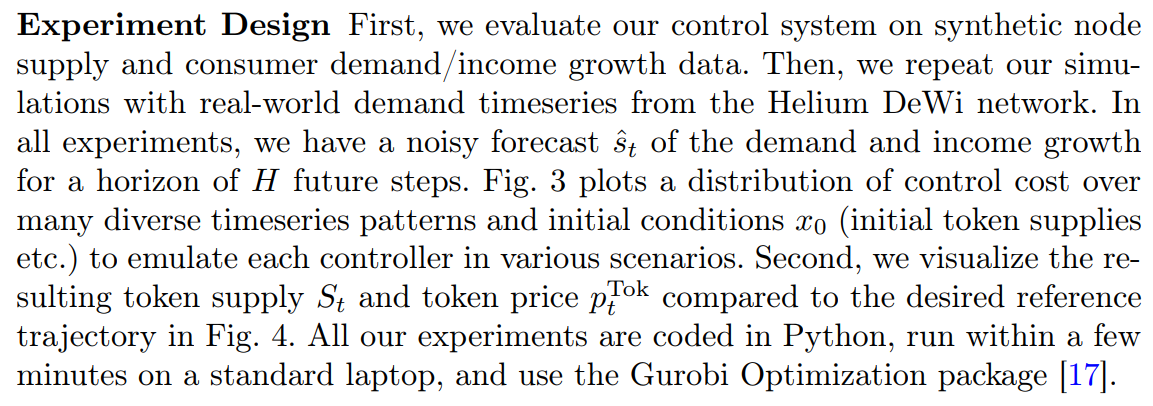
The goal of our evaluation is to show that (i) using control theory enables us to achieve a more stable, increasing token price and (ii) we can reduce control cost v
\ Evaluation Metrics and Benchmark Algorithms: We compare reserve controllers on the following metrics:
\ – Stable Token Price: We track whether the token price is increasing, its volatility, and the mean squared error (MSE) from a reference price trajectory.
\ – Control Cost: This is a weighted sum of the tracking error (MSE between the token price and reference price) as well as control effort.
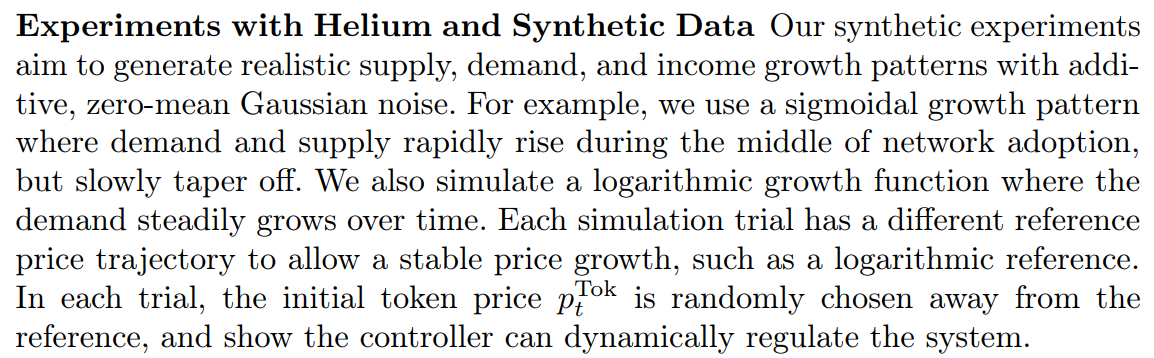
\ We report these metrics for various realistic scenarios where (i) the supply of nodes out-paces the consumer demand, (ii) the supply and demand roughly match, and (iii) the supply lags the consumer demand. Our experiments compare the following schemes:
\ – Model Predictive Control (MPC): We implement the predictive, optimal control scheme proposed in Section 4.
\ – Proportional Integral Derivative (PID): PID controllers are a fitting benchmark since they are widely used in industrial systems such as cruise control, robotic manipulators, and in some algorithmic stablecoins.
\ – No Control: We consider the worst case where the economy has no adaptive control and simply uses the income clearing strategy from Remark 1.
\ \ 
\ \ \ 
\ \ We then repeat the same experimental procedure, but with real timeseries of node growth and consumer demand from the Helium DeWi network, which
\ \ 
\ \ uses a BME protocol. First, since the Helium growth patterns are smooth, we use a classical Auto-Regressive Integrated Moving Average (ARIMA) forecasting model to predict network growth H = 20 days in advance. Then, we implement our controller on a distribution of reference price trajectories. Fig. 4 shows that MPC significantly reduces the control cost compared to PID benchmarks.
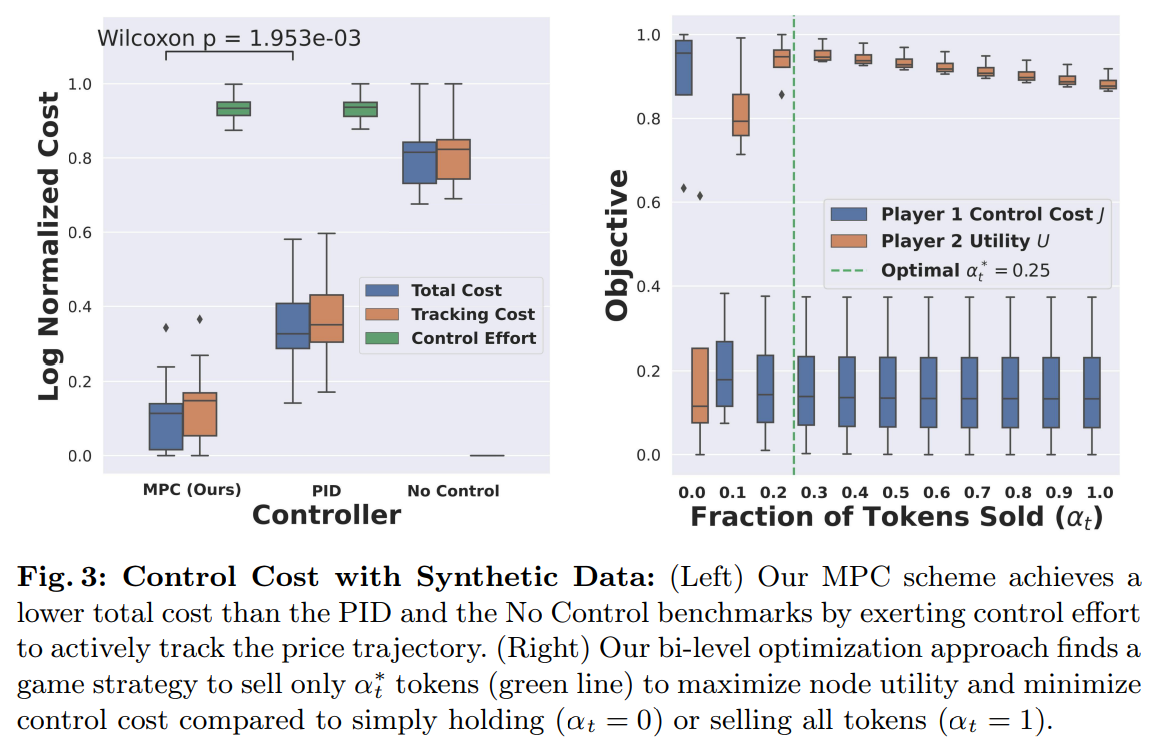
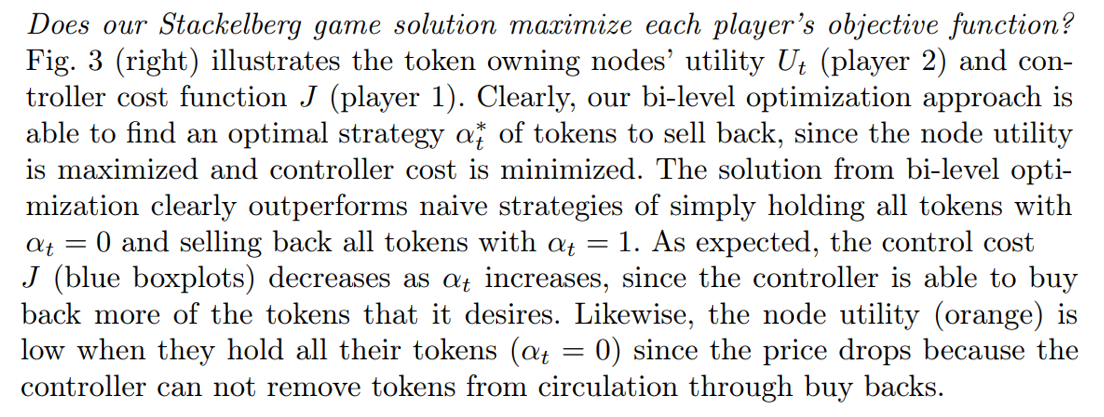
\ Does MPC reduce control cost compared to heuristic controllers? We now evaluate our ultimate performance metric, the control cost, across a wide variety of growth patterns and initial conditions. Specifically, we used 3 growth patterns with Gaussian noise (sigmoidal, logarithmic, exponential) and many scenarios where demand outstrips supply and vice versa. Fig. 3 shows the overall control cost, tracking error, and control effort for all 3 benchmarks. Clearly, MPC achieves a lower control cost than the PID heuristic (Wilcoxon p-value of .001953 is statistically significant at the 0.05 level). As shown in Fig. 3, the key reason for this difference is that PID is largely reactive – it proportionally responds to the current error and integrates the cumulative error, but does not forecast the future system state accurately to optimize performance. In stark contrast, MPC explicitly solves an optimization problem to minimize the control cost.
\ \ 
\ \ \ 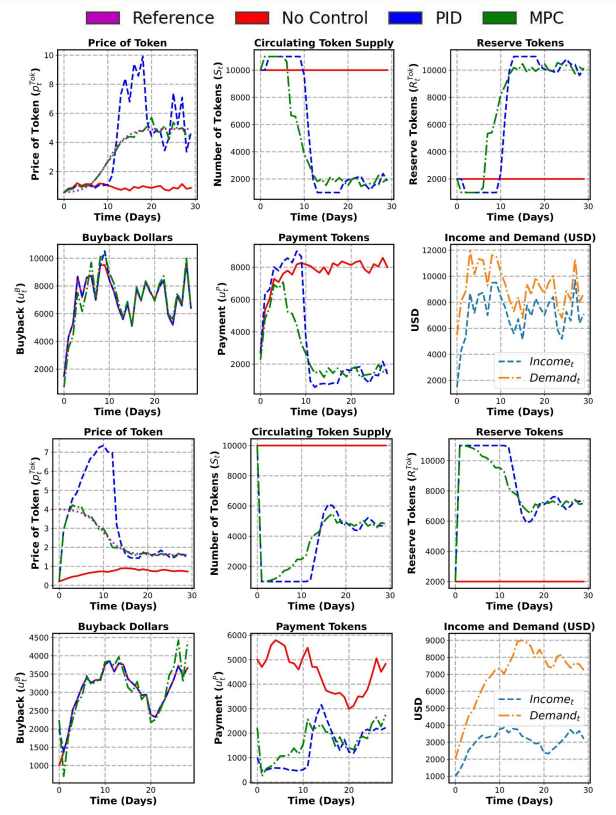
\ \ Does MPC outperform benchmarks to yield a stable token price growth? Fig. 4 shows two example trajectories of our system, where the top two rows are with real Helium data and the bottom two are with synthetic data. Our key result is on the top left for the token price. For the Helium data, our MPC scheme (green) is able to track the reference (purple) extremely well, while heuristic PID captures the general trend but is highly oscillatory since it is reactive. Crucially, the price plummets without control since we pay too many tokens, which causes inflation. However, our MPC scheme adaptively curtails token payments to reduce the circulating supply and avoid inflation (middle). Importantly, the vanilla income-clearing strategy from Remark 1 (red) immediately pays out the exact same number of tokens it buys back from the market. Thus, the net change in the circulating token supply (and hence reserve) is zero, as indicated by the horizontal red lines for the token plots.
\ The last two rows confirm the generality of our approach – we can just as easily follow a smoothly decreasing price trajectory. For example, we might want to price the token more affordably over time. Crucially, the initial token price (row 3, top left) is very low and far from the reference for all schemes, but our MPC method (green) quickly rises to track the reference unlike PID (blue), which overshoots. Importantly, the price without control is very low but slightly increasing since the income/demand gradually increase over time. Finally, MPC slowly increases the adaptive payments after timestep 11 for the price to decrease.
\ Limitations Our trace-driven simulations are limited by offline, historical Helium DeWi data. However, the growth of nodes and consumers might significantly deviate from historical patterns if we actually implemented our proposed controller in the network. In future work, we plan to answer such “what-if” questions using recent advances in counterfactual analysis [25,29,3].
7 Discussion and Future Work
Our central thesis is that Blockchain tokenomics should be programmable and dynamically adapt to node growth and consumer demand. Our key contribution is to model a token economy as a controlled dynamical system, which allows us to leverage rigorous systems theory to design token economies that meet high-level performance metrics (network cost functions). We believe our work is timely as several Blockchain projects are working with burn and mint strategies and our framework enables us to (a) explicitly prove these systems reach a stable equilibrium and (b) flexibly steer this equilibrium to incentivize stable network growth. We are working with several Blockchain projects to instantiate these ideas in practice, which we hope to report on in future work.
References
-
Burn and mint equilibrium. https://messari.io/report/burn-and-mint-equilibrium (2019), [Online; accessed 19-October-2022]
\
-
Summoning the money god: Applying control theory to cryptocurrency monetary policy. https://medium.com/reflexer-labs/summoning-the-money-god-2a3f3564a5f2 (2021), [Online; accessed 10-June2021]
\
-
Agarwal, A., Shah, D., Shen, D.: Synthetic interventions. arXiv preprint arXiv:2006.07691 (2020)
\
-
Agrawal, A., Barratt, S., Boyd, S., Stellato, B.: Learning convex optimization control policies. In: Learning for Dynamics and Control. pp. 361-373. PMLR (2020)
\
-
Åström, K.J., Murray, R.M.: Feedback systems: an introduction for scientists and engineers. Princeton university press (2021)
\
-
Bard, J.F.: Practical bilevel optimization: algorithms and applications, vol. 30. Springer Science & Business Media (2013)
\
-
Bhardwaj, M., Sundaralingam, B., Mousavian, A., Ratliff, N.D., Fox, D., Ramos, F., Boots, B.: Storm: An integrated framework for fast joint-space model-predictive control for reactive manipulation. In: Conference on Robot Learning. pp. 750–759. PMLR (2022)
\
-
Bonalli, R., Cauligi, A., Bylard, A., Pavone, M.: Gusto: Guaranteed sequential trajectory optimization via sequential convex programming. In: 2019 International conference on robotics and automation (ICRA). pp. 6741–6747. IEEE (2019)
\
-
Borrelli, F., Bemporad, A., Morari, M.: Predictive control for linear and hybrid systems. Cambridge University Press (2017)
\
-
Caginal, C.: A dynamical systems approach to cryptocurrency stability. arXiv preprint arXiv:1805.03143 (2018)
\
-
Camacho, E.F., Alba, C.B.: Model predictive control. Springer Science & Business Media (2013)
\
-
Carlsten, M., Kalodner, H., Weinberg, S.M., Narayanan, A.: On the instability of bitcoin without the block reward. In: Proceedings of the 2016 ACM SIGSAC Conference on Computer and Communications Security. pp. 154–167 (2016)
\
-
Chung, H., Shi, E.: Foundations of transaction fee mechanism design. arXiv preprint arXiv:2111.03151 (2021)
\
-
Colson, B., Marcotte, P., Savard, G.: An overview of bilevel optimization. Annals of operations research 153(1), 235–256 (2007)
\
-
Eyal, I.: The miner’s dilemma. In: 2015 IEEE Symposium on Security and Privacy. pp. 89–103. IEEE (2015)
\
-
Eyal, I., Sirer, E.G.: Majority is not enough: Bitcoin mining is vulnerable. Communications of the ACM 61(7), 95–102 (2018)
\
-
Gurobi Optimization, L.: Gurobi optimizer reference manual (2018)
\
-
Haleem, A., Allen, A., Thompson, A., Nijdam, M., Garg, R.: Helium a decentralized wireless network. https://whitepaper.io/document/649/helium-whitepaper (2018)
\
-
Kereiakes, E., Do Kwon, M.D.M., Platias, N.: Terra money: Stability and adoption. White Paper, Apr (2019)
\
-
Labs, P.: Filecoin: A decentralized storage network. https://whitepaper.io/document/599/filecoin-whitepaper (2020)
\
-
Labs, S.: Storj: A decentralized cloud storage network framework. https://www.storj.io/storjv3.pdf (2018
\
-
Levandowski, A.: Intro to pollen mobile. https://docs.pollenmobile.io/pollen-mobile-docs/white-paper/intro-to-pollen-mobile (2021)
\
-
Malyuta, D., Reynolds, T.P., Szmuk, M., Lew, T., Bonalli, R., Pavone, M., Acikmese, B.: Convex optimization for trajectory generation. arXiv preprint arXiv:2106.09125 (2021)
\
-
Messié, V., Fromentoux, G., Marjou, X., Omnes, N.L.: Baladin for blockchainbased 5g networks. In: 2019 22nd Conference on Innovation in Clouds, Internet and Networks and Workshops (ICIN). pp. 201–205. IEEE (2019)
\
-
Morgan, S.L., Winship, C.: Counterfactuals and causal inference. Cambridge University Press (2015)
\
-
Nakamoto, S.: Bitcoin: A peer-to-peer electronic cash system. Decentralized Business Review p. 21260 (2008)
\
-
Network, C.: Computecoin network: The infrastructure of web 3.0 and the metaverse. https://whitepaper.io/document/649/heliumwhitepaper (2020)
\
-
Osborne, M.J., et al.: An introduction to game theory, vol. 3. Oxford university press New York (2004)
\
-
Pearl, J.: Causal inference. Causality: objectives and assessment pp. 39–58 (2010)
\
-
Petkanics, D., et al.: Protocol and economic incentives for a decentralized live video streaming network (2018)
\
-
Roughgarden, T.: Transaction fee mechanism design. ACM SIGecom Exchanges 19(1), 52–55 (2021)
\
-
Snow, P., Deery, B., Lu, J., Johnston, D., Kirby, P.: Factom: Business processes secured by immutable audit trails on the blockchain. Whitepaper, Factom, November 111 (2014)
\
-
Van Den Berg, J.: Iterated lqr smoothing for locally-optimal feedback control of systems with non-linear dynamics and non-quadratic cost. In: 2014 American control conference. pp. 1912–1918. IEEE (2014)
\
-
Williams, G., Drews, P., Goldfain, B., Rehg, J.M., Theodorou, E.A.: Informationtheoretic model predictive control: Theory and applications to autonomous driving. IEEE Transactions on Robotics 34(6), 1603–1622 (2018)
\
-
Zargham, M., Zhang, Z., Preciado, V.: A state-space modeling framework for engineering blockchain-enabled economic systems. arXiv preprint arXiv:1807.00955 (2018)
\
-
Zhang, Z., Zargham, M., Preciado, V.M.: On modeling blockchain-enabled economic networks as stochastic dynamical systems. Applied Network Science 5(1), 1–24 (2020)
\
:::info Authors:
(1) Oguzhan Akcin, The University of Texas at Austin ([email protected]);
(2) Robert P. Streit, The University of Texas at Austin ([email protected]);
(3) Benjamin Oommen, The University of Texas at Austin ([email protected]);
(4) Sriram Vishwanath, The University of Texas at Austin ([email protected]);
(5) Sandeep Chinchali, The University of Texas at Austin ([email protected]).
:::
:::info This paper is available on arxiv under CC BY 4.0 DEED license.
:::
\


You May Also Like

Franklin Templeton CEO Dismisses 50bps Rate Cut Ahead FOMC

Binance Commits $500K to Scale National Ukraine Web3 Ecosystem Growth – Exchanges Bitcoin News

From Telegram to Terminal: Banana Gun’s Pro Platform Hits Ethereum as User Base Surpasses One Million



