BNY Expands Institutional Crypto Custody with USDC Minting and Redemption
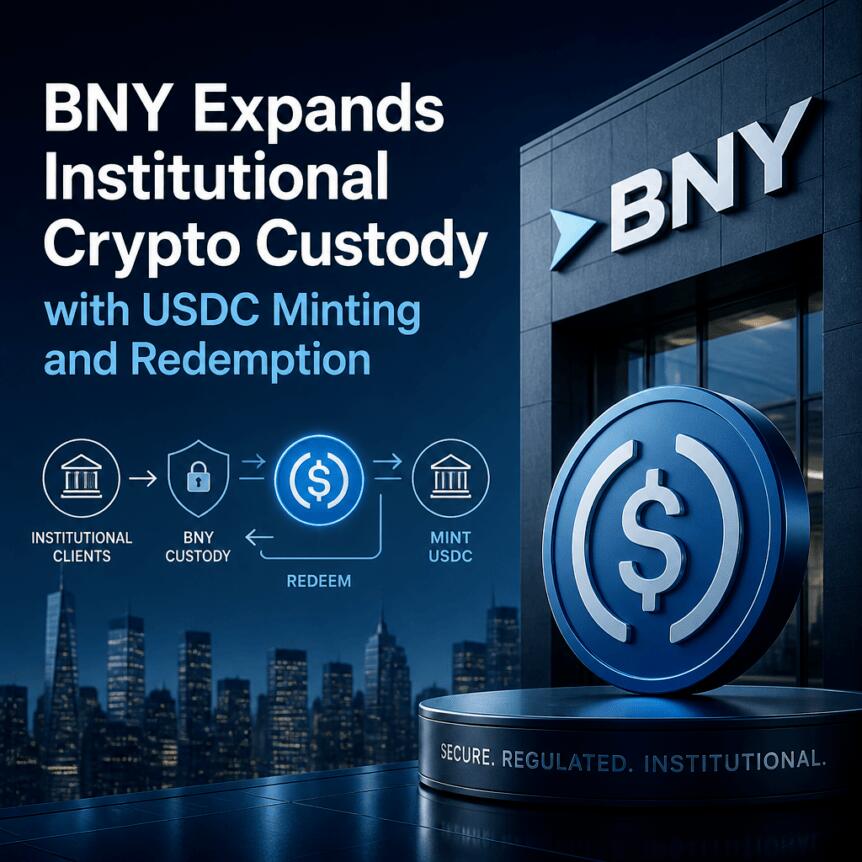
BNY has upgraded its Digital Asset Custody platform to support client use of Circle’s USD Coin (USDC), adding the ability for institutional users to convert US dollars to USDC, store it, and later redeem it back into dollars through the bank.
The bank says this makes USDC the first stablecoin available on its custody service, with plans to expand to other stablecoins and related “digital cash” workflows over time. The move follows BNY’s broader push into crypto-adjacent infrastructure, including custody offerings for major tokens.
Key takeaways
- BNY’s Digital Asset Custody now supports USDC for institutional clients, including storage, transfers, and redemption into USD through the bank.
- Clients can convert dollars into USDC and redeem back into dollars directly within BNY’s platform workflow.
- BNY positions the upgrade as an extension of its existing role as custodian of assets backing USDC reserve arrangements.
- DefiLlama data referenced by BNY puts USDC at more than $73.8 billion in circulation, making it the world’s second-largest stablecoin by market capitalization.
- BNY’s step aligns with a broader wave of stablecoin-related product launches by major banks and asset managers.
BNY turns custody into a stablecoin cashflow tool
BNY’s announcement goes beyond basic custody support. According to the bank, the platform enables institutional clients to convert USD into USDC and redeem USDC back into USD, with storage and transfers of USDC handled through BNY’s custody rails.
For investors and treasury teams, the practical value is that stablecoin operations can be consolidated inside an institution’s existing banking relationship rather than requiring separate workflows across multiple counterparties. While many crypto platforms can hold stablecoins, BNY’s framing emphasizes continuity with traditional banking functions—especially the ability to move between dollars and USDC.
BNY also said the service is intended to expand. Over time, it plans to add additional stablecoins and broader “digital cash” use cases, indicating this is the start of a wider product roadmap rather than a one-off integration for USDC.
Building on BNY’s USDC reserve-custodian role
The expansion is also positioned as a deepening of BNY’s existing partnership with Circle. BNY has previously served as the primary custodian of the assets backing USDC, and it is now extending that relationship from reserve safeguarding into client-facing stablecoin custody and operations.
BNY states that it oversees $59.3 trillion in assets under custody and administration and serves more than 90% of Fortune 100 companies. In its filing to contextualize the move, the bank also cited DefiLlama data showing USDC as the second-largest stablecoin by market capitalization, with more than $73.8 billion in circulation.
That matters because stablecoin adoption has often depended not only on token liquidity and ecosystem growth, but also on credible institutional infrastructure—particularly for regulated participants who want compliance-friendly custody, transfer controls, and clearer operational processes.
Stablecoin infrastructure is becoming a mainstream banking product
BNY’s latest upgrade lands in the middle of a wider trend: major financial institutions are developing products that sit alongside stablecoin issuance, reserve management, and—critically—compliance-aligned investment vehicles.
In May, JPMorgan filed to launch a tokenized money market fund aimed at stablecoin issuers, designed to allow reserve assets to be held in a regulated investment vehicle while earning interest. The proposal described an Ethereum-based fund investing in US Treasury bills and overnight repurchase agreements used to back payment stablecoins.
Earlier in the month, State Street launched a government money market fund for stablecoin issuers aligned with the GENIUS Act. According to the coverage cited in the article, the fund invests in US government securities and repurchase agreements and lists State Street Bank and Anchorage Digital among its initial investors.
Large firms are also exploring other angles of the stablecoin ecosystem. The article notes that Bank of America said it was exploring stablecoins to modernize payments infrastructure, while Fidelity Investments launched a US dollar-backed stablecoin (FIDD) after receiving conditional approval to operate a national trust bank.
While these initiatives are not identical—some target reserve investment structures and others focus on payments modernization—the underlying pattern is clear: traditional institutions are treating stablecoins less as an experimental fringe product and more as an infrastructure layer that can be standardized for regulated use.
Where the market stands for stablecoins
BNY’s move also fits the scale of the stablecoin market itself. The article cites DefiLlama estimates valuing the stablecoin sector at about $313 billion, with Tether’s USDT accounting for roughly 60% of that market.
USDC’s prominence is reflected in BNY’s cited circulation figure, and its position as a large, widely supported stablecoin helps explain why institutional custodians are prioritizing it. However, the next question for market participants is whether BNY’s platform expansion beyond USDC will concentrate on a handful of other major stablecoins or broaden across more issuers and tokens over time.
Investors and operators should watch how quickly BNY rolls out additional stablecoins and whether it extends the platform’s “digital cash” workflows into more payment or treasury use cases, since the pace of expansion will signal how seriously big banks are committing to stablecoin settlement as an operational standard rather than a pilot feature.
This article was originally published as BNY Expands Institutional Crypto Custody with USDC Minting and Redemption on Crypto Breaking News – your trusted source for crypto news, Bitcoin news, and blockchain updates.


You May Also Like

CME Group to launch Solana and XRP futures options in October

Gold Slips Toward $4,000 as Persistent Inflation Data Bolsters Higher Rate Expectations