Michigan Court Blocks Kalshi Sports Betting Contracts in Temporary Order
A Michigan judge has temporarily barred prediction market platform Kalshi from allowing Michigan residents to trade sports event contracts, marking another significant development in the growing legal battle between state regulators and federally regulated prediction markets.
Ingham County Circuit Court Judge Rosemarie Aquilina issued a temporary restraining order that remains in effect for 14 days and is scheduled to expire on July 13. Under the order, Kalshi must prevent users located in Michigan from accessing its sports event contracts through court-mandated geolocation controls.
The judge stated that Kalshi could face $120,000 in fines for each day it fails to comply with the geolocation requirements. The order also requires the company to use a third-party geolocation provider licensed by the Michigan Gaming Control Board.
In the ruling, Aquilina wrote that Michigan residents would suffer irreparable harm from being “exploited by Kalshi’s sports betting operation masquerading as an investment opportunity.”
Michigan Joins Expanding State Enforcement Against Prediction Markets
The latest order follows a lawsuit filed by Michigan Attorney General Dana Nessel in March, which alleged that Kalshi was operating an unlicensed internet sports betting platform in violation of the Michigan Lawful Sports Betting Act. The lawsuit seeks to permanently stop the platform from offering sports-related event contracts in the state.
Michigan now becomes the second U.S. state to obtain a court-ordered restriction against Kalshi’s sports event contracts after Nevada secured a similar temporary ban in March. A comparable legal dispute remains active in Massachusetts, where enforcement has been paused while appeals continue.
The legal challenges extend beyond Michigan. On June 17, Kentucky filed a lawsuit against five prediction market platforms, including Kalshi and Polymarket, alleging they were operating unlicensed sports betting businesses. More than a dozen states have launched legal or regulatory actions against prediction market operators as scrutiny of the sector continues to grow.
Kalshi has consistently argued that its event contracts fall under the exclusive jurisdiction of the U.S. Commodity Futures Trading Commission (CFTC), rather than state gambling regulators. The CFTC has also filed lawsuits against several states, maintaining that federally regulated event contracts are governed by federal commodities law rather than state gaming statutes.
Recently, Kalshi, based in New York City, is reportedly seeking fresh funding at a $40 billion valuation as growth in prediction markets accelerates. The talks come after Kalshi’s annualized revenue surpassed $2 billion and as the company explores a potential IPO despite ongoing regulatory challenges.
Prediction Market Activity Continues to Grow Despite Legal Challenges
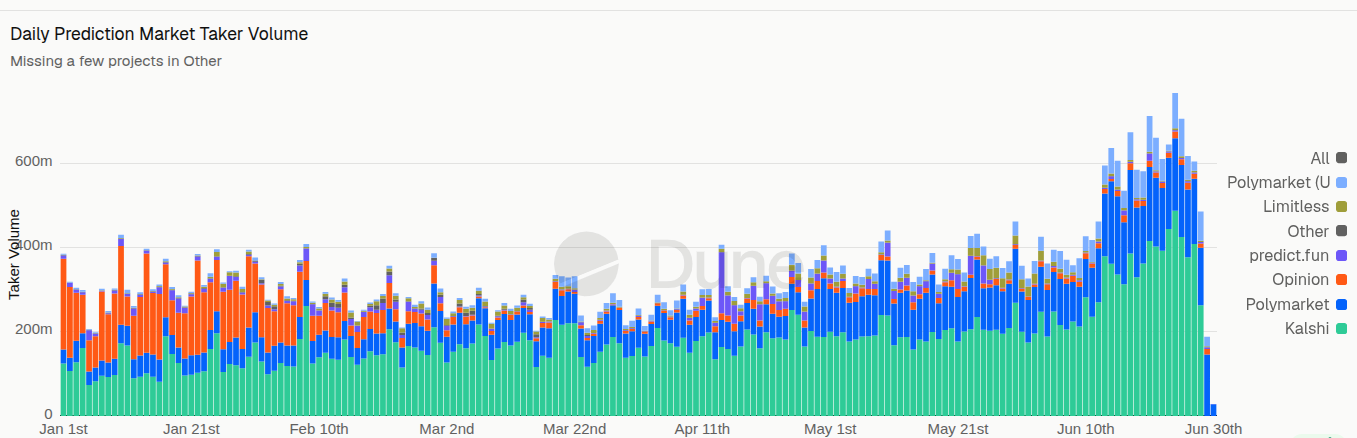 Prediction Market – Dune Analytics
According to Dune Analytics data, daily taker volume, which measures contracts bought or sold by traders filling existing orders, reached a record $713 million on June 20, underscoring the rapid growth of sports event prediction markets even as legal challenges continue across multiple jurisdictions.
The Michigan ruling adds another chapter to the broader national debate over whether sports event contracts offered by prediction markets should be regulated as federally supervised financial derivatives or as state-regulated sports betting products. Additional court proceedings are expected as states and federal regulators continue to dispute jurisdiction over the emerging industry.
Kalshi’s live FIFA World Cup Winner market currently places France as the leading favorite with a 29.1% implied probability, while Argentina follows at 21.1%. The market is scheduled to begin on July 19 and has generated more than $748.5 million in trading volume, reflecting growing participation ahead of the tournament.


You May Also Like

US Supreme Court upholds bans on transgender athletes in school sports

Theo Invests $20M in Fidelity International’s Tokenized Fund, Expanding RWA Footprint