Barclays resets Nike stock price target
Nike has spent the past year and a half trying to convince Wall Street that its turnaround is real. For a while, the story was working. Then, it reported fiscal Q4 results (ended in May).
Now one of the banks that has stuck with Nike (NKE) the longest is recalibrating just how much patience that story deserves.
And the new number tells its own story about how far Nike still has to travel.
Nike's comeback plan is stuck in limbo
Nike CEO Elliott Hill has framed fiscal 2026 as a foundation year, built around what the company calls its Win Now priorities.
The plan reorganized roughly 8,000 employees into sport-focused teams under a new operating model called the Sport Offense.
"We made meaningful structural improvements to lay the groundwork for our Sport Offense across our team culture, innovative product, brand strength, and how we serve consumers in our countries and cities," CEO Elliott Hill explained.
The strategy has produced real wins.
- Running has posted five straight quarters of double-digit growth and added close to one billion dollars in revenue.
- North America grew 3% in the quarter, and wholesale revenue there jumped 10%.
- Nike also noted its revenue and retail sales with Foot Locker turned positive for the first time in four years.
But two of Nike's biggest businesses are still struggling.
Nike Sportswear and Jordan Streetwear, which together account for about half of total revenue, remain in decline, with sell-through so weak it is hurting both current discounting and future order books.
Related: Why Nike's Q4 earnings aren’t about numbers
Greater China was the weakest region in the quarter, with revenue down 17% on a currency-neutral basis and profit down 20%.
For the full year, revenue was flat on a reported basis and down 2% on a currency neutral basis.
Nike also booked a one-time $986 million benefit tied to recovered tariff costs, without which fourth quarter earnings per share would have been $0.20 instead of $0.72, the company said.
Barclays lowers its Nike price target to $52
Barclays analyst Adrienne Yih cut her price target on Nike stock to from $67 to $52, while keeping an “Overweight” rating on the stock, according to Investing.com.
The reasoning was straightforward: Nike's turnaround is progressing more slowly than Barclays had modeled.
At the time of writing, NKE stock trades at $43, which is near its 12-year low. Shares of the iconic footwear giant currently trade 75% below all-time highs.
Barclays isn't alone in trimming expectations. According to Investing.com:
- Stifel, Piper Sandler and UBS each lowered their targets to $45, pointing to a longer turnaround timeline and continued sales weakness.
- Telsey Advisory Group cut its target to $47.
- At the same time, Bernstein SocGen Group lowered its target to $72. Still, it kept an Outperform rating, citing cautious optimism heading into calendar 2027 as innovation and cost cuts start to show up in results.
- UBS was more skeptical, arguing there still isn't an attractive entry point even after the stock's decline.
Nike guided revenue to fall in the low- to mid-single digits from the fourth quarter of fiscal 2026 through the first half of fiscal 2027, with Sportswear remaining under pressure and demand uneven across regions.
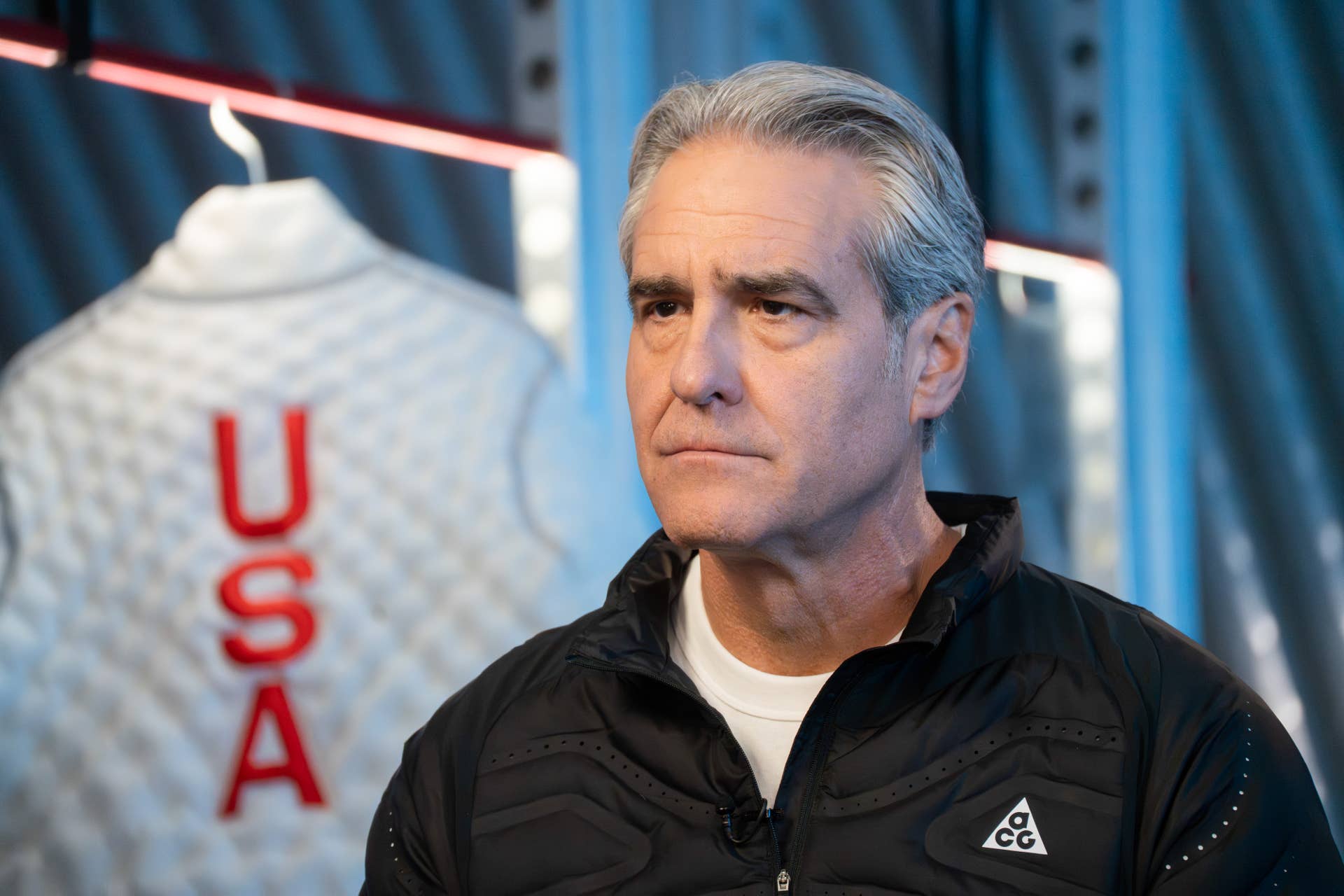 Elliott Hill, chief executive officer at Nike, is optimistic on a turnaround.
Bloomberg&solGetty Images
Is Nike stock fundamentally strong?
Looking past the headlines, Nike's balance sheet still looks solid.
The company held about $9 billion in cash and short-term investments as of May 2026, against total assets of $38.4 billion.
Total liabilities sat at $23.5 billion, leaving a healthy equity cushion, and current assets of $24.6 billion comfortably cover current liabilities of $12.5 billion.
Inventory has stayed essentially flat year over year, a sign that Nike's efforts to clean up excess stock are gaining traction.
More Retail:
- 60-year-old retailer closes over 240 locations across 35 states
- Retail giant exits U.S. fashion after multi-million-dollar scandal
- 79-year-old fast-fashion retailer closes 128 stores
The profit-and-loss picture is more complicated.
- Reported gross margin jumped to 49.2% in the May 2026 quarter, but that was almost entirely the tariff refund. Strip that out and margin was roughly 40.2%, similar to prior quarters.
- The operating margin, excluding one-time items, has been recovering gradually but remains well below Nike's historical double-digit target.
- Free cash flow for the quarter came in at $284 million, down 83% from a year earlier, based on the same data.
- Operating cash flow of $430 million was also well below the prior-year period, reflecting swings in payables and receivables tied to the timing of tariff recovery.
Put together, Nike looks financially stable but not yet fundamentally strong.
Debt levels are manageable, and liquidity is ample, but underlying profitability and cash generation still depend heavily on a Sportswear recovery that management itself says will not show up until the back half of fiscal 2027.
That is roughly the same conclusion Barclays reached with its lower price target.
Related: Nike closes stores, fitness studios, and lays off workers


You May Also Like

US Dollar Slips as Markets Recalibrate Fed Rate Cut Expectations

The spectacular implosion of Trump's big bash shows America is finished with this clown