Samsung distances itself from OUSD stablecoin founding consortium
Samsung has distanced itself from the founding consortium behind the proposed OUSD stablecoin after being named among more than 140 partners announced for the project.
- Samsung says it has not held formal talks with Open Standard despite being named an OUSD founding partner.
- Dunamu, Shinhan Bank, and K-Bank say they are only reviewing participation and have not approved joining the consortium.
- Circle expands institutional USDC services with Standard Chartered as scrutiny grows over OUSD’s founding member claims.
According to a report by Chosun, several South Korean companies listed as founding members of Open Standard’s OUSD consortium have said they either never held formal discussions with the issuer or have not agreed to participate in the initiative. The disclosures have cast uncertainty over the consortium structure that Open Standard unveiled earlier this week.
Open Standard introduced OUSD as a new stablecoin governed by a consortium of more than 140 organizations. The issuer said participating members would jointly oversee the project through a shared governance board while also sharing revenue generated from the stablecoin’s reserve assets.
Samsung says no formal role has been agreed
Speaking to Chosun, a Samsung official said the company had not held official consultations with Open Standard and did not know what role it was expected to play within the consortium. The official’s comments came after Samsung was identified as one of the founding partners in Open Standard’s announcement.
Other companies offered similar responses. According to Chosun, Dunamu, Shinhan Bank and K-Bank confirmed they had received inquiries from Open Standard about joining the project but said they were still reviewing the proposal and had not approved participation.
One company official told the newspaper that the firm first learned it had been listed as a consortium member through domestic media reports. The official said the company had only responded that it would consider the proposal if circumstances developed favorably and expressed surprise at being presented as a member before any agreement had been reached.
The statements contrast with Open Standard’s announcement, which described the listed organizations as founding partners that would participate in collaborative governance and share earnings generated from the stablecoin’s reserves.
Circle partnership gains attention as OUSD faces scrutiny
The questions surrounding OUSD’s founding consortium have emerged only days after the project was unveiled, drawing comparisons with more established stablecoin issuers.
Following Open Standard’s announcement, Circle Chief Executive Jeremy Allaire argued that consortium-based stablecoin models have historically struggled because decision-making tends to be slow and incentives among participants are often misaligned.
Meanwhile, Circle has continued expanding institutional access to its USDC stablecoin through new banking partnerships. Standard Chartered recently launched a service that allows eligible institutional clients to mint and redeem USDC directly through the bank’s platform. Developed with Circle, the service lets clients access fiat banking, custody, digital asset infrastructure and public blockchain connectivity through a single banking relationship instead of opening separate accounts with Circle.
The offering has launched through Standard Chartered’s Dubai International Financial Centre operations, with expansion into additional markets planned subject to regulatory approvals and market readiness.
Investor sentiment also shifted after the latest developments. According to data from Yahoo Finance, Circle’s CRCL shares rebounded by as much as 4% to around $64.62 after an earlier double-digit decline that followed the OUSD announcement and the stock’s removal from several Russell indexes.
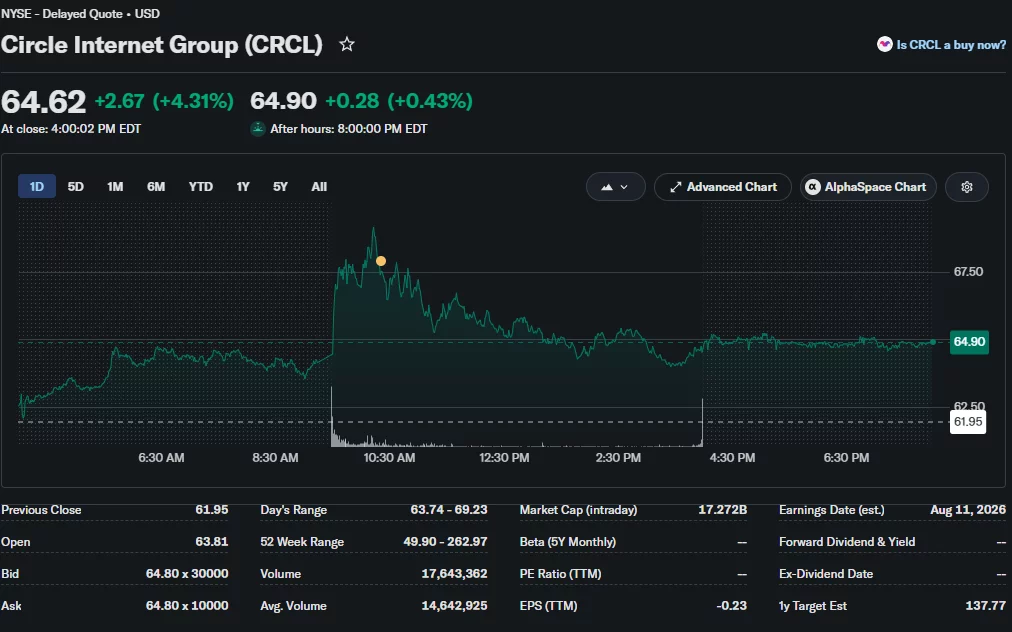
The recovery coincided with gains across crypto-related stocks as Bitcoin climbed back toward the $62,000 level.
The comments from Samsung and other South Korean firms leave Open Standard facing fresh questions over the composition of its announced founding consortium, even as the project continues promoting a governance model built around participation from major corporate partners.


You May Also Like

The spectacular implosion of Trump's big bash shows America is finished with this clown

Aave Price Prediction: AAVE Dips After DeFi Wallet Surge While Pepeto's 150x Presale Window Draws Thousands Before Expected Listing