Sam Bankman-Fried acknowledges that his most significant error was that he had given FTX to the new CEO prior to bankruptcy, and he had no final opportunity to. The disgraced founder of FTX, Sam Bankman-Fried, says that his biggest mistake was the one that sent him the reins of the crypto exchange to the new […] The post Crypto News: Bankman-Fried’s Biggest Mistake: Handing FTX to New CEO appeared first on Live Bitcoin News.Sam Bankman-Fried acknowledges that his most significant error was that he had given FTX to the new CEO prior to bankruptcy, and he had no final opportunity to. The disgraced founder of FTX, Sam Bankman-Fried, says that his biggest mistake was the one that sent him the reins of the crypto exchange to the new […] The post Crypto News: Bankman-Fried’s Biggest Mistake: Handing FTX to New CEO appeared first on Live Bitcoin News.

Crypto News: Bankman-Fried’s Biggest Mistake: Handing FTX to New CEO

Sam Bankman-Fried acknowledges that his most significant error was that he had given FTX to the new CEO prior to bankruptcy, and he had no final opportunity to.

The disgraced founder of FTX, Sam Bankman-Fried, says that his biggest mistake was the one that sent him the reins of the crypto exchange to the new CEO, John J. Ray III, before the company announced its bankruptcy in November 2022. 

Bankman-Fried became aware of a possible external investment that could have rescued FTX just a few minutes after signing over the exchange and said he could not take his decision back. 

It was revealed in a recent exclusive interview with Mother Jones and shed new light on the dramatic final days of the $32 billion exchange that on November 11, 2022, filed Chapter 11 bankruptcy.

Under the leadership of Ray, FTX went bankrupt quickly, and he hired the law firm Sullivan and Cromwell to provide legal advice. The new CEO has a reputation for handling corporate meltdowns such as Enron. 

The fall of FTX was described as an unprecedented corporate control failure where financial records were chaotic and management practices were poor, which was revealed throughout the bankruptcy process.

The bankruptcy of FTX showed that the company had misused millions of customer funds. Customer funds of the company were misused by the sister company, Alameda Research, and the company suffered billions of dollars of trading losses, the notorious Alameda gap. 

Later on, Bankman-Fried was arrested in the Bahamas and extradited to the U.S., where he was sentenced to 25 years in prison over his part in the collapse and the fraud.

FTX Creditors Approach $1.6 Billion Repayment Milestone

Recently, the FTX bankruptcy estate provided information that it will release 1.6 billion dollars to creditors in the continued repayment process. 
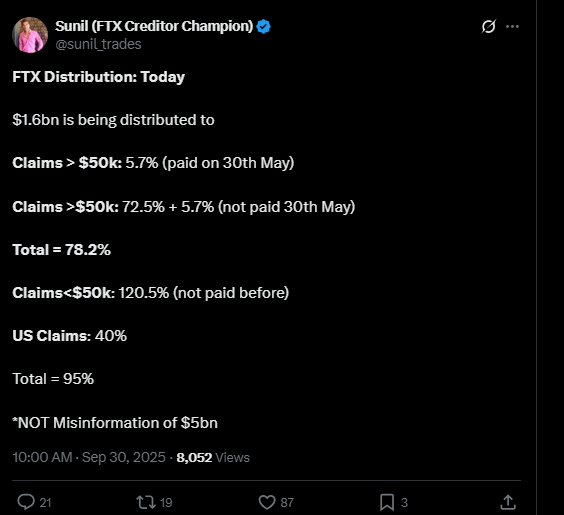
Source – X

This will be the third large tranche after previous repayments in February and May 2025. 

The repayments will be modeled to have high recovery rates for the smaller claimant of more than 120 percent, larger claims of more than 50,000 U.S. claimants will have approximately 60 percent recovery rate, and an overall total repayment rate is near 78.2 percent. 

Such repayments are an indication of a gradual yet progressive bid to pay back creditors following the industry destabilizing meltdown.

Bankman-Fried and his legal team are challenging his conviction, saying the newly appointed CEO mishandled the billion-dollar bankruptcy. 

The law company that made a lot of money out of the costly court cases. This scandal is another twist to the dramatic story of the spectacular collapse of FTX.

The post Crypto News: Bankman-Fried’s Biggest Mistake: Handing FTX to New CEO appeared first on Live Bitcoin News.


Market Opportunity
SecondLive Logo
SecondLive Price(LIVE)
$0.00001705
$0.00001705$0.00001705
-2.62%
USD
SecondLive (LIVE) Live Price Chart
Disclaimer: The articles reposted on this site are sourced from public platforms and are provided for informational purposes only. They do not necessarily reflect the views of MEXC. All rights remain with the original authors. If you believe any content infringes on third-party rights, please contact [email protected] for removal. MEXC makes no guarantees regarding the accuracy, completeness, or timeliness of the content and is not responsible for any actions taken based on the information provided. The content does not constitute financial, legal, or other professional advice, nor should it be considered a recommendation or endorsement by MEXC.

You May Also Like

XRP Hits ‘Extreme Fear’ Levels - Why This Is Secretly Bullish

XRP Hits ‘Extreme Fear’ Levels - Why This Is Secretly Bullish

Ripple’s native token XRP is still battling out with the bears at the $1.90 territory on Friday afternoon. The support-turned-resistance at $1.90 is particularly
Share
Coinstats2026/01/24 03:25
Tokyo’s Metaplanet Launches Miami Subsidiary to Amplify Bitcoin Income

Tokyo’s Metaplanet Launches Miami Subsidiary to Amplify Bitcoin Income

Metaplanet Inc., the Japanese public company known for its bitcoin treasury, is launching a Miami subsidiary to run a dedicated derivatives and income strategy aimed at turning holdings into steady, U.S.-based cash flow. Japanese Bitcoin Treasury Player Metaplanet Opens Miami Outpost The new entity, Metaplanet Income Corp., sits under Metaplanet Holdings, Inc. and is based […]
Share
Coinstats2025/09/18 00:32
The GENIUS Act Is Already Law. Banks Shouldn’t Try to Rewrite It Now

The GENIUS Act Is Already Law. Banks Shouldn’t Try to Rewrite It Now

The post The GENIUS Act Is Already Law. Banks Shouldn’t Try to Rewrite It Now appeared on BitcoinEthereumNews.com. Healthy competition drives innovation and better products for consumers; it is at the center of American economic leadership. Unfortunately, now that the bipartisan GENIUS Act has been signed into law, major legacy financial institutions seem to be having second thoughts about the innovations that stablecoins can bring to financial markets. Bank lobbying groups and public affairs teams have been peppering Congress with complaints about the law, urging members to reopen debate and introduce changes to the legislation that will ensure the stablecoin market doesn’t grow too quickly, protecting banks’ profits and stifling consumer choice. This reactionary response is both overblown and unnecessary. What legacy financial firms should do instead is embrace competition and offer exciting new products and services that consumers want, not try to kneecap emerging players through anti-innovation rules and regulations. The GENIUS Act was carefully designed with a thorough bipartisan process to strengthen consumer safeguards, ensure regulatory oversight, and preserve financial stability. Efforts to roll back its provisions are less about protecting families and more about protecting entrenched banking interests from the competition that helps ensure the U.S. banking system stays the strongest and most innovative in the world. Critics warn that allowing stablecoins to provide rewards could lead to massive deposit outflows from community banks, with figures as high as $6.6 trillion cited. But closer examination shows this fear is unfounded. A July 2025 analysis by consulting firm Charles River Associates found no statistically significant relationship between stablecoin adoption and community bank deposit outflows. In fact, the overwhelming majority of stablecoin reserves remain in the traditional financial system — either in commercial bank accounts or in short-term Treasuries — where they continue to support liquidity and credit in the broader U.S. economy. The dire estimates rely on unrealistic assumptions that every dollar of stablecoin issuance permanently…
Share
BitcoinEthereumNews2025/09/18 09:39