

Is P2P Crypto Trading Safe and Legal in India? (2026 Complete Guide)
BitcoinWorld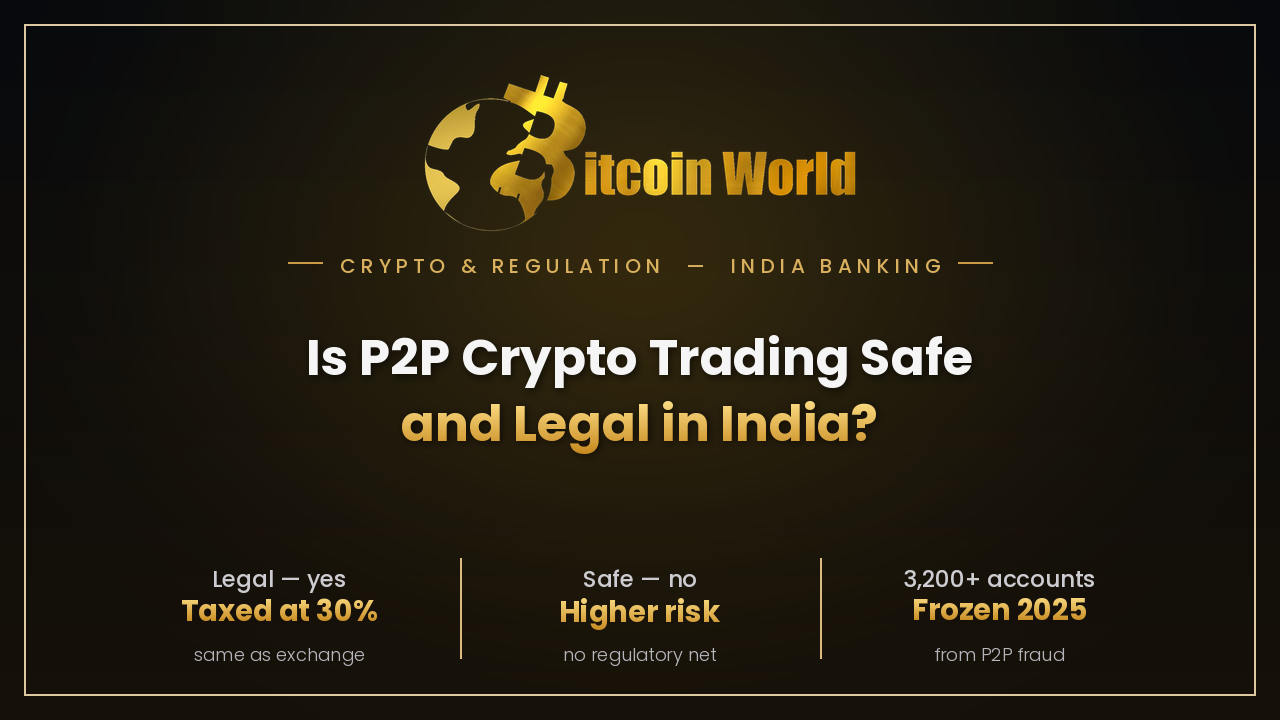
Is P2P Crypto Trading Safe and Legal in India? (2026 Complete Guide)
Is P2P Crypto Trading Safe and Legal in India?
P2P crypto trading in India is legal under current law but carries a significantly higher risk profile than trading on a registered exchange – and understanding exactly where that risk sits is the most important thing any Indian trader can do before placing a single P2P order. Peer-to-peer crypto trading operates through a direct buyer-seller mechanism where the platform holds crypto in escrow but fiat payment flows directly between individuals, outside any centralized oversight. This article covers the legal framework governing P2P trading in India in 2026, the tax rules that apply identically to both P2P and exchange trades, the specific fraud patterns that have frozen thousands of Indian bank accounts, and the concrete steps that make P2P safer for experienced users.
What Is P2P Crypto Trading and How Does It Work in India?
P2P crypto trading in India means buying or selling cryptocurrency directly with another individual, using a platform that facilitates the match and holds the crypto in escrow – but where the INR payment travels from buyer to seller’s bank account directly.
- No centralized order book: Prices are negotiated between counterparties, not determined by a live market order book.
- Escrow mechanism: The selling party’s crypto is locked in the platform’s escrow until the buyer’s payment is confirmed – the crypto is released only after the seller marks payment received.
- INR flows peer-to-peer: The actual fiat payment – UPI, IMPS, or bank transfer – moves directly between two individual bank accounts, bypassing the exchange entirely.
- Most-used platforms in India: Binance P2P is currently the most widely used option for Indian traders, alongside WazirX P2P and OKX P2P.
- Key difference from exchange trading: On a registered exchange, the platform is the counterparty; in P2P, an unknown individual is the counterparty.
Is P2P Crypto Trading Legal in India in 2026?
Yes – P2P crypto trading is legal in India in 2026, but it sits in a less regulated space than exchange trading and comes with specific compliance obligations that many users overlook.
- Legal to conduct: P2P crypto trading between two individuals is not prohibited under Indian law – you are not doing anything illegal by using P2P.
- Tax applies identically: P2P trades are taxed exactly the same as any other crypto transaction. The Income Tax Act’s VDA provisions apply regardless of whether you bought on a centralized exchange or directly from another person.
- Looser regulatory oversight than exchanges: PMLA 2023 brought exchanges under FIU reporting, but peer-to-peer transactions between individuals remain loosely monitored.
- Platform registration matters: Using a P2P feature hosted on a FIU-registered exchange provides more protection than using an unregistered platform – always verify registration on the FIU-IND website before depositing.
- No special P2P tax exemption: 30% flat tax on gains, 1% TDS on qualifying transfers, and mandatory Schedule VDA disclosure apply to every P2P trade in your ITR.
Is P2P Crypto Trading Actually Safe in India?
P2P crypto trading in India is significantly riskier than trading on a FIU-registered exchange – and the risks are specific, not theoretical.
- Centralized exchanges are safer: Centralized exchanges registered with the FIU have KYC requirements, internal fraud controls, and some level of accountability. P2P trades rely entirely on escrow and the platform’s dispute resolution, with no regulatory backing.
- Triangular fraud is the primary risk: A scammer directs a fraud victim to pay your bank account for a P2P trade they conducted with you – you receive stolen money, release crypto, and your bank account gets frozen when the victim files a police complaint.
- Third-party payment risk: Receiving INR from anyone other than the registered P2P buyer is the highest-risk pattern – never accept payment from a third party under any circumstances.
- 3,200+ account freezes in 2025: Thousands of innocent Indian P2P traders had bank accounts frozen in 2025 after unknowingly receiving proceeds of fraud – the criminal process does not require intent.
- No regulatory backstop: Unlike exchange disputes, there is no FIU complaint mechanism or regulated dispute resolution for P2P trades gone wrong.
What Are the Specific Safety Rules for P2P Crypto Trading in India?
Making P2P safer in India requires following a strict set of trade-time disciplines – none of which are optional if you want to protect your bank account.
- Trade only on FIU-registered platforms: Never conduct P2P on an unregistered platform – only platforms listed on the FIU-IND VASP registry have any compliance framework around them.
- Complete KYC on the platform: Always complete KYC on any P2P platform you use to reduce your own legal exposure.
- Verify counterparty ratings: Check completed trade count, completion rate, and average release time – avoid counterparties with fewer than 50 completed trades or below 95% completion rate.
- Accept payment only from the registered buyer: The name on the incoming UPI or bank transfer must exactly match the name on the P2P order – reject any third-party payment immediately and cancel the order.
- Screenshot every step: Capture the order details, buyer information, payment confirmation, and escrow release at the time of the trade – these screenshots are your first line of defence if your account is frozen.
- Avoid cash and informal deals: Users should avoid informal cash-based deals that may expose them to fraud or compliance risks.
- P2P is for experienced users: Beginners are better served by regulated exchanges; P2P is best suited for experienced users with specific needs.
How Are P2P Crypto Trades Taxed in India in 2026?
P2P crypto trading tax in India follows the same framework as all other VDA transfers – there is no reduced rate or lighter obligation for peer-to-peer transactions.
- 30% flat tax on gains: Every profitable P2P trade is taxed at 30% plus 4% cess on the gain (sale consideration minus cost of acquisition).
- 1% TDS obligation: TDS is deducted at source on crypto transfers above ₹50,000 in a financial year (₹10,000 for specified persons).On P2P trades, the buyer must deduct and remit 1% TDS via Form 26QE – the platform does not do this automatically.
- No loss offsetting: Losses on one P2P trade cannot reduce your tax on gains from another.
- Schedule VDA mandatory: Schedule VDA must be filled in your ITR return for every financial year in which you traded.
- Manual record-keeping required: Unlike registered exchanges that generate tax reports automatically, P2P traders must manually track every trade’s INR FMV, counterparty, and timestamp for ITR filing.
Frequently Asked Questions
Is P2P crypto trading safe for beginners in India in 2026?
P2P crypto trading in India is not recommended for beginners – registered exchanges with internal fraud controls, KYC-verified counterparties, and FIU oversight provide significantly more protection. P2P is best suited for experienced users with specific needs, such as accessing tokens not listed on domestic exchanges or trading at better prices. If you are new to crypto, start on a FIU-registered exchange, build familiarity with the mechanics, and only consider P2P once you fully understand the triangular fraud risk and manual tax obligations it involves.
Is the 1% TDS deducted automatically on P2P crypto trades in India?
No – 1% TDS on P2P trades in India is not deducted automatically by the platform. Unlike on registered exchanges where TDS is deducted at the point of trade, on P2P transactions the buyer is individually responsible for deducting and remitting TDS via Form 26QE to the Income Tax Department. Failure to do so makes the buyer liable for the TDS amount plus interest at 1.5% per month and a penalty equal to the TDS amount – making manual P2P tax compliance a significantly higher burden than exchange trading.
What is the most important safety rule for P2P crypto trading in India?
The single most important rule is: never accept payment from anyone other than the registered buyer on your P2P order. Triangular fraud – where a scammer directs a fraud victim to pay your bank account for your crypto – is the leading cause of innocent trader account freezes in India. Always verify payment methods, counterparty ratings, and number of completed trades before initiating any transaction. If the name on the incoming payment does not exactly match the buyer’s name on the order, cancel immediately – no exceptions.
Conclusion: Legal but Not for Everyone – P2P Crypto Trading Demands Experience and Discipline in India
P2P crypto trading in India in 2026 is legal, taxed, and – for experienced, disciplined users – a legitimate way to access crypto markets. But it operates without the regulatory safety net that FIU-registered exchanges provide, makes each buyer personally responsible for TDS compliance, and exposes users to a fraud pattern that has frozen thousands of Indian bank accounts through no fault of their own. The strategic message is clear: if you need P2P for a specific reason – better pricing, specific tokens, or privacy preferences – go in with complete KYC, strict counterparty verification, real-time trade screenshots, and a commitment to manual ITR reporting. If you don’t have a specific reason to use P2P, a registered exchange is safer on every dimension that matters. Know the framework, document every trade, and never release crypto until you have confirmed both the payment and the sender’s identity.
This post Is P2P Crypto Trading Safe and Legal in India? (2026 Complete Guide) first appeared on BitcoinWorld.


You May Also Like

What Does an XRP Address Look Like? And Why You Need a Destination Tag
BlackRock’s spot Bitcoin ETF sees over $772 million in outflows! What does this mean for the crypto market?

Trump rings opening bell for Trump Accounts as Treasury commits $1.4 billion in seed money



