Ethereum Staking Ratio Hits Record 34.4%
Overview
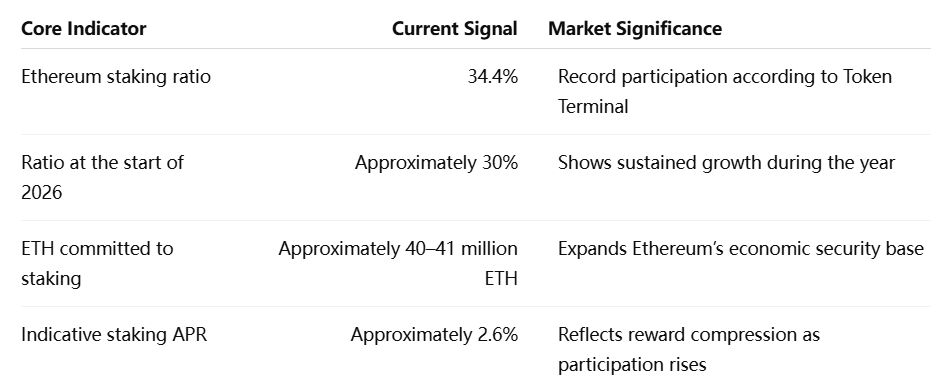
The Ethereum staking ratio has reached a record 34.4%, rising from approximately 30% at the beginning of 2026, according to Token Terminal data reported on August 4. Around 40 million ETH is now committed to Ethereum’s proof-of-stake system, while additional deposits remain in the validator activation queue. This sustained increase indicates that more holders are treating ETH as a productive network asset capable of generating protocol rewards rather than merely as a liquid token for trading.
The milestone appears constructive for Ethereum’s economic security and supply structure. More staked ETH raises the capital required to disrupt the network and limits the amount of native ETH immediately available for sale. However, the relationship between staking and liquid supply is more complicated than the headline suggests. Liquid staking tokens allow participants to trade, lend, or use claims on staked ETH across decentralized finance, meaning that deposited capital can remain economically active even when the underlying ETH is locked at the consensus layer.
A rising Ethereum staking ratio also creates trade-offs. As more ETH enters validation, the base reward available to individual validators declines. Growth concentrated among large exchanges, custodians, and liquid staking protocols may also increase operational dependencies. The record is therefore an important fundamental signal, but its effect on ETH depends on staking yields, issuance, token burning, institutional demand, network activity, and global liquidity.
Key Takeaways
- The Ethereum staking ratio increased from approximately 30% to a record 34.4%.
- More staked ETH strengthens network security but does not remove all related liquidity from the market.
- Higher participation compresses validator yields and increases the importance of operator diversification.
- The record may support ETH’s long-term fundamentals, but it does not guarantee price appreciation.
Ethereum Staking Ratio Reaches a New Milestone
How the 34.4% Record Should Be Interpreted
Token Terminal reported that 34.4% of ETH supply is now staked, representing a new historical high. The figure should nevertheless be attributed to its specific source because staking platforms can display different results. Ethereum.org currently reports more than 41 million ETH staked, approximately 33% of supply, and an indicative annual percentage rate of around 2.6%. Variations may reflect different supply definitions, update times, queued deposits, or rules for classifying active balances.
The methodological difference does not invalidate the broader trend. The Ethereum staking ratio has increased materially from approximately 30% at the beginning of the year, while validator deposits have continued despite declining base returns. That combination suggests sustained demand rather than a temporary statistical fluctuation. Investors should focus on the direction and composition of participation instead of treating one real-time percentage as a permanently fixed measure.
Why the Ethereum Staking Ratio Continues to Rise
Ethereum’s staking infrastructure has become easier to access since withdrawals were enabled through the Shanghai and Capella upgrades. Participants no longer face the uncertainty of an indefinite lock-up, while staking services, pooled products, custodians, and wallet integrations have reduced the technical barriers associated with operating validator software. These developments allow both individual and institutional holders to participate without maintaining independent hardware.
The Pectra upgrade further improved validator efficiency. EIP-7251 increased the maximum effective validator balance from 32 ETH to 2,048 ETH on an opt-in basis, allowing larger operators to consolidate validators and enabling rewards above the original 32 ETH threshold to compound more efficiently. Although these changes do not directly create staking demand, they make long-term participation operationally simpler.
Demand has also persisted despite an indicative APR of approximately 2.6%. This suggests that some holders increasingly view staking as the default productive use of long-term ETH positions. Institutions can combine market exposure with protocol rewards, while liquid staking enables crypto-native investors to retain access to trading, lending, and collateral opportunities.
Staking Changes ETH Liquidity and Validator Returns
Does More Staking Really Reduce ETH’s Liquid Supply?
Native staking limits immediate liquidity because deposited ETH cannot be sold directly until a validator exits and completes the withdrawal process. Ethereum rate-limits entries and exits to preserve consensus stability, so waiting periods can expand when demand becomes heavily concentrated in one direction. When ETH moves from exchange balances into validators, the amount available for immediate spot-market selling may decline.
However, staked ETH should not be described as permanently removed from circulation. Liquid staking protocols issue transferable tokens representing claims on deposited ETH and accumulated rewards. These tokens can be sold, supplied to lending markets, placed in liquidity pools, or used as collateral. A participant can therefore exit the economic exposure through a secondary market without waiting for the underlying validator to leave, provided that sufficient liquidity exists.
The real supply effect depends on the source of deposits and the subsequent use of liquid staking tokens. ETH moved from an exchange into a solo validator generally restricts sell-side liquidity more directly than ETH deposited through a liquid staking protocol and reused in leveraged DeFi strategies. Exchange balances, validator queues, liquid staking liquidity, and collateral ratios should therefore be assessed alongside the Ethereum staking ratio.
Higher Participation Compresses Validator Rewards
Ethereum’s reward mechanism provides a natural counterbalance to unlimited staking growth. The base reward available to an individual validator declines as the network’s total active balance increases. Ethereum’s documentation explains that aggregate issuance grows approximately with the square root of the validator population, while the base reward per validator falls as participation expands.
Actual returns are not determined by the base reward alone. Validator income can include consensus rewards, priority fees, block-proposal revenue, and maximal extractable value. Net returns also depend on uptime, hardware costs, service charges, taxes, slashing exposure, and whether the validator is selected to propose particularly valuable blocks.
Yield compression may eventually slow the Ethereum staking ratio, but institutional participants can remain interested even at relatively low rates. An organization already planning to hold ETH may treat staking rewards as incremental income rather than the primary reason for owning the asset. Liquid staking also reduces opportunity costs by allowing capital to remain usable elsewhere, although this introduces additional smart-contract, liquidity, leverage, and counterparty risks.
Network Security, Concentration, and ETH Issuance
A Stronger Security Base Can Still Become Concentrated
More staked ETH increases the economic cost of attacking Ethereum. A malicious participant would need to control or compromise substantially more capital, while slashing and correlation penalties can destroy part of the stake used in provably dishonest behavior. The higher Ethereum staking ratio therefore expands the economic resources protecting consensus.
Yet a larger validator balance does not automatically produce greater decentralization. The outcome depends on whether new deposits are distributed among independent home validators, node operators, custodians, exchanges, and staking protocols. If most new ETH flows through a small number of intermediaries, Ethereum can become economically more secure while simultaneously becoming more dependent on concentrated infrastructure.
Liquid staking creates another layer of systemic importance. A major protocol exploit, governance failure, token depeg, or concentration of delegated stake could transmit stress through lending markets and liquidity pools. Analysts should therefore monitor provider market share, node-operator diversity, client distribution, withdrawal-key control, and geographic concentration rather than relying exclusively on the total amount of ETH staked.
Why Record Staking Revives the Issuance Debate
Validator rewards form part of Ethereum’s security budget and are partly funded through new ETH issuance. As participation rises, the network gains additional economic protection, but the marginal security benefit of each new deposit may decline. Non-staking holders are diluted by newly issued rewards, creating a policy debate over how much issuance Ethereum should provide to attract an adequate validator base.
Proposals for tempered, capped, or tapered issuance seek to change the reward curve when the Ethereum staking ratio reaches elevated levels. Supporters argue that the protocol should avoid paying for more security than it requires and that lower issuance could reduce dilution, excessive financialization, and concentration among large staking services. They also note that liquid staking and execution-layer revenue may keep validation attractive even when base rewards decline.
Critics warn that changing the reward framework could introduce policy uncertainty, weaken institutional demand, or make Ethereum’s future security budget harder to evaluate. These ideas remain research proposals rather than adopted protocol policy. The debate nevertheless highlights the difficult balance between maintaining robust validation, controlling long-term issuance, and preventing a small group of intermediaries from accumulating excessive influence.
The Ethereum Staking Ratio Is a Signal, Not a Price Guarantee
The Ethereum staking ratio reaching 34.4% demonstrates that ETH is increasingly being used as productive capital within the network. Rising participation strengthens proof-of-stake security, reflects greater confidence in Ethereum’s validation infrastructure, and can reduce part of the native ETH supply available for immediate sale. These characteristics are constructive for Ethereum’s long-term economic foundation, particularly if staking growth is accompanied by higher network usage, stable institutional demand, and diversified validator participation.
The record should not be interpreted as proof that ETH prices must rise. Liquid staking allows much of the value committed to validation to remain economically mobile, while the use of staking tokens as collateral can introduce leverage and liquidation risk. An increase in the Ethereum staking ratio can consequently reduce native spot liquidity without producing an equivalent reduction in the broader market’s capacity to sell ETH exposure.
Higher participation also compresses validator returns. If yields fall below the level required by operators after infrastructure costs, fees, and risk are considered, deposit growth may slow or the exit queue may expand. Conversely, continued deposits at lower yields would indicate that staking is becoming less dependent on short-term returns and more closely associated with long-duration ETH allocation.
Price performance will ultimately depend on several forces operating together. Spot ETF flows, Treasury yields, the U.S. dollar, regulatory policy, global liquidity, transaction demand, stablecoin settlement, DeFi activity, blob fees, token burning, and exchange balances can outweigh the effect of staking during any individual market cycle. The Ethereum staking ratio is most useful when evaluated as one component of the wider supply-and-demand structure.
Investors should monitor validator entry and exit queues, realized staking yields, ETH exchange balances, liquid staking token liquidity, and the market shares of major providers. They should also compare new issuance with ETH burned through EIP-1559 and follow issuance proposals without assuming that any research discussion will become protocol policy. The 34.4% milestone is a meaningful fundamental development, but its lasting value will depend on whether Ethereum can translate greater participation into stronger security without creating excessive concentration, leverage, or unnecessary dilution.
Risk Disclaimer: This article is for reference only and does not constitute investment advice. The cryptocurrency market is highly volatile. Please make decisions cautiously based on your individual circumstances.
You May Also Like

Dinari and Circle Bring Tokenized Stocks to US Investors

DeepSeek Funding Restart Puts China AI Valuations Back in Focus

Arthur Hayes ETH Target Revives Ethereum RWA Settlement Trade