This article validates the MENT-Flow model in 2:1 phase space tomography by comparing its performance against the MENT algorithm and an unregularized neural network.This article validates the MENT-Flow model in 2:1 phase space tomography by comparing its performance against the MENT algorithm and an unregularized neural network.

2D Phase Space Tomography: Validating MENT-Flow Against MENT Using 1D Projections

I. Introduction

II. Maximum Entropy Tomography

  • A. Ment
  • B. Ment-Flow

III. Numerical Experiments

  • A. 2D reconstructions from 1D projections
  • B. 6D reconstructions from 1D projections

IV. Conclusion and Extensions

V. Acknowledgments and References

A. 2D reconstructions from 1D projections

Our first experiment tests the model performance in 2:1 phase space tomography. We assume an accelerator composed of drifts and quadrupole magnets, such that a symplectic transfer matrix M approximates the dynamics. The transfer matrix can be decomposed as

\
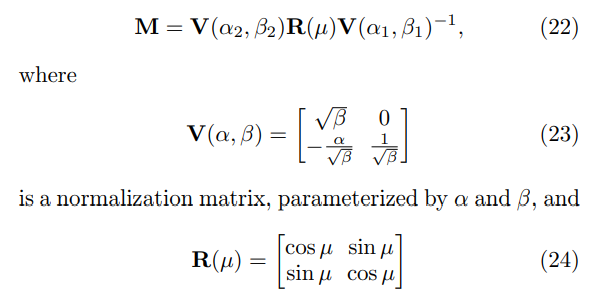
\ is a rotation by the phase advance µ. The projection angle, and hence the reconstruction quality, depends only on the phase advance. Various constraints can limit the projection angle range, but we assume the projection angles are evenly spaced over the maximum 180-degree range.

\ Fig. 2 shows reconstructions from a varying number of projections, comparing MENT, MENT-Flow, and the unregularized neural network (NN). It is clear that maximizing the stochastic estimate in Eq. (16) pushes the distribution’s entropy close to its constrained maximum. (Recall that MENT maximizes entropy by construction). Although the MENT solutions are of higher quality, the differences are not visible from afar.

\ Fig. 2 illustrates that entropy maximization is a conservative approach to the reconstruction problem. All reconstructed features are implied by the data. In contrast, the distributions in the bottom rows fit the data but are unnecessarily complex. Of course, reconstructions from one or two projections are bound to fail if the prior is uninformative, but these cases are still useful because they demonstrate MENT’s logical consistency: given only the marginal distributions and an uncorrelated prior, the posterior is the product of the marginals. On the other extreme, with enough data, the feasible distributions differ only in minor details. MENT shines in intermediate cases where the measurements contain just enough information to constrain the distribution’s primary features. For example, the continuous spiral structure develops rapidly with the number of views in Fig. 2.

\ Fig. 2 also illustrates the flow’s capacity to represent complicated distributions despite the restriction to invertible transformations. This example focuses on spiral patterns, which are characteristic of nonlinear dynamics. (Additional examples are included in the supplemental material.) It is important to note that, while our analysis focuses on the beam core, low-density regions can also impact accelerator performance [33]. Flows can struggle to model distribution tails [34]. Our ground-truth distribution does not have significant halo and we do not report the agreement at this level; however, preliminary studies indicate the Kullback-Leibler (KL) divergence may enhance dynamic range relative to, i.e., the mean absolute error when fitting data.

\
\

:::info Authors:

(1) Austin Hoover, Oak Ridge National Laboratory, Oak Ridge, Tennessee 37830, USA ([email protected]);

(2) Jonathan C. Wong, Institute of Modern Physics, Chinese Academy of Sciences, Lanzhou 730000, China.

:::


:::info This paper is available on arxiv under CC BY 4.0 DEED license.

:::

\

Market Opportunity
null Logo
null Price(null)
--
----
USD
null (null) Live Price Chart
Disclaimer: The articles reposted on this site are sourced from public platforms and are provided for informational purposes only. They do not necessarily reflect the views of MEXC. All rights remain with the original authors. If you believe any content infringes on third-party rights, please contact [email protected] for removal. MEXC makes no guarantees regarding the accuracy, completeness, or timeliness of the content and is not responsible for any actions taken based on the information provided. The content does not constitute financial, legal, or other professional advice, nor should it be considered a recommendation or endorsement by MEXC.

You May Also Like

MAXI DOGE Holders Diversify into $GGs for Fast-Growth 2025 Crypto Presale Opportunities

MAXI DOGE Holders Diversify into $GGs for Fast-Growth 2025 Crypto Presale Opportunities

Presale crypto tokens have become some of the most active areas in Web3, offering early access to projects that blend culture, finance, and technology. Investors are constantly searching for the best crypto presale to buy right now, comparing new token presales across different niches. MAXI DOGE has gained attention for its meme-driven energy, but early [...] The post MAXI DOGE Holders Diversify into $GGs for Fast-Growth 2025 Crypto Presale Opportunities appeared first on Blockonomi.
Share
Blockonomi2025/09/18 00:00
Bank of Canada cuts rate to 2.5% as tariffs and weak hiring hit economy

Bank of Canada cuts rate to 2.5% as tariffs and weak hiring hit economy

The Bank of Canada lowered its overnight rate to 2.5% on Wednesday, responding to mounting economic damage from US tariffs and a slowdown in hiring. The quarter-point cut was the first since March and met predictions from markets and economists. Governor Tiff Macklem, speaking in Ottawa, said the decision was unanimous. “With a weaker economy […]
Share
Cryptopolitan2025/09/17 23:09
Edges higher ahead of BoC-Fed policy outcome

Edges higher ahead of BoC-Fed policy outcome

The post Edges higher ahead of BoC-Fed policy outcome appeared on BitcoinEthereumNews.com. USD/CAD gains marginally to near 1.3760 ahead of monetary policy announcements by the Fed and the BoC. Both the Fed and the BoC are expected to lower interest rates. USD/CAD forms a Head and Shoulder chart pattern. The USD/CAD pair ticks up to near 1.3760 during the late European session on Wednesday. The Loonie pair gains marginally ahead of monetary policy outcomes by the Bank of Canada (BoC) and the Federal Reserve (Fed) during New York trading hours. Both the BoC and the Fed are expected to cut interest rates amid mounting labor market conditions in their respective economies. Inflationary pressures in the Canadian economy have cooled down, emerging as another reason behind the BoC’s dovish expectations. However, the Fed is expected to start the monetary-easing campaign despite the United States (US) inflation remaining higher. Investors will closely monitor press conferences from both Fed Chair Jerome Powell and BoC Governor Tiff Macklem to get cues about whether there will be more interest rate cuts in the remainder of the year. According to analysts from Barclays, the Fed’s latest median projections for interest rates are likely to call for three interest rate cuts by 2025. Ahead of the Fed’s monetary policy, the US Dollar Index (DXY), which tracks the Greenback’s value against six major currencies, holds onto Tuesday’s losses near 96.60. USD/CAD forms a Head and Shoulder chart pattern, which indicates a bearish reversal. The neckline of the above-mentioned chart pattern is plotted near 1.3715. The near-term trend of the pair remains bearish as it stays below the 20-day Exponential Moving Average (EMA), which trades around 1.3800. The 14-day Relative Strength Index (RSI) slides to near 40.00. A fresh bearish momentum would emerge if the RSI falls below that level. Going forward, the asset could slide towards the round level of…
Share
BitcoinEthereumNews2025/09/18 01:23