The Ethereum ETF landscape just shifted in a way few saw coming. Grayscale Investments has officially introduced staking to its Ethereum Exchange-Traded Funds, a first in the U.S. market. This move, announced on October 6, signals a new era where traditional investors can finally earn staking rewards directly through regulated ETF structures. In simple terms, Grayscale is blending Wall Street’s favorite vehicle, ETFs, with one of blockchain’s core reward mechanisms. That combination could redefine how institutional capital interacts with Ethereum. Ethereum ETFs Just Got an Upgrade Grayscale confirmed that both its Ethereum Mini Trust (ETH) and Ethereum Trust (ETHE) now include staking features. Investors can either have rewards automatically reinvested to compound gains or receive them as cash payouts. The firm also extended staking to its Solana Trust (GSOL), pending regulatory clearance to list it as a spot product. Once approved, it will be among the first Solana-based ETFs in the United States to support staking. According to Grayscale, this dual-option model was crafted to give investors flexibility, from those seeking long-term growth to others prioritizing short-term liquidity. The move comes as Ethereum’s staking yield averages around 3.2%, giving ETF issuers an avenue to offset management fees and pass on savings to investors. Regulatory Shift Opens the Door For years, U.S. regulators treated staking as a gray zone. Under the previous SEC chair, some staking programs were classified as unregistered securities. That stance led to enforcement actions and forced several exchanges to shut down or restructure their staking services. But tides are changing. Over the past year, regulators have softened their tone. Liquid staking, when properly structured, is no longer automatically considered a securities offering. The shift, coupled with friendlier crypto rhetoric under the Trump administration, gave firms like Grayscale the green light to innovate. Ethereum’s proof-of-stake design rewards validators who help secure the network. By integrating that directly into ETFs, Grayscale is essentially bridging DeFi yields with the comfort of traditional finance. Institutional Stakes Rise Market analysts believe this could reshape competition in the Ethereum ETF sector. Lower fees, coupled with yield potential, make ETH-based funds more attractive than ever. As of early October, about 36 million ETH, roughly 30% of the total supply, is staked, with liquid staking protocols like Lido leading the pack. Institutional involvement through ETFs could push that number even higher. “Ethereum staking through ETFs introduces a new standard for yield exposure in regulated markets,” wrote market analyst Ryan Selkis on X, calling it “a long-awaited bridge between crypto utility and traditional asset management.” If major players like BlackRock or Fidelity follow Grayscale’s lead, the competition could compress fees industry-wide, a win for investors and a potential catalyst for fresh inflows into ETH. Risks and Realities Despite optimism, experts warn that staking isn’t risk-free. Validator concentration could create centralization risks, and yield fluctuations may impact fund performance. Redemption management is another challenge; ETFs must maintain enough liquid ETH to process withdrawals while staking a meaningful portion to earn rewards. Still, Grayscale’s institutional staking setup, using vetted validator networks and custodians, is designed to balance compliance with yield generation. It marks a careful but confident step into a more mature era of crypto finance. Conclusion Grayscale’s integration of staking into Ethereum ETFs is more than a corporate tweak; it’s a statement. It suggests that crypto yield products can exist inside the rules, not around them. For Ethereum, it could mean new layers of liquidity, demand, and long-term network stability. For investors, it’s a taste of passive income without leaving the comfort zone of regulated markets. As the race for ETF innovation heats up, Grayscale may have just given Ethereum a new growth narrative, one where staking isn’t just for crypto natives anymore. Frequently Asked Questions 1. What does staking in an ETF mean?It allows investors to earn yield from blockchain validation directly within an ETF structure, without managing tokens themselves. 2. Is staking in ETFs safe?While it adds yield potential, risks like validator performance, network slashing, and liquidity constraints remain. 3. How does this affect Ethereum’s price?More staking can reduce circulating supply, which may support long-term price stability if demand grows. 4. Will other asset managers follow?Yes, many analysts expect competitors like BlackRock or Fidelity to explore similar staking integrations. Glossary of Key Terms ETF (Exchange-Traded Fund):A pooled investment vehicle traded on stock exchanges, offering exposure to assets like crypto. Staking:The process of locking up crypto to validate transactions on proof-of-stake networks and earn rewards. ETH:The native cryptocurrency of the Ethereum network, used for transactions and staking. Validator:A network participant who helps confirm transactions and maintain blockchain security in exchange for rewards. Read More: Why Grayscale’s Ethereum ETF Staking Could Spark the Next Institutional Wave">Why Grayscale’s Ethereum ETF Staking Could Spark the Next Institutional WaveThe Ethereum ETF landscape just shifted in a way few saw coming. Grayscale Investments has officially introduced staking to its Ethereum Exchange-Traded Funds, a first in the U.S. market. This move, announced on October 6, signals a new era where traditional investors can finally earn staking rewards directly through regulated ETF structures. In simple terms, Grayscale is blending Wall Street’s favorite vehicle, ETFs, with one of blockchain’s core reward mechanisms. That combination could redefine how institutional capital interacts with Ethereum. Ethereum ETFs Just Got an Upgrade Grayscale confirmed that both its Ethereum Mini Trust (ETH) and Ethereum Trust (ETHE) now include staking features. Investors can either have rewards automatically reinvested to compound gains or receive them as cash payouts. The firm also extended staking to its Solana Trust (GSOL), pending regulatory clearance to list it as a spot product. Once approved, it will be among the first Solana-based ETFs in the United States to support staking. According to Grayscale, this dual-option model was crafted to give investors flexibility, from those seeking long-term growth to others prioritizing short-term liquidity. The move comes as Ethereum’s staking yield averages around 3.2%, giving ETF issuers an avenue to offset management fees and pass on savings to investors. Regulatory Shift Opens the Door For years, U.S. regulators treated staking as a gray zone. Under the previous SEC chair, some staking programs were classified as unregistered securities. That stance led to enforcement actions and forced several exchanges to shut down or restructure their staking services. But tides are changing. Over the past year, regulators have softened their tone. Liquid staking, when properly structured, is no longer automatically considered a securities offering. The shift, coupled with friendlier crypto rhetoric under the Trump administration, gave firms like Grayscale the green light to innovate. Ethereum’s proof-of-stake design rewards validators who help secure the network. By integrating that directly into ETFs, Grayscale is essentially bridging DeFi yields with the comfort of traditional finance. Institutional Stakes Rise Market analysts believe this could reshape competition in the Ethereum ETF sector. Lower fees, coupled with yield potential, make ETH-based funds more attractive than ever. As of early October, about 36 million ETH, roughly 30% of the total supply, is staked, with liquid staking protocols like Lido leading the pack. Institutional involvement through ETFs could push that number even higher. “Ethereum staking through ETFs introduces a new standard for yield exposure in regulated markets,” wrote market analyst Ryan Selkis on X, calling it “a long-awaited bridge between crypto utility and traditional asset management.” If major players like BlackRock or Fidelity follow Grayscale’s lead, the competition could compress fees industry-wide, a win for investors and a potential catalyst for fresh inflows into ETH. Risks and Realities Despite optimism, experts warn that staking isn’t risk-free. Validator concentration could create centralization risks, and yield fluctuations may impact fund performance. Redemption management is another challenge; ETFs must maintain enough liquid ETH to process withdrawals while staking a meaningful portion to earn rewards. Still, Grayscale’s institutional staking setup, using vetted validator networks and custodians, is designed to balance compliance with yield generation. It marks a careful but confident step into a more mature era of crypto finance. Conclusion Grayscale’s integration of staking into Ethereum ETFs is more than a corporate tweak; it’s a statement. It suggests that crypto yield products can exist inside the rules, not around them. For Ethereum, it could mean new layers of liquidity, demand, and long-term network stability. For investors, it’s a taste of passive income without leaving the comfort zone of regulated markets. As the race for ETF innovation heats up, Grayscale may have just given Ethereum a new growth narrative, one where staking isn’t just for crypto natives anymore. Frequently Asked Questions 1. What does staking in an ETF mean?It allows investors to earn yield from blockchain validation directly within an ETF structure, without managing tokens themselves. 2. Is staking in ETFs safe?While it adds yield potential, risks like validator performance, network slashing, and liquidity constraints remain. 3. How does this affect Ethereum’s price?More staking can reduce circulating supply, which may support long-term price stability if demand grows. 4. Will other asset managers follow?Yes, many analysts expect competitors like BlackRock or Fidelity to explore similar staking integrations. Glossary of Key Terms ETF (Exchange-Traded Fund):A pooled investment vehicle traded on stock exchanges, offering exposure to assets like crypto. Staking:The process of locking up crypto to validate transactions on proof-of-stake networks and earn rewards. ETH:The native cryptocurrency of the Ethereum network, used for transactions and staking. Validator:A network participant who helps confirm transactions and maintain blockchain security in exchange for rewards. Read More: Why Grayscale’s Ethereum ETF Staking Could Spark the Next Institutional Wave">Why Grayscale’s Ethereum ETF Staking Could Spark the Next Institutional Wave

Why Grayscale’s Ethereum ETF Staking Could Spark the Next Institutional Wave

The Ethereum ETF landscape just shifted in a way few saw coming. Grayscale Investments has officially introduced staking to its Ethereum Exchange-Traded Funds, a first in the U.S. market. This move, announced on October 6, signals a new era where traditional investors can finally earn staking rewards directly through regulated ETF structures.

In simple terms, Grayscale is blending Wall Street’s favorite vehicle, ETFs, with one of blockchain’s core reward mechanisms. That combination could redefine how institutional capital interacts with Ethereum.

Ethereum ETFs Just Got an Upgrade

Grayscale confirmed that both its Ethereum Mini Trust (ETH) and Ethereum Trust (ETHE) now include staking features. Investors can either have rewards automatically reinvested to compound gains or receive them as cash payouts.

The firm also extended staking to its Solana Trust (GSOL), pending regulatory clearance to list it as a spot product. Once approved, it will be among the first Solana-based ETFs in the United States to support staking.

According to Grayscale, this dual-option model was crafted to give investors flexibility, from those seeking long-term growth to others prioritizing short-term liquidity. The move comes as Ethereum’s staking yield averages around 3.2%, giving ETF issuers an avenue to offset management fees and pass on savings to investors.
Grayscale Ethereum ETF

Regulatory Shift Opens the Door

For years, U.S. regulators treated staking as a gray zone. Under the previous SEC chair, some staking programs were classified as unregistered securities. That stance led to enforcement actions and forced several exchanges to shut down or restructure their staking services.

But tides are changing. Over the past year, regulators have softened their tone. Liquid staking, when properly structured, is no longer automatically considered a securities offering. The shift, coupled with friendlier crypto rhetoric under the Trump administration, gave firms like Grayscale the green light to innovate.

Ethereum’s proof-of-stake design rewards validators who help secure the network. By integrating that directly into ETFs, Grayscale is essentially bridging DeFi yields with the comfort of traditional finance.

Institutional Stakes Rise

Market analysts believe this could reshape competition in the Ethereum ETF sector. Lower fees, coupled with yield potential, make ETH-based funds more attractive than ever.

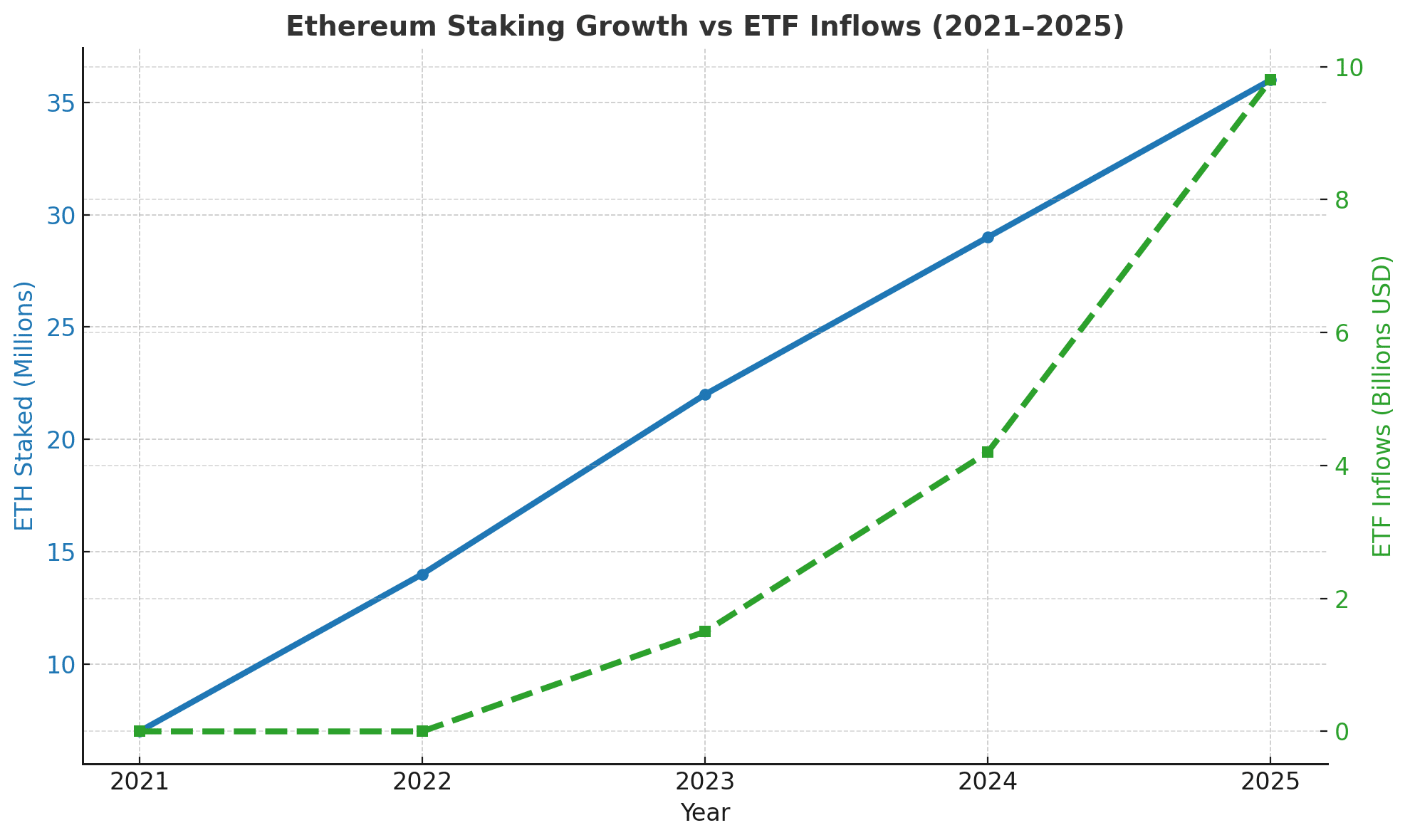
As of early October, about 36 million ETH, roughly 30% of the total supply, is staked, with liquid staking protocols like Lido leading the pack. Institutional involvement through ETFs could push that number even higher.

“Ethereum staking through ETFs introduces a new standard for yield exposure in regulated markets,” wrote market analyst Ryan Selkis on X, calling it “a long-awaited bridge between crypto utility and traditional asset management.”

If major players like BlackRock or Fidelity follow Grayscale’s lead, the competition could compress fees industry-wide, a win for investors and a potential catalyst for fresh inflows into ETH.

Risks and Realities

Despite optimism, experts warn that staking isn’t risk-free. Validator concentration could create centralization risks, and yield fluctuations may impact fund performance. Redemption management is another challenge; ETFs must maintain enough liquid ETH to process withdrawals while staking a meaningful portion to earn rewards.

Still, Grayscale’s institutional staking setup, using vetted validator networks and custodians, is designed to balance compliance with yield generation. It marks a careful but confident step into a more mature era of crypto finance.

Conclusion

Grayscale’s integration of staking into Ethereum ETFs is more than a corporate tweak; it’s a statement. It suggests that crypto yield products can exist inside the rules, not around them. For Ethereum, it could mean new layers of liquidity, demand, and long-term network stability. For investors, it’s a taste of passive income without leaving the comfort zone of regulated markets.

As the race for ETF innovation heats up, Grayscale may have just given Ethereum a new growth narrative, one where staking isn’t just for crypto natives anymore.

Frequently Asked Questions

1. What does staking in an ETF mean?
It allows investors to earn yield from blockchain validation directly within an ETF structure, without managing tokens themselves.

2. Is staking in ETFs safe?
While it adds yield potential, risks like validator performance, network slashing, and liquidity constraints remain.

3. How does this affect Ethereum’s price?
More staking can reduce circulating supply, which may support long-term price stability if demand grows.

4. Will other asset managers follow?
Yes, many analysts expect competitors like BlackRock or Fidelity to explore similar staking integrations.

Glossary of Key Terms

ETF (Exchange-Traded Fund):
A pooled investment vehicle traded on stock exchanges, offering exposure to assets like crypto.

Staking:
The process of locking up crypto to validate transactions on proof-of-stake networks and earn rewards.

ETH:
The native cryptocurrency of the Ethereum network, used for transactions and staking.

Validator:
A network participant who helps confirm transactions and maintain blockchain security in exchange for rewards.

Read More: Why Grayscale’s Ethereum ETF Staking Could Spark the Next Institutional Wave">Why Grayscale’s Ethereum ETF Staking Could Spark the Next Institutional Wave


Market Opportunity
Illusion of Life Logo
Illusion of Life Price(SPARK)
$0.002433
$0.002433$0.002433
-6.45%
USD
Illusion of Life (SPARK) Live Price Chart
Disclaimer: The articles reposted on this site are sourced from public platforms and are provided for informational purposes only. They do not necessarily reflect the views of MEXC. All rights remain with the original authors. If you believe any content infringes on third-party rights, please contact [email protected] for removal. MEXC makes no guarantees regarding the accuracy, completeness, or timeliness of the content and is not responsible for any actions taken based on the information provided. The content does not constitute financial, legal, or other professional advice, nor should it be considered a recommendation or endorsement by MEXC.

You May Also Like

VIRTUAL Weekly Analysis Jan 21

VIRTUAL Weekly Analysis Jan 21

The post VIRTUAL Weekly Analysis Jan 21 appeared on BitcoinEthereumNews.com. VIRTUAL closed the week up 3.57% at $0.84, but the long-term downtrend maintains its
Share
BitcoinEthereumNews2026/01/22 06:54
MetaMask Token: Exciting Launch Could Be Sooner Than Expected

MetaMask Token: Exciting Launch Could Be Sooner Than Expected

BitcoinWorld MetaMask Token: Exciting Launch Could Be Sooner Than Expected The cryptocurrency community is buzzing with exciting news: a native MetaMask token might arrive sooner than many anticipated. This development could reshape how users interact with the popular Web3 wallet and the broader decentralized ecosystem. It signals a significant step forward for one of the most widely used tools in the blockchain space. What’s Fueling the MetaMask Token Buzz? Joseph Lubin, the CEO of ConsenSys, the company behind MetaMask, recently shared insights that ignited this excitement. According to reports from The Block, Lubin indicated that a MetaMask token could launch ahead of previous expectations. This isn’t the first time the idea has surfaced; Dan Finlay, one of MetaMask’s founders, had previously mentioned the possibility of issuing such a token. ConsenSys has been a pivotal player in the Ethereum ecosystem, developing essential infrastructure and applications. MetaMask, their flagship wallet, serves millions of users, providing a gateway to decentralized applications (dApps), NFTs, and various blockchain networks. Therefore, any move to introduce a native token is a major event for the entire Web3 community. Why is a MetaMask Token So Anticipated? The prospect of a MetaMask token generates immense interest because it could introduce new layers of utility and community governance. Users often speculate about the benefits such a token could offer. Here are some key reasons for the high anticipation: Governance Rights: A token could empower users to participate in the future direction and development of MetaMask. This means voting on new features, upgrades, or even changes to the platform’s policies. Ecosystem Rewards: Tokens might be distributed as rewards for active participation, using certain features, or contributing to the MetaMask community. This incentivizes engagement and loyalty. Enhanced Utility: The token could unlock premium features, reduce transaction fees, or provide exclusive access to services within the MetaMask ecosystem or partnered dApps. Decentralization: Introducing a token often aligns with the broader Web3 ethos of decentralization, distributing control and ownership among its users rather than centralizing it within ConsenSys. Consequently, a token launch is seen as a way to deepen user involvement and foster a more robust, community-driven ecosystem around the wallet. Exploring the Potential Impact of a MetaMask Token The introduction of a MetaMask token could have far-reaching implications for the decentralized finance (DeFi) and Web3 landscape. Firstly, it could set a new standard for how popular infrastructure tools engage with their user base. By providing a tangible stake, MetaMask might strengthen its position as a community-governed platform. Moreover, a token could significantly boost the wallet’s visibility and adoption, attracting new users eager to participate in its governance or benefit from its utility. This could also lead to innovative integrations with other blockchain projects, creating a more interconnected and efficient Web3 experience. Ultimately, the success of such a token will depend on its design, utility, and how effectively it engages the global MetaMask community. What Challenges Could a MetaMask Token Face? While the excitement is palpable, launching a MetaMask token also presents several challenges that ConsenSys must navigate carefully. One primary concern is regulatory scrutiny. The classification of cryptocurrency tokens varies across jurisdictions, and ensuring compliance is crucial for long-term success. Furthermore, designing a fair and equitable distribution model is paramount. Ensuring that the token provides genuine utility beyond mere speculation will be another hurdle. A token must integrate seamlessly into the MetaMask experience and offer clear value to its holders. Additionally, managing community expectations and preventing market manipulation will require robust strategies. Addressing these challenges effectively will be key to the token’s sustainable growth and positive reception. What’s Next for the MetaMask Ecosystem? The prospect of a MetaMask token signals an evolving strategy for ConsenSys and the future of Web3 wallets. It reflects a growing trend where foundational tools seek to empower their communities through tokenization. Users are keenly watching for official announcements regarding the token’s mechanics, distribution, and launch timeline. This development could solidify MetaMask’s role not just as a wallet, but as a central pillar of decentralized identity and interaction. The potential for a sooner-than-expected launch adds an element of urgency and excitement, encouraging users to stay informed about every new detail. It represents a significant milestone for a platform that has become synonymous with accessing the decentralized web. Conclusion The hints from ConsenSys CEO Joseph Lubin regarding an earlier launch for the MetaMask token have undoubtedly captured the attention of the entire crypto world. This potential development promises to bring enhanced governance, utility, and community engagement to millions of MetaMask users. While challenges exist, the underlying potential for a more decentralized and user-driven ecosystem is immense. The coming months will likely reveal more about this highly anticipated token, marking a new chapter for one of Web3’s most vital tools. Frequently Asked Questions (FAQs) Q1: What is a MetaMask token? A MetaMask token would be a native cryptocurrency issued by ConsenSys, the company behind the MetaMask wallet. It is expected to offer various utilities, including governance rights, rewards, and access to special features within the MetaMask ecosystem. Q2: Why is ConsenSys considering launching a MetaMask token? ConsenSys is likely exploring a token launch to further decentralize the MetaMask platform, empower its user community with governance rights, incentivize active participation, and potentially unlock new forms of utility and growth for the ecosystem. Q3: What benefits could users gain from a MetaMask token? Users could gain several benefits, such as the ability to vote on MetaMask’s future developments, earn rewards for using the wallet, access exclusive features, or potentially reduce transaction fees. It also provides a direct stake in the platform’s success. Q4: When is the MetaMask token expected to launch? While no official launch date has been confirmed, ConsenSys CEO Joseph Lubin has indicated that the launch could happen sooner than previously expected. The exact timeline remains subject to official announcements from ConsenSys. Q5: How would a MetaMask token impact the broader Web3 ecosystem? A MetaMask token could significantly impact Web3 by setting a precedent for user-owned and governed infrastructure tools. It could drive further decentralization, foster innovation, and strengthen the connection between users and the platforms they rely on, ultimately contributing to a more robust and participatory decentralized internet. To learn more about the latest crypto market trends, explore our article on key developments shaping Ethereum institutional adoption. This post MetaMask Token: Exciting Launch Could Be Sooner Than Expected first appeared on BitcoinWorld.
Share
Coinstats2025/09/19 15:40
Former Pantera partner launches $300 million SOL vault Solmate in UAE

Former Pantera partner launches $300 million SOL vault Solmate in UAE

PANews reported on September 18 that according to AggrNews, a former Pantera partner leads Solmate in the UAE and manages the $300 million Solana digital asset treasury (DAT).
Share
PANews2025/09/18 21:22