

AI Models Can Now Identify Individual Trees from Forest Scans
:::info Authors:
(1) Jonathan Henrich, Chairs of Statistics and Econometrics, Faculty of Economics, University of Gottingen, Germany ([email protected])
(2) Jan van Delden, Institute of Computer Science, University of Gottingen Germany ([email protected]).
:::
Table of Links
Abstract and 1 Introduction
- Materials and Methods
- Results and Discussion
- Conclusion and References
ABSTRACT
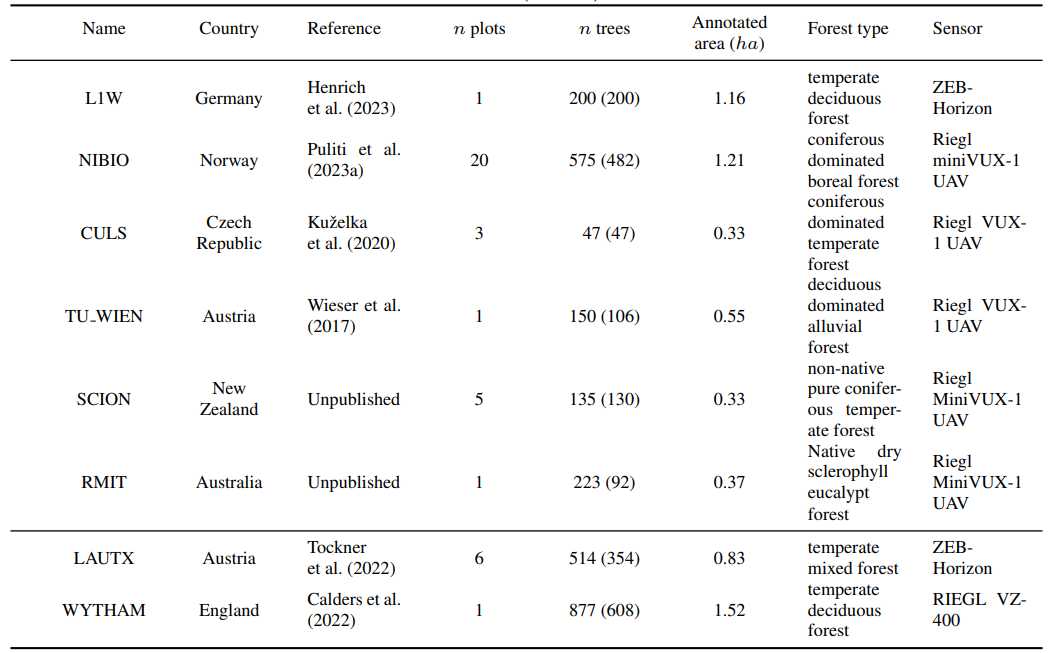
The segmentation of individual trees from forest point clouds is a crucial task for downstream analyses such as carbon sequestration estimation. Recently, deeplearning-based methods have been proposed which show the potential of learning to segment trees. Since these methods are trained in a supervised way, the question arises how general models can be obtained that are applicable across a wide range of settings. So far, training has been mainly conducted with data from one specific laser scanning type and for specific types of forests. In this work, we train one segmentation model under various conditions, using seven diverse datasets found in literature, to gain insights into the generalization capabilities under domain-shift. Our results suggest that a generalization from coniferous dominated sparse point clouds to deciduous dominated high-resolution point clouds is possible. Conversely, qualitative evidence suggests that generalization from high-resolution to low-resolution point clouds is challenging. This emphasizes the need for forest point clouds with diverse data characteristics for model development. To enrich the available data basis, labeled trees from two previous works were propagated to the complete forest point cloud and are made publicly available at https://doi.org/10.25625/QUTUWU.
1 INTRODUCTION
As global climate change accelerates, driven by anthropogenic activities, the role of forests in carbon sequestration, biodiversity preservation, and regulation of local and global climatic conditions has been brought into sharp focus. To investigate how forests contribute to these environmental aspects, quantifiable data on their structure and development is urgently needed. In this context, technologies that enable the creation of holistic, three-dimensional representations of forests in the form of point clouds play a vital role. Such technologies are terrestrial or mobile laser scanning (TLS, MLS), but also laser scanning via low-flying unmanned aerial vehicles (UAV). Such forest point clouds often need to be segmented into individual trees for further analysis, which is an instance segmentation problem. The most commonly used paradigm for tree segmentation is to first detect tree trunks and then assign the remaining points to individual trees based on hand-crafted features such as distance or local geometry (Trochta et al., 2017; Burt et al., 2019). However, laser scanning characteristics, forest structures, and interactions between trees are diverse. So, defining a fixed set of assignment rules and features that consistently lead to a good segmentation performance is a highly challenging task.
\ Advances in point cloud processing outside the forest domain show the advantage of performing instance segmentation using deep learning (Vu et al., 2022; Jiang et al., 2020), so that relevant features can be learned in a data-driven way. Only recently, these methods have been applied to the forest domain, yielding promising segmentation results (Xiang et al., 2023; Henrich et al., 2023). Since these methods are trained in a supervised way using specific datasets, a key challenge is to obtain general models that are applicable across a wide range of settings. In this context, an important question is how models generalize to out-of-domain settings. Differences in the training data are, for example, caused by different laser scanning characteristics or forest types. Training a
\ 
\ supervised deep learning algorithm requires forest point clouds that come with segmentation labels. Although recent works have acknowledged this need and put considerable effort into making highquality labeled forest point clouds publicly available (Puliti et al., 2023b; Henrich et al., 2023), the size and diversity of these datasets is still limited. Other works provide segmented trees that have been manually segmented (Tockner et al., 2022) or manually checked for quality assurance (Calders et al., 2022). However, these works do not include the non-tree points in their published data. Only if labels are available for the complete point cloud, it is possible to train a fully deep learning-based segmentation pipeline that does not require separate pre-processing steps.
\ This work makes two contributions: (1) The existing corpus of labeled forest point clouds is extended by propagating the publicly provided individual tree labels of two previous works (Tockner et al., 2022; Calders et al., 2022) to the complete point clouds. These point clouds are made publicly available. (2) An existing deep-learning-based tree segmentation model (Henrich et al., 2023) is trained with forest point clouds from different settings to provide insights into the generalization capabilities under domain-shift.
\
:::info This paper is available on arxiv under CC by-SA 4.0 Deed (Attribution-Sharealike 4.0 International) license.
:::
\


You May Also Like

Trump torn apart for military purge following Pentagon power struggle

PENGU Notches Double-Digit Gains as Bitcoin Hits $78K Amid $418M Liquidation Spree




