This study evaluates TreeLearn, a deep-learning-based tree segmentation model trained on multi-domain forest point clouds. Results show that fine-tuning the model with both high- and low-resolution datasets (MLS, TLS, UAV) significantly improves instance segmentation performance and generalization across forest types. The findings highlight the importance of diverse, labeled training data to develop AI models capable of accurately mapping trees in varying environments—laying groundwork for scalable, data-driven forest monitoring and management.This study evaluates TreeLearn, a deep-learning-based tree segmentation model trained on multi-domain forest point clouds. Results show that fine-tuning the model with both high- and low-resolution datasets (MLS, TLS, UAV) significantly improves instance segmentation performance and generalization across forest types. The findings highlight the importance of diverse, labeled training data to develop AI models capable of accurately mapping trees in varying environments—laying groundwork for scalable, data-driven forest monitoring and management.

AI Just Got Better at Counting Trees

Abstract and 1 Introduction

  1. Materials and Methods
  2. Results and Discussion
  3. Conclusion and References

3 RESULTS AND DISCUSSION

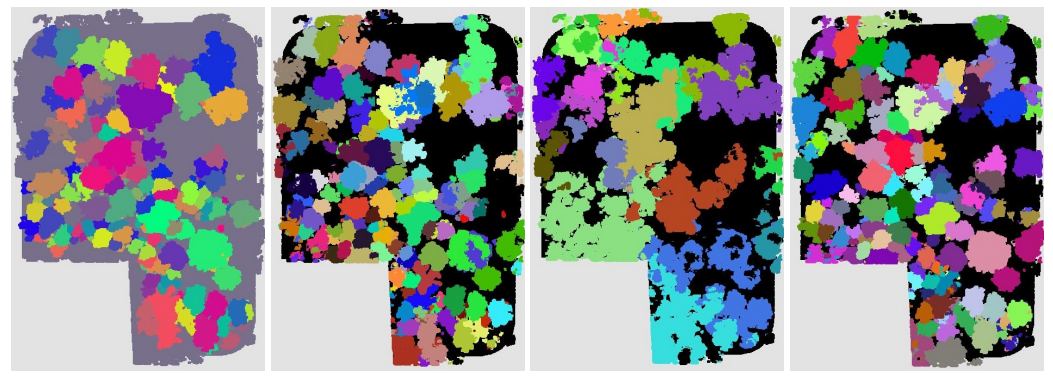
Segmentation results were computed for the point cloud L1W (MLS, deciduous dominated). Results obtained by using the publicly available TreeLearn checkpoint without further training serve as a baseline (Table 3). Even when fine-tuning the model with out-of-domain data (UAV, coniferous dominated), instance segmentation performance in terms of the F1-score increases substantially from 93.98 % to 96.25 %. In terms of tree detection (one FP) and semantic segmentation (99.41%), the fine-tuned model performs slightly worse than the baseline. However, these aspects are less important compared to instance segmentation performance. For example, FP predictions can be manually discarded or merged into complete trees without much effort if they are not too frequent. When using in-domain data (MLS+TLS, deciduous dominated) for fine-tuning, instance segmentation performance is further increased to 97.31% (see Fig. 1 for a qualitative comparison). Since the number of trees used during training is roughly equal in the in-domain and out-of-domain conditions, the performance gap is most likely due to the domain-shift. However, other factors, such as differences in forest complexity, are hard to quantify and cannot be controlled for. When using all available data for training, test performance decreases slightly (96.88 %) compared to only using in-domain data. In addition to quantitative segmentation results on L1W, all three models were used to obtain qualitative results on RMIT, a low-resolution UAV point cloud (Fig. 2). These results suggest that an adequate segmentation performance on low-resolution UAV data can only be achieved when including it during training. If only MLS+TLS data is used, segmentation quality decreases drastically due to severe cases of merged trees.

4 CONCLUSION

In this paper, we trained the deep-learning-based tree segmentation method TreeLearn with data from various domains and systematically evaluated its test performance. It was shown that a model trained on out-of-domain coniferous dominated UAV point clouds can generalize to deciduous dom

\ Figure 1: Fine-grained test results on an MLS point cloud (L1W). From left to right the images show (1) the ground truth segmentation and model results obtained by fine-tuning on (2) UAV, (3) MLS+TLS and (4) all data. Results are best when in-domain data is included during training.
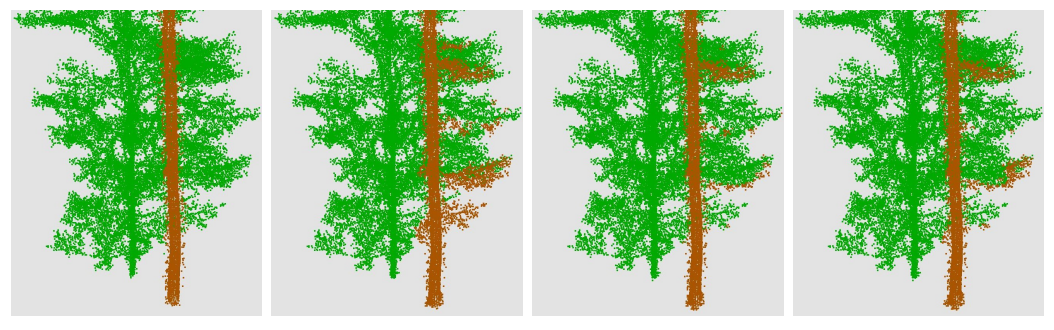
\ Figure 2: Qualitative test results on a low-resolution UAV-scanned point cloud (RMIT). From left to right the images show (1) the ground truth segmentation and model results obtained by fine-tuning on (2) UAV, (3) MLS+TLS and (4) all data. When only MLS and TLS data is used, segmentation results have severe mistakes. When UAV data is included during training, results are substantially improved.

\ inated MLS point clouds. Qualitative results indicate that training exclusively with high-resolution data, although improving performance in this domain, leads to poor generalization in low-resolution UAV settings (Fig. 2). Including UAV data in addition to high-resolution data during training alleviates this issue. This emphasizes the importance of a broad training data basis to obtain models that are applicable to a wide range of domains. To enrich the available forest point clouds, labeled tree data from previous works was propagated to the whole forest point cloud and is made publicly available at https://doi.org/10.25625/QUTUWU. Going forward, a quantifiable characterization of different forest point clouds should be established to enable a more thorough and systematic comparison between domains. Furthermore, the consequences of stronger domain-shifts in terms of forest structure on model performance should be investigated, for example by using dense tropical forests. Such experiments are crucial to determine what exactly is needed in terms of model development and data provision to obtain powerful and general tree segmentation models.

\ The results of this study can be regarded as preliminary evidence for the potential of deep learning to obtain general tree segmentation methods. While such methods rely on high-quality labeled forest data, many recent works have acknowledged this need by providing publicly available datasets. Due to the rapid development of deep learning methods and the availability of more and more highquality labeled data, we expect deep-learning-based tree segmentation to become an increasingly powerful tool. In contrast to traditional segmentation methods, such methods are able to learn segmentation rules for forest point clouds with diverse characteristics in a data-driven way, thus eliminating the need for cumbersome hyperparameter tuning or models designed for specific domains. These features make methods user-friendly and practically applicable given highly diverse forest and point cloud characteristics.

REFERENCES

Andrew Burt, Mathias Disney, and Kim Calders. Extracting individual trees from lidar point clouds using treeseg. Methods Ecol. Evol., 10(3):438–445, 2019. doi: https://doi.org/10.1111/ 2041-210x.13121.

\ Kim Calders, Hans Verbeeck, Andrew Burt, Niall Origo, Joanne Nightingale, Yadvinder Malhi, Phil Wilkes, Pasi Raumonen, Robert GH Bunce, and Mathias Disney. Laser scanning reveals potential underestimation of biomass carbon in temperate forest. Ecological Solutions and Evidence, 3(4): e12197, 2022.

\ GreenValley International. Lidar360 point cloud post-processing software, 2022. URL https: //greenvalleyintl.com/LiDAR360. Accessed: 26.10.2022.

\ Jonathan Henrich, Jan van Delden, Dominik Seidel, Thomas Kneib, and Alexander Ecker. Treelearn: A comprehensive deep learning method for segmenting individual trees from forest point clouds. arXiv preprint arXiv:2309.08471, 2023.

\ Li Jiang, Hengshuang Zhao, Shaoshuai Shi, Shu Liu, Chi-Wing Fu, and Jiaya Jia. Pointgroup: Dualset point grouping for 3d instance segmentation. In Proc. IEEE/CVF conf. comput. vis. Pattern recognit., pp. 4867–4876, 2020. doi: https://doi.org/10.1109/cvpr42600.2020.00492.

\ Karel Kuzelka, Martin Slavık, and Peter Surovy. Very high density point clouds from uav laser ` scanning for automatic tree stem detection and direct diameter measurement. Remote Sensing, 12 (8):1236, 2020.

\ Ilya Loshchilov and Frank Hutter. Sgdr: Stochastic gradient descent with warm restarts, 2016.

\ Ilya Loshchilov and Frank Hutter. Decoupled weight decay regularization, 2017.

\ Stefano Puliti, J Paul McLean, Nicolas Cattaneo, Carolin Fischer, and Rasmus Astrup. Tree height-growth trajectory estimation using uni-temporal uav laser scanning data and deep learning. Forestry, 96(1):37–48, 2023a.

\ Stefano Puliti, Grant Pearse, Peter Surovy, Luke Wallace, Markus Hollaus, Maciej Wielgosz, and ` Rasmus Astrup. For-instance: a uav laser scanning benchmark dataset for semantic and instance segmentation of individual trees. arXiv prepr. arXiv:2309.01279, 2023b. doi: https://doi.org/10. 1109/ccdc52312.2021.9602282.

\ Charles R Qi, Or Litany, Kaiming He, and Leonidas J Guibas. Deep hough voting for 3d object detection in point clouds. In proc. IEEE/CVF Int. Conf. Comput. Vis., pp. 9277–9286, 2019. doi: https://doi.org/10.1109/iccv.2019.00937.

\ Andreas Tockner, Christoph Gollob, Ralf Kraßnitzer, Tim Ritter, and Arne Nothdurft. Automatic tree crown segmentation using dense forest point clouds from personal laser scanning (pls). Int. J. Appl. Earth Obs. Geoinformation, 114:103025, 2022. doi: https://doi.org/10.1016/j.jag.2022. 103025.

\ Jan Trochta, Martin Krcek, Tomas Vrska, and Kamil Kral. 3D Forest: An application for descriptions of three-dimensional forest structures using terrestrial LiDAR. PloS one, 12(5):e0176871, 2017. doi: https://doi.org/10.1371/journal.pone.0176871.

\ Thang Vu, Kookhoi Kim, Tung M Luu, Thanh Nguyen, and Chang D Yoo. Softgroup for 3d instance segmentation on point clouds. In Proc. IEEE/CVF Conf. Comput. Vis. Pattern Recognit., pp. 2708–2717, 2022. doi: https://doi.org/10.1109/cvpr52688.2022.00273.

\ Martin Wieser, Gottfried Mandlburger, Markus Hollaus, Johannes Otepka, Philipp Glira, and Norbert Pfeifer. A case study of uas borne laser scanning for measurement of tree stem diameter. Remote Sensing, 9(11):1154, 2017.

\ B Xiang, T Peters, T Kontogianni, F Vetterli, S Puliti, R Astrup, and K Schindler. Towards accurate instance segmentation in large-scale lidar point clouds. ISPRS Annals of the Photogrammetry, Remote Sensing and Spatial Information Sciences, 10:605–612, 2023. doi: https://doi.org/10. 5194/isprs-annals-X-1-W1-2023-605-2023.

\

:::info Authors:

(1) Jonathan Henrich, Chairs of Statistics and Econometrics, Faculty of Economics, University of Gottingen, Germany ([email protected])

(2) Jan van Delden, Institute of Computer Science, University of Gottingen Germany ([email protected]).

:::


:::info This paper is available on arxiv under CC by-SA 4.0 Deed (Attribution-Sharealike 4.0 International) license.

:::

\

Market Opportunity
null Logo
null Price(null)
--
----
USD
null (null) Live Price Chart
Disclaimer: The articles reposted on this site are sourced from public platforms and are provided for informational purposes only. They do not necessarily reflect the views of MEXC. All rights remain with the original authors. If you believe any content infringes on third-party rights, please contact [email protected] for removal. MEXC makes no guarantees regarding the accuracy, completeness, or timeliness of the content and is not responsible for any actions taken based on the information provided. The content does not constitute financial, legal, or other professional advice, nor should it be considered a recommendation or endorsement by MEXC.

You May Also Like

VIRTUAL Weekly Analysis Jan 21

VIRTUAL Weekly Analysis Jan 21

The post VIRTUAL Weekly Analysis Jan 21 appeared on BitcoinEthereumNews.com. VIRTUAL closed the week up 3.57% at $0.84, but the long-term downtrend maintains its
Share
BitcoinEthereumNews2026/01/22 06:54
MetaMask Token: Exciting Launch Could Be Sooner Than Expected

MetaMask Token: Exciting Launch Could Be Sooner Than Expected

BitcoinWorld MetaMask Token: Exciting Launch Could Be Sooner Than Expected The cryptocurrency community is buzzing with exciting news: a native MetaMask token might arrive sooner than many anticipated. This development could reshape how users interact with the popular Web3 wallet and the broader decentralized ecosystem. It signals a significant step forward for one of the most widely used tools in the blockchain space. What’s Fueling the MetaMask Token Buzz? Joseph Lubin, the CEO of ConsenSys, the company behind MetaMask, recently shared insights that ignited this excitement. According to reports from The Block, Lubin indicated that a MetaMask token could launch ahead of previous expectations. This isn’t the first time the idea has surfaced; Dan Finlay, one of MetaMask’s founders, had previously mentioned the possibility of issuing such a token. ConsenSys has been a pivotal player in the Ethereum ecosystem, developing essential infrastructure and applications. MetaMask, their flagship wallet, serves millions of users, providing a gateway to decentralized applications (dApps), NFTs, and various blockchain networks. Therefore, any move to introduce a native token is a major event for the entire Web3 community. Why is a MetaMask Token So Anticipated? The prospect of a MetaMask token generates immense interest because it could introduce new layers of utility and community governance. Users often speculate about the benefits such a token could offer. Here are some key reasons for the high anticipation: Governance Rights: A token could empower users to participate in the future direction and development of MetaMask. This means voting on new features, upgrades, or even changes to the platform’s policies. Ecosystem Rewards: Tokens might be distributed as rewards for active participation, using certain features, or contributing to the MetaMask community. This incentivizes engagement and loyalty. Enhanced Utility: The token could unlock premium features, reduce transaction fees, or provide exclusive access to services within the MetaMask ecosystem or partnered dApps. Decentralization: Introducing a token often aligns with the broader Web3 ethos of decentralization, distributing control and ownership among its users rather than centralizing it within ConsenSys. Consequently, a token launch is seen as a way to deepen user involvement and foster a more robust, community-driven ecosystem around the wallet. Exploring the Potential Impact of a MetaMask Token The introduction of a MetaMask token could have far-reaching implications for the decentralized finance (DeFi) and Web3 landscape. Firstly, it could set a new standard for how popular infrastructure tools engage with their user base. By providing a tangible stake, MetaMask might strengthen its position as a community-governed platform. Moreover, a token could significantly boost the wallet’s visibility and adoption, attracting new users eager to participate in its governance or benefit from its utility. This could also lead to innovative integrations with other blockchain projects, creating a more interconnected and efficient Web3 experience. Ultimately, the success of such a token will depend on its design, utility, and how effectively it engages the global MetaMask community. What Challenges Could a MetaMask Token Face? While the excitement is palpable, launching a MetaMask token also presents several challenges that ConsenSys must navigate carefully. One primary concern is regulatory scrutiny. The classification of cryptocurrency tokens varies across jurisdictions, and ensuring compliance is crucial for long-term success. Furthermore, designing a fair and equitable distribution model is paramount. Ensuring that the token provides genuine utility beyond mere speculation will be another hurdle. A token must integrate seamlessly into the MetaMask experience and offer clear value to its holders. Additionally, managing community expectations and preventing market manipulation will require robust strategies. Addressing these challenges effectively will be key to the token’s sustainable growth and positive reception. What’s Next for the MetaMask Ecosystem? The prospect of a MetaMask token signals an evolving strategy for ConsenSys and the future of Web3 wallets. It reflects a growing trend where foundational tools seek to empower their communities through tokenization. Users are keenly watching for official announcements regarding the token’s mechanics, distribution, and launch timeline. This development could solidify MetaMask’s role not just as a wallet, but as a central pillar of decentralized identity and interaction. The potential for a sooner-than-expected launch adds an element of urgency and excitement, encouraging users to stay informed about every new detail. It represents a significant milestone for a platform that has become synonymous with accessing the decentralized web. Conclusion The hints from ConsenSys CEO Joseph Lubin regarding an earlier launch for the MetaMask token have undoubtedly captured the attention of the entire crypto world. This potential development promises to bring enhanced governance, utility, and community engagement to millions of MetaMask users. While challenges exist, the underlying potential for a more decentralized and user-driven ecosystem is immense. The coming months will likely reveal more about this highly anticipated token, marking a new chapter for one of Web3’s most vital tools. Frequently Asked Questions (FAQs) Q1: What is a MetaMask token? A MetaMask token would be a native cryptocurrency issued by ConsenSys, the company behind the MetaMask wallet. It is expected to offer various utilities, including governance rights, rewards, and access to special features within the MetaMask ecosystem. Q2: Why is ConsenSys considering launching a MetaMask token? ConsenSys is likely exploring a token launch to further decentralize the MetaMask platform, empower its user community with governance rights, incentivize active participation, and potentially unlock new forms of utility and growth for the ecosystem. Q3: What benefits could users gain from a MetaMask token? Users could gain several benefits, such as the ability to vote on MetaMask’s future developments, earn rewards for using the wallet, access exclusive features, or potentially reduce transaction fees. It also provides a direct stake in the platform’s success. Q4: When is the MetaMask token expected to launch? While no official launch date has been confirmed, ConsenSys CEO Joseph Lubin has indicated that the launch could happen sooner than previously expected. The exact timeline remains subject to official announcements from ConsenSys. Q5: How would a MetaMask token impact the broader Web3 ecosystem? A MetaMask token could significantly impact Web3 by setting a precedent for user-owned and governed infrastructure tools. It could drive further decentralization, foster innovation, and strengthen the connection between users and the platforms they rely on, ultimately contributing to a more robust and participatory decentralized internet. To learn more about the latest crypto market trends, explore our article on key developments shaping Ethereum institutional adoption. This post MetaMask Token: Exciting Launch Could Be Sooner Than Expected first appeared on BitcoinWorld.
Share
Coinstats2025/09/19 15:40
Former Pantera partner launches $300 million SOL vault Solmate in UAE

Former Pantera partner launches $300 million SOL vault Solmate in UAE

PANews reported on September 18 that according to AggrNews, a former Pantera partner leads Solmate in the UAE and manages the $300 million Solana digital asset treasury (DAT).
Share
PANews2025/09/18 21:22