If you’ve been grinding cases and ended up with a pile of mid-tier skins you never use, CSGO upgrader games might be exactly what you’re looking for. These are essentially high-stakes trade-up systems where you risk your current skins for a shot at something way better – think of it as CSGO’s version of double […]If you’ve been grinding cases and ended up with a pile of mid-tier skins you never use, CSGO upgrader games might be exactly what you’re looking for. These are essentially high-stakes trade-up systems where you risk your current skins for a shot at something way better – think of it as CSGO’s version of double […]

Best CSGO Upgrade Sites – Where to Safely Upgrade Skins?

If you’ve been grinding cases and ended up with a pile of mid-tier skins you never use, CSGO upgrader games might be exactly what you’re looking for. These are essentially high-stakes trade-up systems where you risk your current skins for a shot at something way better – think of it as CSGO’s version of double or nothing, except you’re not just doubling your value.

The concept is straightforward but intense: you pick a target skin you want (maybe that Karambit you’ve been eyeing), throw in whatever items you’re willing to sacrifice, and the system calculates your odds based on the value gap between what you’re risking and what you’re chasing. Then comes the nerve-wracking part – watching that spin animation decide whether your collection of AK skins just became a butterfly knife or vanished into the digital void.

We’ve been testing CSGO upgrader sites across every major platform, putting our own inventories on the line to see which ones actually deliver. Here’s what we found: while the core gambling mechanics stay consistent, the user experience varies dramatically between sites.

The best platforms give you crystal-clear odds displays and smooth interfaces that make it easy to calculate risk versus reward. The sketchy ones bury crucial information behind flashy animations and confusing multiplier systems that make it nearly impossible to understand what you’re actually betting.

After weeks of testing with real skins and real money, SkinsLuck consistently stood out as the cleanest experience with the most transparent path to those high-tier items you’re actually trying to reach.

Top CSGO Skin Upgrade Sites We Actually Trust

We put each CSGO upgrader through the same test: deposit real skins, attempt multiple upgrades, and see which platforms actually deliver on their promises. The sites that made our list all nail the fundamentals – you can see your exact odds before committing, withdrawals happen fast when you hit something good, and the success rates feel legitimate instead of suspiciously stacked against you. Most importantly, the interface doesn’t leave you wondering if you accidentally bet your knife when you meant to risk a five-dollar skin.

1. SkinsLuck: The Upgrader That Actually Makes Sense
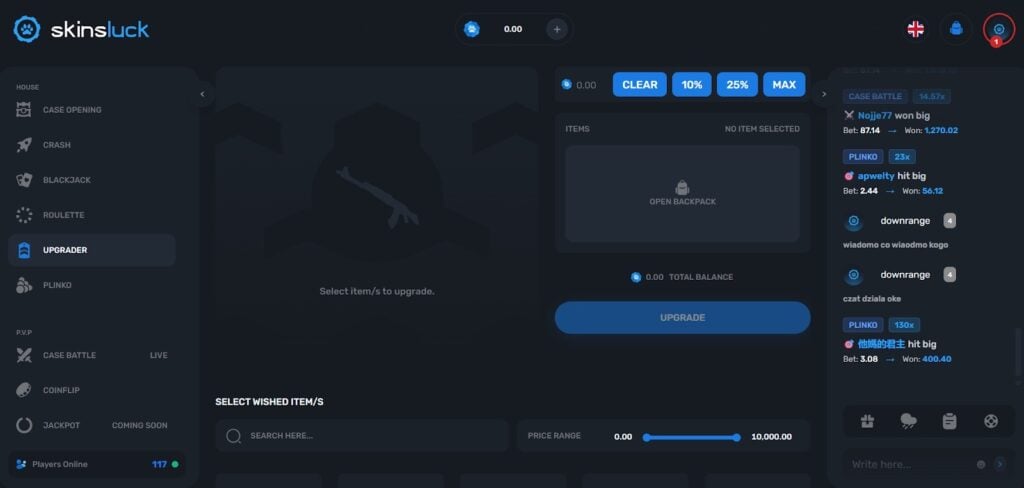
Right off the bat, SkinsLuck does what every CSGO upgrade site should: it shows you exactly what you’re risking and what your chances are before you commit. No hidden math, no confusing multipliers that require a calculator – just pick your target skin, select what you’re willing to risk, and see your odds displayed clearly. The interface feels properly designed, like they actually tested it with real players instead of just shipping whatever looked good in the mockups.

What makes this CSGO skin upgrade site genuinely different is the post-upgrade flow. You know that moment when you hit a big upgrade and suddenly the site gets mysteriously slow? Yeah, that doesn’t happen here. We’re talking actual instant – not “instant” that means waiting three hours for a trade bot.

The upgrader also connects seamlessly with their other modes, so you can bounce between cases, battles, and upgrading without feeling like you’re navigating three different websites.

The filtering deserves a mention because it’s surprisingly good. Want to target specific knife patterns? Filter by collection. Looking for StatTrak items only? Two clicks and you’re there. After testing sites that make you scroll through pages of random skins to find what you want, SkinsLuck feels like it actually values your time. Small details, but they add up to a much better experience overall.

Pros

  • Crystal-clear odds display with no hidden calculations
  • Genuinely instant withdrawals (we tested multiple times)
  • Smart filtering system for targeting specific skins
  • Smooth integration with other game modes

Cons

  • Newer platform with smaller community than veterans
  • Limited promotional events compared to bonus-heavy sites

2. Skin.Club: The Community-Driven Upgrader
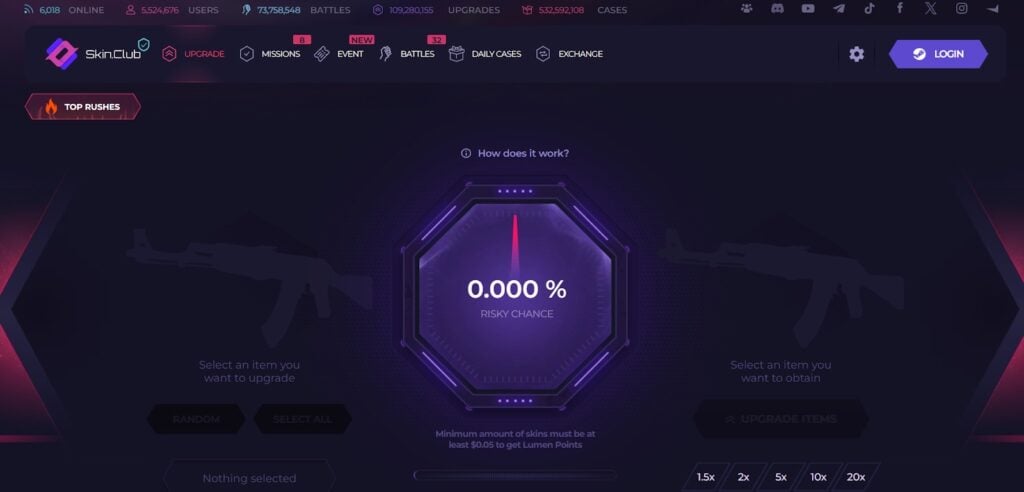
Skin.Club takes a different approach with their upgrader, adding community elements that make it feel less isolated than just you versus the algorithm. The upgrade streaks leaderboard shows successful runs from other players, which is either motivating or soul-crushing, depending on your recent luck. But hey, at least you know real people are hitting those crazy upgrades.

The main issue compared to other CSGO upgrade sites is withdrawal consistency. During peak hours, you might be waiting longer than you’d like, and skin availability can be spotty. The core mechanics work fine, but the overall polish isn’t quite there. It feels like they built a good foundation, but haven’t really updated much since. Still functional, just not as smooth as newer platforms.

Pros

  • Strong provably fair implementation with clear verification
  • Upgrade streak leaderboard adds a competitive element

Cons

  • Withdrawal delays reported during peak times
  • Interface feels dated compared to modern alternatives

3. Hellcase: The Multi-Game Flexibility King
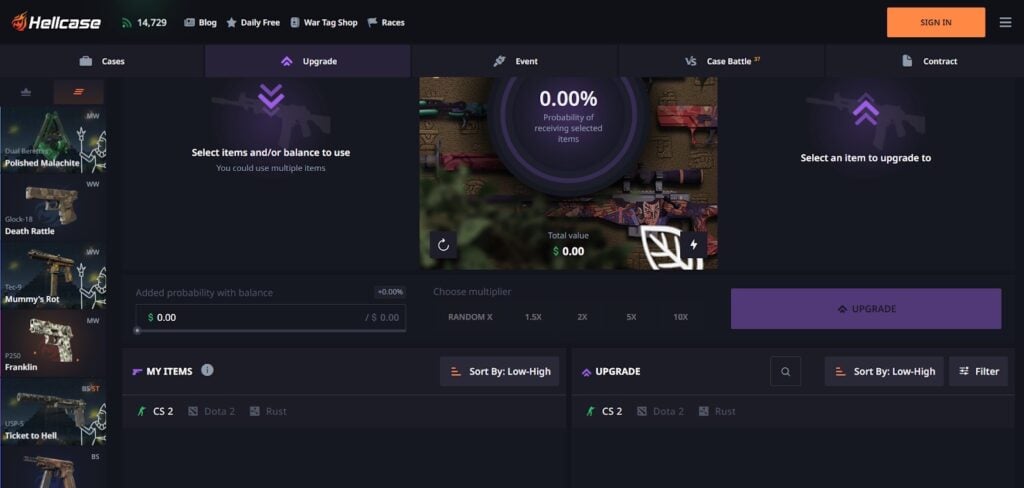
Hellcase caught our attention with cross-game upgrading – you can actually turn CSGO skins into Dota 2 items and vice versa. If you’ve got random Dota drops collecting dust in your inventory, this finally gives them a purpose. The multiplier system is solid too, letting you play it safe with x1.5 attempts or go for broke with x10 shots when you’re feeling confident about your luck.

Where Hellcase stumbles is their pricing system. We caught several instances where their valuations were way off from actual market prices – sometimes by pretty significant amounts. This makes it a pain to calculate whether an upgrade path is actually worth attempting, especially when you’re trying to figure out if you’re getting fair odds or getting played.

Pros

  • Cross-game upgrading between CS and Dota 2
  • Multiple multiplier options for risk management

Cons

  • Questionable skin valuations don’t match market
  • Interface can get cluttered with promotions

4. Clash.gg: The Balance-Based Alternative
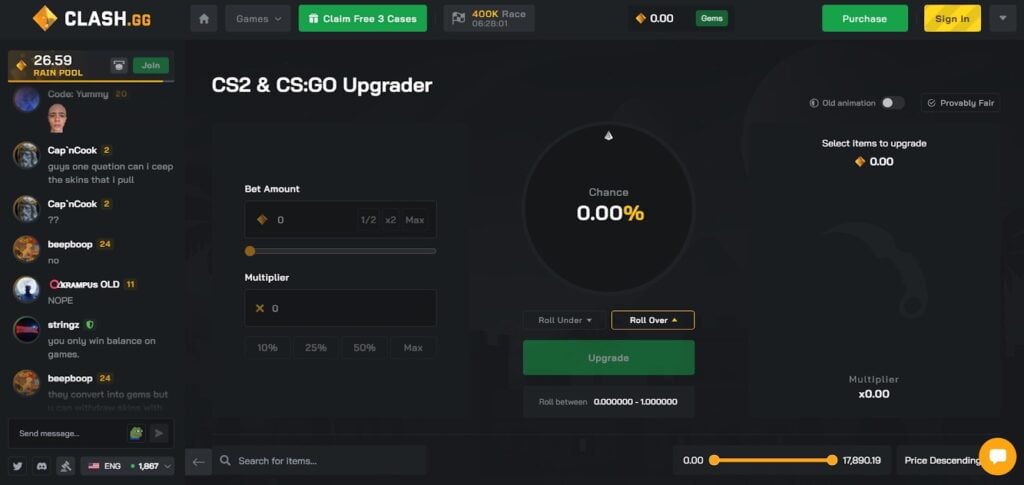
Clash.gg runs everything through their gem balance system instead of direct skin trades. You deposit skins, get gems, then use those gems for upgrading. Some players prefer this system, others find it unnecessarily complicated. After spending time with it, we can see both sides – it’s consistent once you understand it, but adds extra steps to what should be simple.

The good news is their rakeback system applies to upgrader losses too, so you’re getting a tiny percentage back even when things go south. What holds it back from being a top CSGO upgrade site is the withdrawal process.

Instead of instant bot trades, you’re dealing with API keys and waiting for confirmations. The gem system also means you can’t always withdraw the exact skin you won – you get the value and have to find something comparable in their cashout store.

Pros

  • Rakeback on all upgrades softens losses
  • Strong provably fair implementation

Cons

  • Gem system adds unnecessary complexity
  • Withdrawal process more complicated than competitors

5. Key-Drop: The Safety Net Upgrader
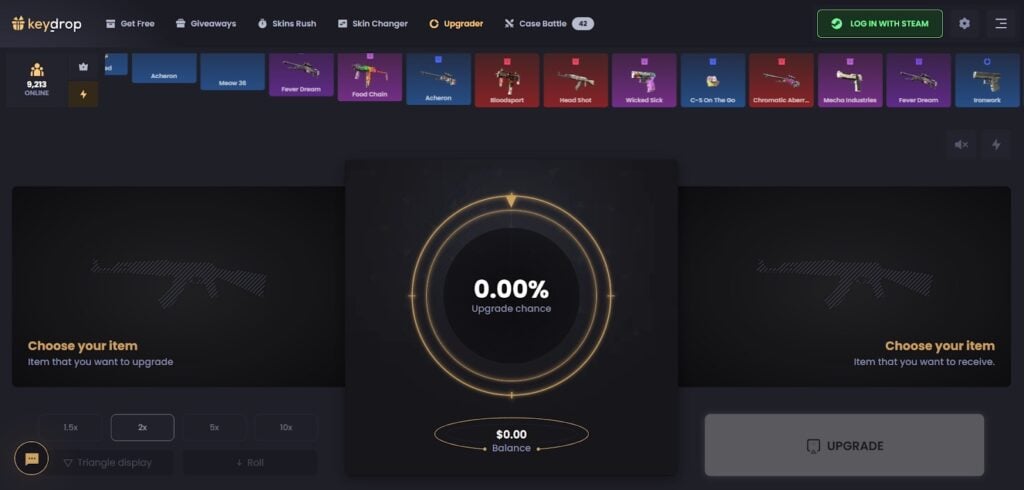
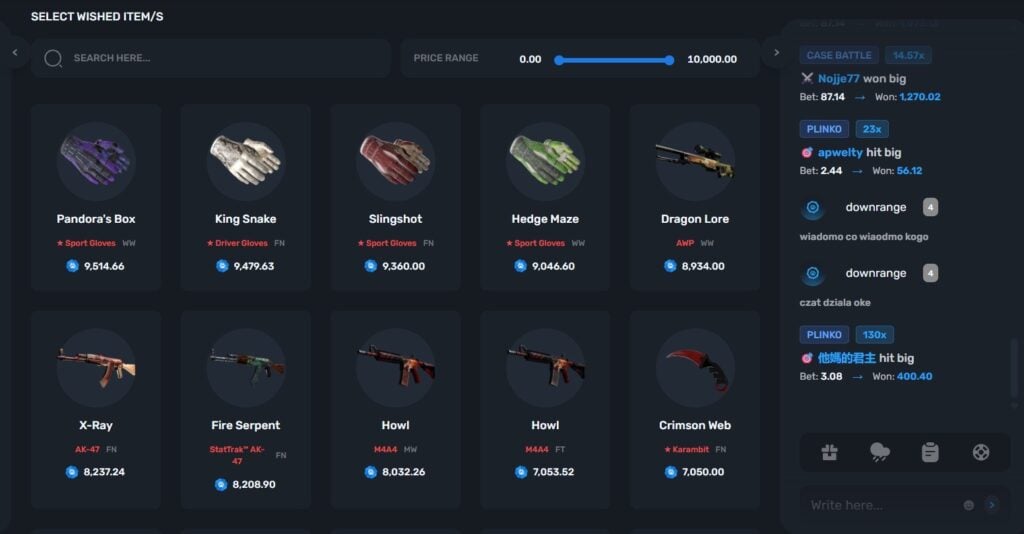
Key-Drop’s unique angle is their cashback system. When you fail an upgrade, you get either a random skin or a voucher instead of nothing. The compensation is usually worth way less than what you risked, but it can make a difference. At the very least, you’re not staring at a completely empty result after a failed attempt.

This CSGO skin upgrade site hits a major limitation with its withdrawal system – CS skins only, no crypto or other payment options. Their inventory also tends to run thin during busy periods, so even when you hit a good upgrade, you might end up waiting to actually claim your winnings.

Support response times have been problematic, too, according to user feedback. When you’re dealing with valuable items, slow support becomes a real headache.

Pros

  • Cashback system softens failed upgrades
  • Clear percentage limits prevent extreme gambling 

Cons

  • CS skin withdrawals only
  • Support can be slow to respond

How CSGO Skin Upgraders Actually Work?

Let’s cut through the marketing fluff and talk about what’s actually happening when you hit that upgrade button. Spoiler: it’s simpler than sites want you to think.

The Basic Math Behind Every Upgrade 

Every CSGO upgrade system uses the same formula. Take your skin’s value, divide it by the target skin’s value, and that’s roughly your success chance. A $10 skin chasing a $100 knife? You’re looking at around ten percent odds. No magic, no special algorithms – just basic probability math.

What “Provably Fair” Actually Means?

Sites generate a random seed before your upgrade, show you its hash, then reveal the seed after. You can verify the result matched the original seed using any hash calculator. It’s basically the site proving they didn’t change the outcome after seeing your bet. Most players never check, but it’s there.

Reading Between the Marketing Lines 

Every site claims they’re “the most fair” or have “the best odds,” but the math is identical across platforms. What actually varies is the user experience, withdrawal speed, and how transparent they are about the process. Focus on these practical differences, not the marketing promises about revolutionary fairness systems

Final Verdict on CSGO Upgrade Sites

Upgraders fill a specific niche in the CS skin ecosystem. They’re for when opening cases feels too random, but trading feels too slow. You get that immediate gambling hit with slightly more control over the outcome. The key is picking the right platform and understanding the game you’re playing.
SkinsLuck stands out as the most polished option currently available, especially if you value transparency and speed. The other sites have their moments – Hellcase for cross-game flexibility, Skin.Club for community features, Clash.gg for the rakeback system, and Key-Drop for that safety net feeling. But for pure upgrading experience, we kept coming back to SkinsLuck.

Ready to turn those duplicate skins into something worth showing off? Try SkinsLuck’s upgrader today!

Frequently Asked Questions About CSGO Upgrade Sites

Can You Actually Profit From Upgraders Long-Term?

Mathematically, no. Upgraders have a house edge like any gambling game. You might hit lucky streaks or score big individual wins, but the math favors the platform over thousands of attempts. Successful players treat it as entertainment that sometimes pays out, not a money-making strategy.

What’s the Difference Between Upgraders and Trade-up Contracts?

Trade-up contracts are Valve’s official system requiring ten skins of the same quality to guarantee one skin from the next tier. Upgraders on third-party sites let you risk any skin for a chance at any other skin, with odds based on value difference. More flexibility, but also more risk.

How Do I Verify if an Upgrade Was Fair?

Legitimate sites show you a hash before each upgrade attempt. After the result, they provide the seed that created that hash. You can verify the hash matches the seed using online calculators. If a site doesn’t offer this or makes it complicated, that’s a red flag.

Why Do Some Sites Use Balance Instead of Direct Skin Trading?

Balance-based systems like Clash.gg’s gems simplify the backend but add complexity for users. Instead of managing thousands of skin trades, everything converts to currency. The downside is you can’t always withdraw the exact skin you wanted, just something of equivalent value.

Should I Use High or Low Multipliers When Upgrading?

Depends on your goal. Low multipliers (x1.5-x2) give better odds but smaller rewards – good for gradually building value. High multipliers (x5-x10) are lottery tickets with terrible odds but massive potential payouts. Most successful upgraders stick to the middle ground around x2-x3 for the best risk-reward balance.

This article has been provided by one of our commercial partners and does not reflect Cryptonomist’s opinion. Please be aware our commercial partners may use affiliate programs to generate revenues through the links on this article.


Market Opportunity
Polytrade Logo
Polytrade Price(TRADE)
$0.06098
$0.06098$0.06098
-2.54%
USD
Polytrade (TRADE) Live Price Chart
Disclaimer: The articles reposted on this site are sourced from public platforms and are provided for informational purposes only. They do not necessarily reflect the views of MEXC. All rights remain with the original authors. If you believe any content infringes on third-party rights, please contact [email protected] for removal. MEXC makes no guarantees regarding the accuracy, completeness, or timeliness of the content and is not responsible for any actions taken based on the information provided. The content does not constitute financial, legal, or other professional advice, nor should it be considered a recommendation or endorsement by MEXC.

You May Also Like

Shocking OpenVPP Partnership Claim Draws Urgent Scrutiny

Shocking OpenVPP Partnership Claim Draws Urgent Scrutiny

The post Shocking OpenVPP Partnership Claim Draws Urgent Scrutiny appeared on BitcoinEthereumNews.com. The cryptocurrency world is buzzing with a recent controversy surrounding a bold OpenVPP partnership claim. This week, OpenVPP (OVPP) announced what it presented as a significant collaboration with the U.S. government in the innovative field of energy tokenization. However, this claim quickly drew the sharp eye of on-chain analyst ZachXBT, who highlighted a swift and official rebuttal that has sent ripples through the digital asset community. What Sparked the OpenVPP Partnership Claim Controversy? The core of the issue revolves around OpenVPP’s assertion of a U.S. government partnership. This kind of collaboration would typically be a monumental endorsement for any private cryptocurrency project, especially given the current regulatory climate. Such a partnership could signify a new era of mainstream adoption and legitimacy for energy tokenization initiatives. OpenVPP initially claimed cooperation with the U.S. government. This alleged partnership was said to be in the domain of energy tokenization. The announcement generated considerable interest and discussion online. ZachXBT, known for his diligent on-chain investigations, was quick to flag the development. He brought attention to the fact that U.S. Securities and Exchange Commission (SEC) Commissioner Hester Peirce had directly addressed the OpenVPP partnership claim. Her response, delivered within hours, was unequivocal and starkly contradicted OpenVPP’s narrative. How Did Regulatory Authorities Respond to the OpenVPP Partnership Claim? Commissioner Hester Peirce’s statement was a crucial turning point in this unfolding story. She clearly stated that the SEC, as an agency, does not engage in partnerships with private cryptocurrency projects. This response effectively dismantled the credibility of OpenVPP’s initial announcement regarding their supposed government collaboration. Peirce’s swift clarification underscores a fundamental principle of regulatory bodies: maintaining impartiality and avoiding endorsements of private entities. Her statement serves as a vital reminder to the crypto community about the official stance of government agencies concerning private ventures. Moreover, ZachXBT’s analysis…
Share
BitcoinEthereumNews2025/09/18 02:13
The Role of Blockchain in Building Safer Web3 Gaming Ecosystems

The Role of Blockchain in Building Safer Web3 Gaming Ecosystems

The gaming industry is in the midst of a historic shift, driven by the rise of Web3. Unlike traditional games, where developers and publishers control assets and dictate in-game economies, Web3 gaming empowers players with ownership and influence. Built on blockchain technology, these ecosystems are decentralized by design, enabling true digital asset ownership, transparent economies, and a future where players help shape the games they play. However, as Web3 gaming grows, security becomes a focal point. The range of security concerns, from hacking to asset theft to vulnerabilities in smart contracts, is a significant issue that will undermine or erode trust in this ecosystem, limiting or stopping adoption. Blockchain technology could be used to create security processes around secure, transparent, and fair Web3 gaming ecosystems. We will explore how security is increasing within gaming ecosystems, which challenges are being overcome, and what the future of security looks like. Why is Security Important in Web3 Gaming? Web3 gaming differs from traditional gaming in that players engage with both the game and assets with real value attached. Players own in-game assets that exist as tokens or NFTs (Non-Fungible Tokens), and can trade and sell them. These game assets usually represent significant financial value, meaning security failure could represent real monetary loss. In essence, without security, the promises of owning “something” in Web3, decentralized economies within games, and all that comes with the term “fair” gameplay can easily be eroded by fraud, hacking, and exploitation. This is precisely why the uniqueness of blockchain should be emphasized in securing Web3 gaming. How Blockchain Ensures Security in Web3 Gaming?
  1. Immutable Ownership of Assets Blockchain records can be manipulated by anyone. If a player owns a sword, skin, or plot of land as an NFT, it is verifiably in their ownership, and it cannot be altered or deleted by the developer or even hacked. This has created a proven track record of ownership, providing control back to the players, unlike any centralised gaming platform where assets can be revoked.
  2. Decentralized Infrastructure Blockchain networks also have a distributed architecture where game data is stored in a worldwide network of nodes, making them much less susceptible to centralised points of failure and attacks. This decentralised approach makes it exponentially more difficult to hijack systems or even shut off the game’s economy.
  3. Secure Transactions with Cryptography Whether a player buys an NFT or trades their in-game tokens for other items or tokens, the transactions are enforced by cryptographic algorithms, ensuring secure, verifiable, and irreversible transactions and eliminating the risks of double-spending or fraudulent trades.
  4. Smart Contract Automation Smart contracts automate the enforcement of game rules and players’ economic exchanges for the developer, eliminating the need for intermediaries or middlemen, and trust for the developer. For example, if a player completes a quest that promises a reward, the smart contract will execute and distribute what was promised.
  5. Anti-Cheating and Fair Gameplay The naturally transparent nature of blockchain makes it extremely simple for anyone to examine a specific instance of gameplay and verify the economic outcomes from that play. Furthermore, multi-player games that enforce smart contracts on things like loot sharing or win sharing can automate and measure trustlessness and avoid cheating, manipulations, and fraud by developers.
  6. Cross-Platform Security Many Web3 games feature asset interoperability across platforms. This interoperability is made viable by blockchain, which guarantees ownership is maintained whenever assets transition from one game or marketplace to another, thereby offering protection to players who rely on transfers for security against fraud. Key Security Dangers in Web3 Gaming Although blockchain provides sound first principles of security, the Web3 gaming ecosystem is susceptible to threats. Some of the most serious threats include:
Smart Contract Vulnerabilities: Smart contracts that are poorly written or lack auditing will leave openings for exploitation and thereby result in asset loss. Phishing Attacks: Unintentionally exposing or revealing private keys or signing transactions that are not possible to reverse, under the assumption they were genuine transaction requests. Bridge Hacks: Cross-chain bridges, which allow players to move their assets between their respective blockchains, continually face hacks, requiring vigilance from players and developers. Scams and Rug Pulls: Rug pulls occur when a game project raises money and leaves, leaving player assets worthless. Regulatory Ambiguity: Global regulations remain unclear; risks exist for players and developers alike. While blockchain alone won’t resolve every issue, it remediates the responsibility of the first principles, more so when joined by processes such as auditing, education, and the right governance, which can improve their contribution to the security landscapes in game ecosystems. Real Life Examples of Blockchain Security in Web3 Gaming Axie Infinity (Ronin Hack): The Axie Infinity game and several projects suffered one of the biggest hacks thus far on its Ronin bridge; however, it demonstrated the effectiveness of multi-sig security and the effective utilization of decentralization. The industry benefited through learning and reflection, thus, as projects have implemented changes to reduce the risks of future hacks or misappropriation. Immutable X: This Ethereum scaling solution aims to ensure secure NFT transactions for gaming, allowing players to trade an asset without the burden of exorbitant fees and fears of being a victim of fraud. Enjin: Enjin is providing a trusted infrastructure for Web3 games, offering secure NFT creation and transfer while reiterating that ownership and an asset securely belong to the player. These examples indubitably illustrate that despite challenges to overcome, blockchain remains the foundational layer on which to build more secure Web3 gaming environments. Benefits of Blockchain Security for Players and Developers For Players: Confidence in true ownership of assets Transparency in in-game economies Protection against nefarious trades/scams For Developers: More trust between players and the platform Less reliance on centralized infrastructure Ability to attract wealth and players based on provable fairness By incorporating blockchain security within the mechanics of game design, developers can create and enforce resilient ecosystems where players feel reassured in investing time, money, and ownership within virtual worlds. The Future of Secure Web3 Gaming Ecosystems As the wisdom of blockchain technology and industry knowledge improves, the future for secure Web3 gaming looks bright. New growing trends include: Zero-Knowledge Proofs (ZKPs): A new wave of protocols that enable private transactions and secure smart contracts while managing user privacy with an element of transparency. Decentralized Identity Solutions (DID): Helping players control their identities and decrease account theft risks. AI-Enhanced Security: Identifying irregularities in user interactions by sampling pattern anomalies to avert hacks and fraud by time-stamping critical events. Interoperable Security Standards: Allowing secured and seamless asset transfers across blockchains and games. With these innovations, blockchain will not only secure gaming assets but also enhance the overall trust and longevity of Web3 gaming ecosystems. Conclusion Blockchain is more than a buzzword in Web3; it is the only way to host security, fairness, and transparency. With blockchain, players confirm immutable ownership of digital assets, there is a decentralized infrastructure, and finally, it supports smart contracts to automate code that protects players and developers from the challenges of digital economies. The threats, vulnerabilities, and scams that come from smart contracts still persist, but the industry is maturing with better security practices, cross-chain solutions, and increased formal cryptographic tools. In the coming years, blockchain will remain the base to digital economies and drive Web3 gaming environments that allow players to safely own, trade, and enjoy their digital experiences free from fraud and exploitation. While blockchain and gaming alone entertain, we will usher in an era of secure digital worlds where trust complements innovation. The Role of Blockchain in Building Safer Web3 Gaming Ecosystems was originally published in Coinmonks on Medium, where people are continuing the conversation by highlighting and responding to this story
Share
Medium2025/09/18 14:40
Morning Crypto Report: $3.6 XRP Dream Is Not Dead: Bollinger Bands, ‘New Cardano’ Rockets 40%, Vitalik Buterin Sells Binance Coin and Other Crypto Amid ‘Crypto Winter’

Morning Crypto Report: $3.6 XRP Dream Is Not Dead: Bollinger Bands, ‘New Cardano’ Rockets 40%, Vitalik Buterin Sells Binance Coin and Other Crypto Amid ‘Crypto Winter’

The post Morning Crypto Report: $3.6 XRP Dream Is Not Dead: Bollinger Bands, ‘New Cardano’ Rockets 40%, Vitalik Buterin Sells Binance Coin and Other Crypto Amid
Share
BitcoinEthereumNews2025/12/21 22:15



