Europe’s Digital Asset Rules Miss Key Transferability Insights

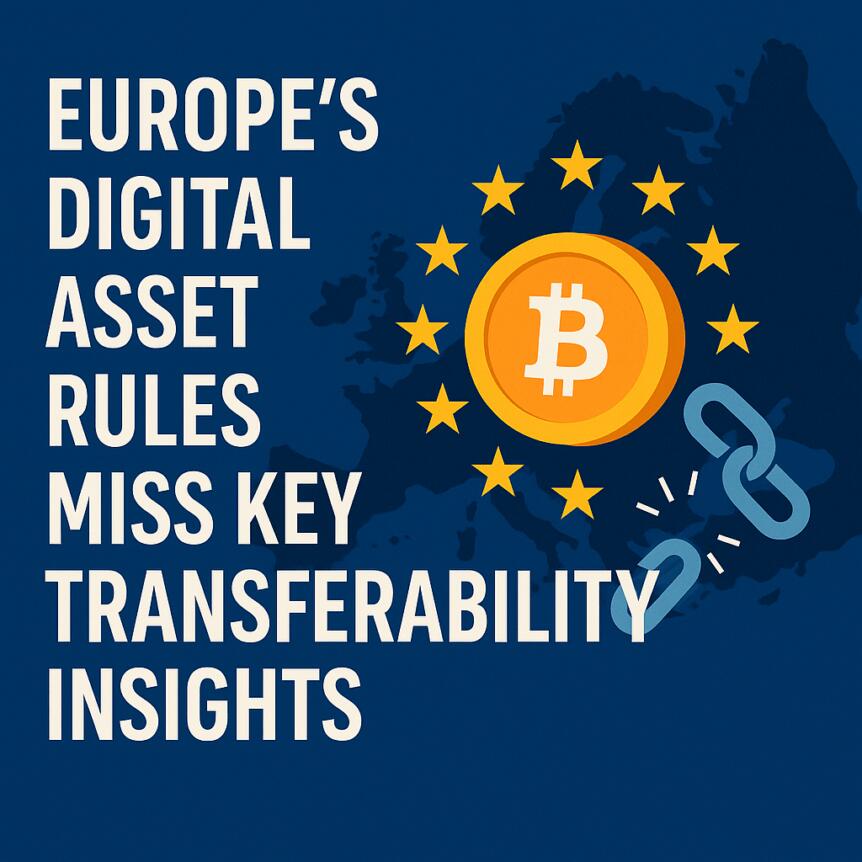
Europe continues to navigate the evolving landscape of crypto regulation, particularly regarding the tokenization of non-transferable assets. With current frameworks like MiCA and MiFID II often overlooking assets that are inherently non-transferable, regulators are exploring innovative approaches. The EU Blockchain Sandbox offers a promising pathway by establishing clear standards for digital twins — faithful digital representations of these assets — without automatically reclassifying them as security tokens. This development aims to foster legitimate innovation while maintaining legal clarity across Europe’s expanding crypto markets.
- The EU Blockchain Sandbox introduces a “digital twin” approach to regulate non-transferable assets in crypto markets.
- Recognizing faithful digital replicas prevents misclassification of non-transferable assets as security tokens under EU law.
- Legal requalification occurs only when engineered transferability features alter the fundamental nature of the asset.
- Regulators advocate a sequential analysis: first check MiFID II, then MiCA, followed by AIFMD and national laws.
- Clear, practical regulatory guidance aims to balance innovation and market security in Europe.
Tokenization Outpaces Regulation
While traditional securities like bonds or shares retain their legal status on a blockchain, simply recording a non-transferable asset as a digital twin does not automatically convert it into a security token. The legal classification remains tied to the nature of the underlying asset, regardless of how it is represented on-chain. Yet, creators seeking liquidity might add transferability features, potentially requalifying the token under regulations such as MiCA or MiFID II.
Related: Banks are building on Web3, moving beyond initial exploration
The EU’s approach emphasizes that the sequence of analysis matters. First, determine if the token qualifies as a MiFID II financial instrument. If not, evaluate whether it falls under MiCA, and subsequently consider AIFMD for collective investment structures. If none apply, national law governs. Significantly, the transferability criterion in MiCA is pivotal: non-transferable tokens do not fall under its scope, preserving their classification outside its regulation.
Engineering Transferability and Requalification
A digital twin that precisely mirrors the original asset should maintain its legal classification. However, when developers embed transferability workarounds or wrappers that enable trading, they risk creating a new instrument that falls under crypto regulation frameworks. Proper technical, contractual, and legal measures are essential to ensure that the digital representation remains compliant with its original nature.
When tokens are engineered to add transferability, they might requalify, deviating from the initial asset’s legal status. Developers must incorporate enforced redemption and reissuance mechanics to keep the asset non-transferable, ensuring it stays outside of MiCA’s scope.
Regulatory Clarifications from the EU Blockchain Sandbox
The Sandbox has clarified that a true “digital twin” that exactly replicates the original asset without added features retains its legal classification. Only when tokenization introduces transferability, liquidity features, or other modifications does the classification change, potentially bringing it under additional regulation such as MiFID II.
Decisive in this process is the technical impossibility of transferring a non-transferable token to anyone other than the issuer or offeror, with strict enforced redemption mechanics. This approach aims to prevent misclassification and foster compliant innovation in Europe’s crypto markets.
Moving Toward Clearer Regulation
Supervisors do not need new legislation but require precise, pragmatic guidance. A stepwise analysis — starting with MiFID II, then MiCA, followed by national law — provides clarity, especially regarding engineered transferability. The sandbox experience illustrates the importance of structured dialogue to clarify legal uncertainties around tokenization and digital twins.
Such guidance will help protect investors, support compliant digitization of private-market rights, and prevent outflow of tokenization activity to non-EU jurisdictions. Distinguishing between digital twins and engineered transferability keeps the European market innovative yet secure.
The Bottom Line
Tokenization offers significant potential but comes with regulatory challenges. The EU Blockchain Sandbox has charted a pathway for balanced oversight, emphasizing the importance of technical integrity and legal clarity. Clear regulatory guidance will ensure Europe remains competitive while safeguarding market stability in the evolving crypto landscape.
Opinion by: Elisenda Fabrega, general counsel at Brickken.
This article provides general information and is not legal or investment advice. Opinions expressed are those of the author and do not necessarily reflect the views of Cointelegraph.
This article was originally published as Europe’s Digital Asset Rules Miss Key Transferability Insights on Crypto Breaking News – your trusted source for crypto news, Bitcoin news, and blockchain updates.


You May Also Like

USD/INR Rally Intensifies: US Dollar Gains and Oil Price Surge Shake Indian Forex Market
Samsung Electronics Faces Major Strike Threat as 40,000 Employees Protest Compensation Disparity