Polymarket founder Shayne Coplan—newly thrust into the broader financial spotlight after Bloomberg placed him on its Billionaires Index as the youngest self-made member—has ignited fresh speculation about a native token for the event-markets platform. In a terse post on X, Coplan simply wrote: “$BTC $ETH $BNB $SOL $POLY 🤔,” a construction that bracketed an unannounced […]Polymarket founder Shayne Coplan—newly thrust into the broader financial spotlight after Bloomberg placed him on its Billionaires Index as the youngest self-made member—has ignited fresh speculation about a native token for the event-markets platform. In a terse post on X, Coplan simply wrote: “$BTC $ETH $BNB $SOL $POLY 🤔,” a construction that bracketed an unannounced […]

Polymarket Founder Teases POLY — Crypto’s Biggest Airdrop Incoming?

Polymarket founder Shayne Coplan—newly thrust into the broader financial spotlight after Bloomberg placed him on its Billionaires Index as the youngest self-made member—has ignited fresh speculation about a native token for the event-markets platform. In a terse post on X, Coplan simply wrote: “$BTC $ETH $BNB $SOL $POLY 🤔,” a construction that bracketed an unannounced “$POLY” ticker alongside four of the market’s largest assets and set off immediate debate about token timing, design, and whether an airdrop could accompany any launch.

Will Polymarket Launch A Token?

The timing of the tease is striking. On Tuesday, Intercontinental Exchange (ICE)—the owner of the New York Stock Exchange—announced a strategic investment of up to $2 billion in Polymarket that implies a roughly $8 billion pre-money valuation. ICE framed the deal as a bet on the institutionalization of event-based information markets and their underlying data exhaust. “Intercontinental Exchange… announced a strategic investment in Polymarket,” the company said, specifying the “up to $2 billion” commitment and the approximate valuation impact.

Polymarket’s trajectory has been anything but linear. In January 2022, the US Commodity Futures Trading Commission issued a cease-and-desist order and a $1.4 million civil monetary penalty over unregistered event-based binary options, requiring the platform to wind down non-compliant markets. The CFTC’s order also documented the firm’s cooperation and remedial steps. Those actions forced Polymarket to rebuild its compliance posture even as prediction markets were gaining cultural relevance during major political events and sports seasons.

Against that backdrop, Coplan’s five-ticker line reads like an ambition statement more than a technical spec sheet. There are no published details on issuance mechanics, governance scope, chain selection, or distribution; Polymarket itself has not announced a token, and there is no public documentation outlining airdrop criteria, eligibility windows, or clawbacks.

But the semiotic weight of placing “POLY” in the same breath as Bitcoin, Ether, BNB, and Solana was not lost on traders who have come to expect user distributions when crypto-native platforms formalize decentralization or community governance. Until Polymarket releases definitive materials, any talk of timing, supply, or airdrops remains conjecture.

For now, the only on-record line about a token is Coplan’s—nothing more, nothing less. Given Polymarket’s regulatory history and its newly prominent backer, any tokenization path would likely be sequenced with care. Until formal disclosures arrive, the market will continue to parse a single eight-word post for signal.

Biggest Crypto Airdrop Ever?

As of today, Solana’s market cap hovers around $124–125 billion, with XRP sitting near $170 billion and BNB around $178 billion. That puts SOL roughly at the #6 slot today, below XRP and BNB. In other words, a token placed directly behind SOL would be ~#7 at roughly $120–124 billion in market cap.

By day-one dollar value, the watermark for an airdrop is Arbitrum. The foundation allocated about 1.162 billion ARB to users; contemporaneous trading around $1.35–$1.40 put the aggregate day-one value near $1.6 billion—well ahead of prior marquee drops. For comparison, Uniswap’s Sept. 2020 airdrop distributed 150 million UNI; launch-day pricing implied roughly $0.5–$0.6 billion in value. These would be the benchmarks that POLY would have to surpass.

At press time, the total crypto market cap stood at $4.08 trillion.
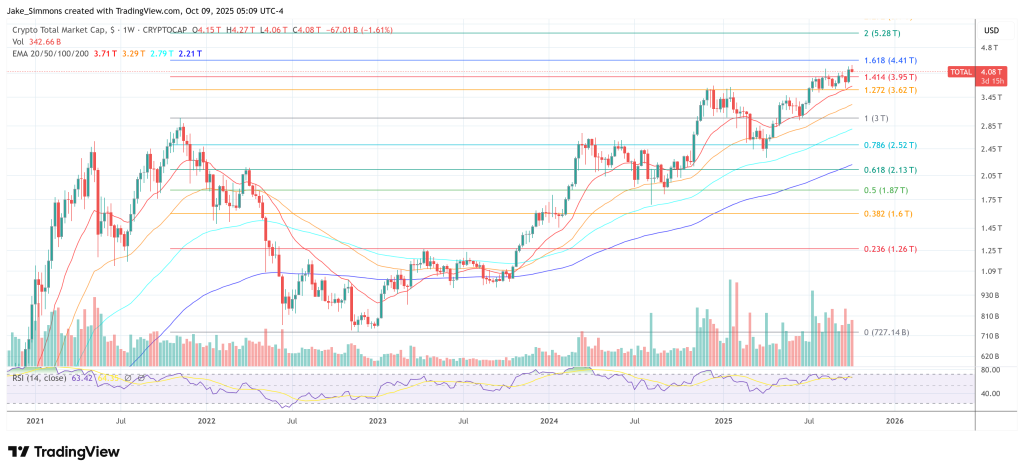
Total crypto market cap
Market Opportunity
Index Cooperative Logo
Index Cooperative Price(INDEX)
$0.4979
$0.4979$0.4979
-0.24%
USD
Index Cooperative (INDEX) Live Price Chart
Disclaimer: The articles reposted on this site are sourced from public platforms and are provided for informational purposes only. They do not necessarily reflect the views of MEXC. All rights remain with the original authors. If you believe any content infringes on third-party rights, please contact [email protected] for removal. MEXC makes no guarantees regarding the accuracy, completeness, or timeliness of the content and is not responsible for any actions taken based on the information provided. The content does not constitute financial, legal, or other professional advice, nor should it be considered a recommendation or endorsement by MEXC.

You May Also Like

WIF price reclaims 200-day moving average

WIF price reclaims 200-day moving average

WIF (WIF) price is entering a critical technical phase as price action reclaims the 200-day moving average, a level that often separates bearish control from bullish
Share
Crypto.news2026/01/13 23:44
China Blocks Nvidia’s RTX Pro 6000D as Local Chips Rise

China Blocks Nvidia’s RTX Pro 6000D as Local Chips Rise

The post China Blocks Nvidia’s RTX Pro 6000D as Local Chips Rise appeared on BitcoinEthereumNews.com. China Blocks Nvidia’s RTX Pro 6000D as Local Chips Rise China’s internet regulator has ordered the country’s biggest technology firms, including Alibaba and ByteDance, to stop purchasing Nvidia’s RTX Pro 6000D GPUs. According to the Financial Times, the move shuts down the last major channel for mass supplies of American chips to the Chinese market. Why Beijing Halted Nvidia Purchases Chinese companies had planned to buy tens of thousands of RTX Pro 6000D accelerators and had already begun testing them in servers. But regulators intervened, halting the purchases and signaling stricter controls than earlier measures placed on Nvidia’s H20 chip. Image: Nvidia An audit compared Huawei and Cambricon processors, along with chips developed by Alibaba and Baidu, against Nvidia’s export-approved products. Regulators concluded that Chinese chips had reached performance levels comparable to the restricted U.S. models. This assessment pushed authorities to advise firms to rely more heavily on domestic processors, further tightening Nvidia’s already limited position in China. China’s Drive Toward Tech Independence The decision highlights Beijing’s focus on import substitution — developing self-sufficient chip production to reduce reliance on U.S. supplies. “The signal is now clear: all attention is focused on building a domestic ecosystem,” said a representative of a leading Chinese tech company. Nvidia had unveiled the RTX Pro 6000D in July 2025 during CEO Jensen Huang’s visit to Beijing, in an attempt to keep a foothold in China after Washington restricted exports of its most advanced chips. But momentum is shifting. Industry sources told the Financial Times that Chinese manufacturers plan to triple AI chip production next year to meet growing demand. They believe “domestic supply will now be sufficient without Nvidia.” What It Means for the Future With Huawei, Cambricon, Alibaba, and Baidu stepping up, China is positioning itself for long-term technological independence. Nvidia, meanwhile, faces…
Share
BitcoinEthereumNews2025/09/18 01:37
Trump: Powell did a bad job.

Trump: Powell did a bad job.

PANews reported on January 13th that, according to Jinshi Data, US President Trump stated: "Federal Reserve Chairman Powell is either incompetent or dishonest.
Share
PANews2026/01/13 23:40