The global markets were shaken after President Donald Trump announced a 100% tariff on Chinese goods starting November 1, reigniting a full-scale trade war between the two largest economies. With $1.6 trillion already wiped from the US stock market in a single day, the question on every investor’s mind is simple: what happens next for crypto?Why  US–China Tariff Matter for Crypto Market?Unlike traditional equities, cryptocurrencies are not tied to a single economy, but they react sharply to macroeconomic shocks. Tariffs between the US and China hit two pressure points: inflation and liquidity. Higher import costs push inflation up, and central banks may respond with tighter monetary policy, reducing liquidity. For risk assets like Bitcoin and altcoins, reduced liquidity often translates into selling pressure.At the same time, crypto is increasingly viewed as a hedge against geopolitical risk. If trade tensions escalate into broader financial instability, investors may turn to Bitcoin as a digital safe haven, mirroring how gold reacts to crises. This dual role creates volatility: panic selling first, then speculative inflows if confidence in fiat weakens.Chart Analysis: Where Is the Crypto Market Headed?Total Market Cap: TradingViewLooking at the Total Crypto Market Cap chart, the recent candles tell a story of sharp reversal. After testing the upper Bollinger Band near $4.2 trillion, the market plunged below $3.7 trillion, with a massive wick extending towards $3.2 trillion. That wick signals extreme panic liquidation, followed by partial recovery.The Bollinger Bands are widening, which usually signals higher volatility ahead. The mid-band around $3.93 trillion is acting as resistance, while immediate support sits near $3.59 trillion. If this level breaks decisively, the next stop could be $3.2 trillion. On the upside, reclaiming $3.9–4 trillion could set the stage for a rebound rally.Could Rare Earth Politics Spill Into Crypto Market?Image Source: TruthsocialChina’s restrictions on rare earth exports aren’t just about minerals; they’re a geopolitical weapon. Rare earths are essential for high-tech industries, including chips, batteries, and EVs. Any disruption in this supply chain threatens US tech stocks, which are already reeling. When equities are unstable, crypto often becomes collateral damage as institutions de-risk across all volatile asset classes.But here’s the twist: if US–China relations worsen further and global trust in traditional financial systems declines, crypto could see inflows as an alternative store of value. In essence, rare earth disputes may indirectly fuel Bitcoin’s “digital gold” narrative.Short-Term Outlook: More Crypto Market Crash Before Relief?Given the November 1 deadline for tariffs by Donald Trump, markets are bracing for weeks of uncertainty. Expect sharp swings as traders position for worst-case outcomes. The chart suggests crypto market cap could retest $3.5 trillion, with a possible extension to $3.2 trillion if panic deepens.However, if inflation fears push more investors to seek decentralized assets, Bitcoin and Ethereum may lead a relief rally. Historically, crypto thrives when traditional markets lose investor trust.Long-Term View: A Turning Point for Adoption?If the trade war escalates, crypto adoption could accelerate. Both the US and China are heavily invested in blockchain technologies. For China, pushing digital yuan adoption could reduce reliance on dollar-settled trade. For the US, crypto may gain traction as retail and institutional investors seek alternatives to inflation-weakened fiat.The rare earth standoff might also highlight blockchain’s role in securing supply chains, further intertwining crypto with geopolitics.Final TakeThe US–China tariff battle has thrown crypto into a storm of uncertainty. Short-term, volatility and downside risk dominate the charts. But long-term, these geopolitical tensions may be the very fuel that strengthens crypto’s case as a hedge against inflation, trade wars, and broken global trust.The question isn’t just whether crypto will fall or rise in the next few weeks. The deeper question is whether this trade war marks the beginning of crypto’s evolution from speculative asset to essential financial refuge.The global markets were shaken after President Donald Trump announced a 100% tariff on Chinese goods starting November 1, reigniting a full-scale trade war between the two largest economies. With $1.6 trillion already wiped from the US stock market in a single day, the question on every investor’s mind is simple: what happens next for crypto?Why  US–China Tariff Matter for Crypto Market?Unlike traditional equities, cryptocurrencies are not tied to a single economy, but they react sharply to macroeconomic shocks. Tariffs between the US and China hit two pressure points: inflation and liquidity. Higher import costs push inflation up, and central banks may respond with tighter monetary policy, reducing liquidity. For risk assets like Bitcoin and altcoins, reduced liquidity often translates into selling pressure.At the same time, crypto is increasingly viewed as a hedge against geopolitical risk. If trade tensions escalate into broader financial instability, investors may turn to Bitcoin as a digital safe haven, mirroring how gold reacts to crises. This dual role creates volatility: panic selling first, then speculative inflows if confidence in fiat weakens.Chart Analysis: Where Is the Crypto Market Headed?Total Market Cap: TradingViewLooking at the Total Crypto Market Cap chart, the recent candles tell a story of sharp reversal. After testing the upper Bollinger Band near $4.2 trillion, the market plunged below $3.7 trillion, with a massive wick extending towards $3.2 trillion. That wick signals extreme panic liquidation, followed by partial recovery.The Bollinger Bands are widening, which usually signals higher volatility ahead. The mid-band around $3.93 trillion is acting as resistance, while immediate support sits near $3.59 trillion. If this level breaks decisively, the next stop could be $3.2 trillion. On the upside, reclaiming $3.9–4 trillion could set the stage for a rebound rally.Could Rare Earth Politics Spill Into Crypto Market?Image Source: TruthsocialChina’s restrictions on rare earth exports aren’t just about minerals; they’re a geopolitical weapon. Rare earths are essential for high-tech industries, including chips, batteries, and EVs. Any disruption in this supply chain threatens US tech stocks, which are already reeling. When equities are unstable, crypto often becomes collateral damage as institutions de-risk across all volatile asset classes.But here’s the twist: if US–China relations worsen further and global trust in traditional financial systems declines, crypto could see inflows as an alternative store of value. In essence, rare earth disputes may indirectly fuel Bitcoin’s “digital gold” narrative.Short-Term Outlook: More Crypto Market Crash Before Relief?Given the November 1 deadline for tariffs by Donald Trump, markets are bracing for weeks of uncertainty. Expect sharp swings as traders position for worst-case outcomes. The chart suggests crypto market cap could retest $3.5 trillion, with a possible extension to $3.2 trillion if panic deepens.However, if inflation fears push more investors to seek decentralized assets, Bitcoin and Ethereum may lead a relief rally. Historically, crypto thrives when traditional markets lose investor trust.Long-Term View: A Turning Point for Adoption?If the trade war escalates, crypto adoption could accelerate. Both the US and China are heavily invested in blockchain technologies. For China, pushing digital yuan adoption could reduce reliance on dollar-settled trade. For the US, crypto may gain traction as retail and institutional investors seek alternatives to inflation-weakened fiat.The rare earth standoff might also highlight blockchain’s role in securing supply chains, further intertwining crypto with geopolitics.Final TakeThe US–China tariff battle has thrown crypto into a storm of uncertainty. Short-term, volatility and downside risk dominate the charts. But long-term, these geopolitical tensions may be the very fuel that strengthens crypto’s case as a hedge against inflation, trade wars, and broken global trust.The question isn’t just whether crypto will fall or rise in the next few weeks. The deeper question is whether this trade war marks the beginning of crypto’s evolution from speculative asset to essential financial refuge.

US–China Tariff War: Can Crypto Market Survive the New Trade War?

2025/10/11 12:10
4 min read
For feedback or concerns regarding this content, please contact us at [email protected]

The global markets were shaken after President Donald Trump announced a 100% tariff on Chinese goods starting November 1, reigniting a full-scale trade war between the two largest economies. With $1.6 trillion already wiped from the US stock market in a single day, the question on every investor’s mind is simple: what happens next for crypto?

Why  US–China Tariff Matter for Crypto Market?

Unlike traditional equities, cryptocurrencies are not tied to a single economy, but they react sharply to macroeconomic shocks. Tariffs between the US and China hit two pressure points: inflation and liquidity. Higher import costs push inflation up, and central banks may respond with tighter monetary policy, reducing liquidity. For risk assets like Bitcoin and altcoins, reduced liquidity often translates into selling pressure.

At the same time, crypto is increasingly viewed as a hedge against geopolitical risk. If trade tensions escalate into broader financial instability, investors may turn to Bitcoin as a digital safe haven, mirroring how gold reacts to crises. This dual role creates volatility: panic selling first, then speculative inflows if confidence in fiat weakens.

Chart Analysis: Where Is the Crypto Market Headed?
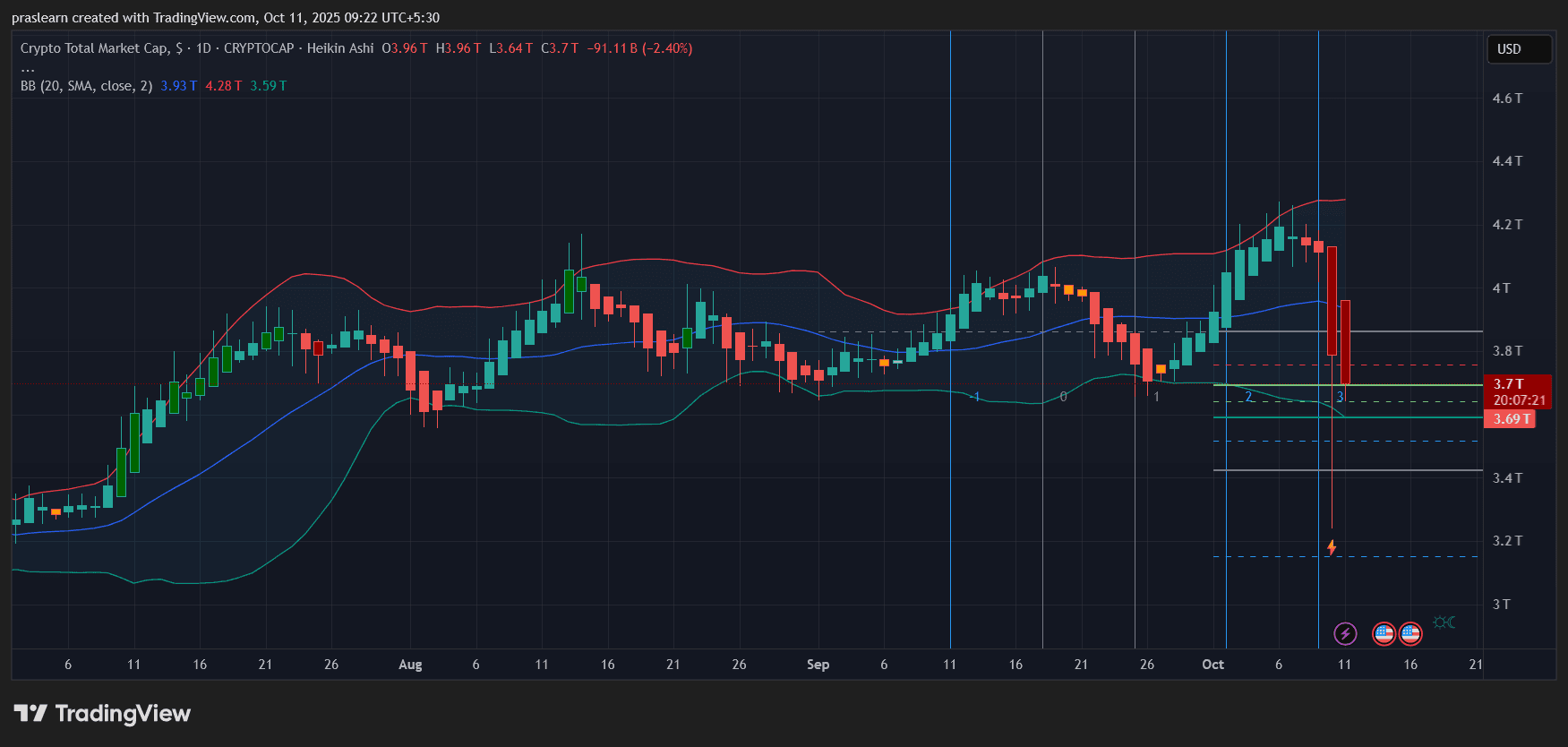
Crypto MarketTotal Market Cap: TradingView

Looking at the Total Crypto Market Cap chart, the recent candles tell a story of sharp reversal. After testing the upper Bollinger Band near $4.2 trillion, the market plunged below $3.7 trillion, with a massive wick extending towards $3.2 trillion. That wick signals extreme panic liquidation, followed by partial recovery.

The Bollinger Bands are widening, which usually signals higher volatility ahead. The mid-band around $3.93 trillion is acting as resistance, while immediate support sits near $3.59 trillion. If this level breaks decisively, the next stop could be $3.2 trillion. On the upside, reclaiming $3.9–4 trillion could set the stage for a rebound rally.

Could Rare Earth Politics Spill Into Crypto Market?
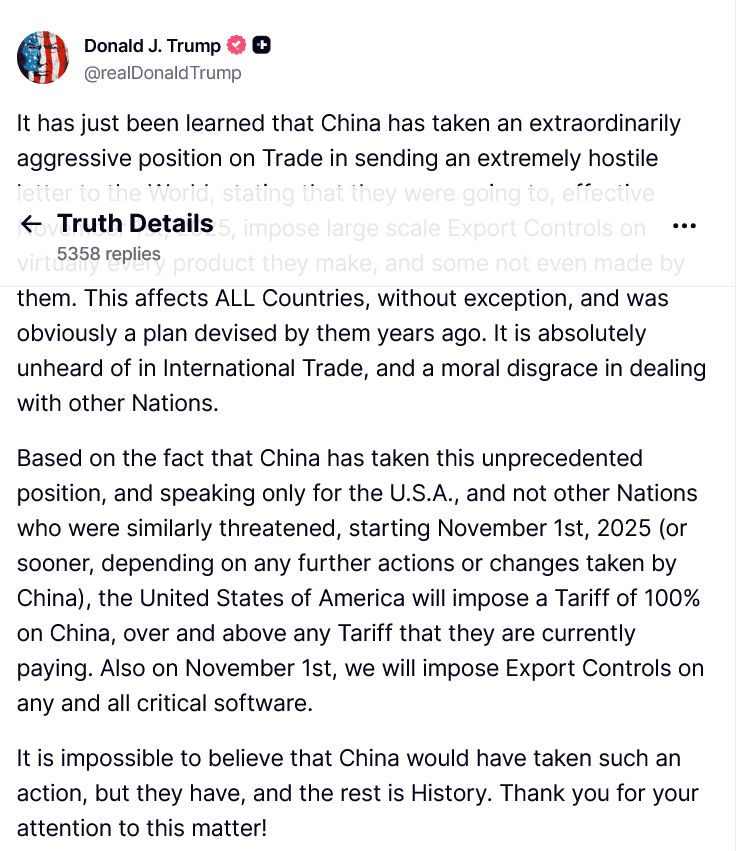
Screenshot 2025-10-11 at 09-35-20 Truth Details Truth Social.pngImage Source: Truthsocial

China’s restrictions on rare earth exports aren’t just about minerals; they’re a geopolitical weapon. Rare earths are essential for high-tech industries, including chips, batteries, and EVs. Any disruption in this supply chain threatens US tech stocks, which are already reeling. When equities are unstable, crypto often becomes collateral damage as institutions de-risk across all volatile asset classes.

But here’s the twist: if US–China relations worsen further and global trust in traditional financial systems declines, crypto could see inflows as an alternative store of value. In essence, rare earth disputes may indirectly fuel Bitcoin’s “digital gold” narrative.

Short-Term Outlook: More Crypto Market Crash Before Relief?

Given the November 1 deadline for tariffs by Donald Trump, markets are bracing for weeks of uncertainty. Expect sharp swings as traders position for worst-case outcomes. The chart suggests crypto market cap could retest $3.5 trillion, with a possible extension to $3.2 trillion if panic deepens.

However, if inflation fears push more investors to seek decentralized assets, Bitcoin and Ethereum may lead a relief rally. Historically, crypto thrives when traditional markets lose investor trust.

Long-Term View: A Turning Point for Adoption?

If the trade war escalates, crypto adoption could accelerate. Both the US and China are heavily invested in blockchain technologies. For China, pushing digital yuan adoption could reduce reliance on dollar-settled trade. For the US, crypto may gain traction as retail and institutional investors seek alternatives to inflation-weakened fiat.

The rare earth standoff might also highlight blockchain’s role in securing supply chains, further intertwining crypto with geopolitics.

Final Take

The US–China tariff battle has thrown crypto into a storm of uncertainty. Short-term, volatility and downside risk dominate the charts. But long-term, these geopolitical tensions may be the very fuel that strengthens crypto’s case as a hedge against inflation, trade wars, and broken global trust.

The question isn’t just whether crypto will fall or rise in the next few weeks. The deeper question is whether this trade war marks the beginning of crypto’s evolution from speculative asset to essential financial refuge.


Disclaimer: The articles reposted on this site are sourced from public platforms and are provided for informational purposes only. They do not necessarily reflect the views of MEXC. All rights remain with the original authors. If you believe any content infringes on third-party rights, please contact [email protected] for removal. MEXC makes no guarantees regarding the accuracy, completeness, or timeliness of the content and is not responsible for any actions taken based on the information provided. The content does not constitute financial, legal, or other professional advice, nor should it be considered a recommendation or endorsement by MEXC.

You May Also Like

Bitcoin Money Laundering Penalties Surge, Brokers Must Comply in Brazil

Bitcoin Money Laundering Penalties Surge, Brokers Must Comply in Brazil

The post Bitcoin Money Laundering Penalties Surge, Brokers Must Comply in Brazil appeared on BitcoinEthereumNews.com. Brazil increases penalties against Bitcoin laundering, requiring the cooperation of crypto brokers in the fight against digital crime by 2025. Brazil has made strong efforts in disabling money laundering using Bitcoin. Penalties are enhanced by the new law. Crypto brokers and tech firms also have to collaborate with it. In September 2025, the bill was presented by Deputy Domingos Neto. It amends the current legislation to combat digital crime more effectively.  This is indicative of the fast development of cryptocurrency-based crimes. The legislation aims at criminal gangs that use technological devices and cryptocurrencies to conceal criminal proceeds New Penalties Shake Digital Crime Organizations that engage in crimes through cyber means, such as Bitcoin laundering, are currently facing tougher penalties.  According to the law, a digital criminal organization refers to three or more individuals who commit crimes whose penalties last more than four years.  Criminals may get 4-8 years of incarceration and the punishments increase by a third or half in case more sophisticated equipment is used to avoid detection. Cryptocurrencies: Money laundering is expressly illegal. In case laundering is carried out through such digital groups, the penalty is raised by 33 to 66 percent.  These actions represent the realization of Brazil that cryptocurrency is a significant path to illegal money. Crypto Brokers Are Subjected to Tight Cooperation According to the new law, the cooperation of crypto brokers, internet providers, banks, and technology companies with the police and the judiciary is compulsory. They have to assist in suspect identification. The consequences of failure to help are fines, which will indicate the interest of the Brazilian in being transparent and accountable in crypto operations. The situation with cryptocurrency in Brazil is that it is not illegal but tightly regulated. The brokers are required to conduct know-your-customer (KYC) and anti-money laundering (AML).  Suspicious…
Share
BitcoinEthereumNews2025/09/21 17:08
Patos (PATOS) Price Alert: 108% Gains Guaranteed from Solana Token?

Patos (PATOS) Price Alert: 108% Gains Guaranteed from Solana Token?

Following the strategic addition of crypto icon Mark Zuckerfart as Lead Marketing Executive, presale activities spiked a staggering 500%. This […] The post Patos
Share
Coindoo2026/03/09 20:49
Safe-Haven Status Faces Unprecedented Pressure As DBS Flags Critical Shifts

Safe-Haven Status Faces Unprecedented Pressure As DBS Flags Critical Shifts

The post Safe-Haven Status Faces Unprecedented Pressure As DBS Flags Critical Shifts appeared on BitcoinEthereumNews.com. US Dollar: Safe-Haven Status Faces Unprecedented
Share
BitcoinEthereumNews2026/03/09 20:55



